
TL;DR
AI SEO can describe two different jobs: using AI to help perform SEO work, and improving your website's usefulness and visibility in AI-generated answers. The first concerns how your team works; the second concerns how your business is discovered and represented. Prioritise workflow assistance when research and production are the bottleneck. Prioritise AI-search visibility when important customer questions expose missing or inaccurate business information. If both matter, connect them through a small, reviewed pilot and measure each outcome separately.
An AI-written article is not automatically optimised for AI answers. Equally, a useful page can support AI-search discovery without having been written by AI.
That distinction should come before choosing software or commissioning more content. Otherwise, you can buy a faster drafting workflow when the real problem is unclear service information, or start tracking AI mentions while your most important pages still need basic SEO work.
We approach AI SEO by asking one question first: what needs to improve for the business, and what evidence would show that improvement?
Table of contents
- What is AI SEO? Two meanings worth separating
- Where AI can help with SEO work
- What improving visibility in AI answers involves
- Which AI SEO approach should your business prioritise?
- A practical example: one business, two different jobs
- Connect both tracks through a small pilot
- Common misunderstandings that waste budget
- FAQ
- Start with evidence about your own business
- Sources
- Recommended Reads
What is AI SEO? Two meanings worth separating
The terminology can be confusing because the same phrase describes both a production method and a visibility goal. We distinguish them as follows.
AI-assisted SEO: changing how the work gets done
AI-assisted SEO means using AI to support tasks such as organising keyword research, developing briefs, drafting content and reviewing page improvements. Your objective might be to reduce preparation time or help a small team maintain important pages consistently.
The output is work your team can inspect: a grouped keyword list, a proposed content plan, a draft or a summary of performance data. Whether that work improves search performance remains a separate question.
AI-search optimisation: changing what systems can find and use
AI-search optimisation means improving business information and website content so it is accessible, understandable and useful when an AI-powered search experience assembles an answer.
This includes the foundations of SEO, not an escape from them. Google's generative AI search guidance emphasises useful, original content and established SEO practices rather than a separate collection of AI-only tricks.
| Question | AI-assisted SEO | AI-search optimisation |
|---|---|---|
| What changes? | Research, planning and production workflows | The information available about your business |
| Typical work | Organise query data and prepare a brief | Clarify service scope and publish supporting evidence |
| Immediate measure | Time and effort per approved output | Accurate representation and relevant visibility |
| What does not prove success? | Generating more drafts | Getting one favourable AI answer |
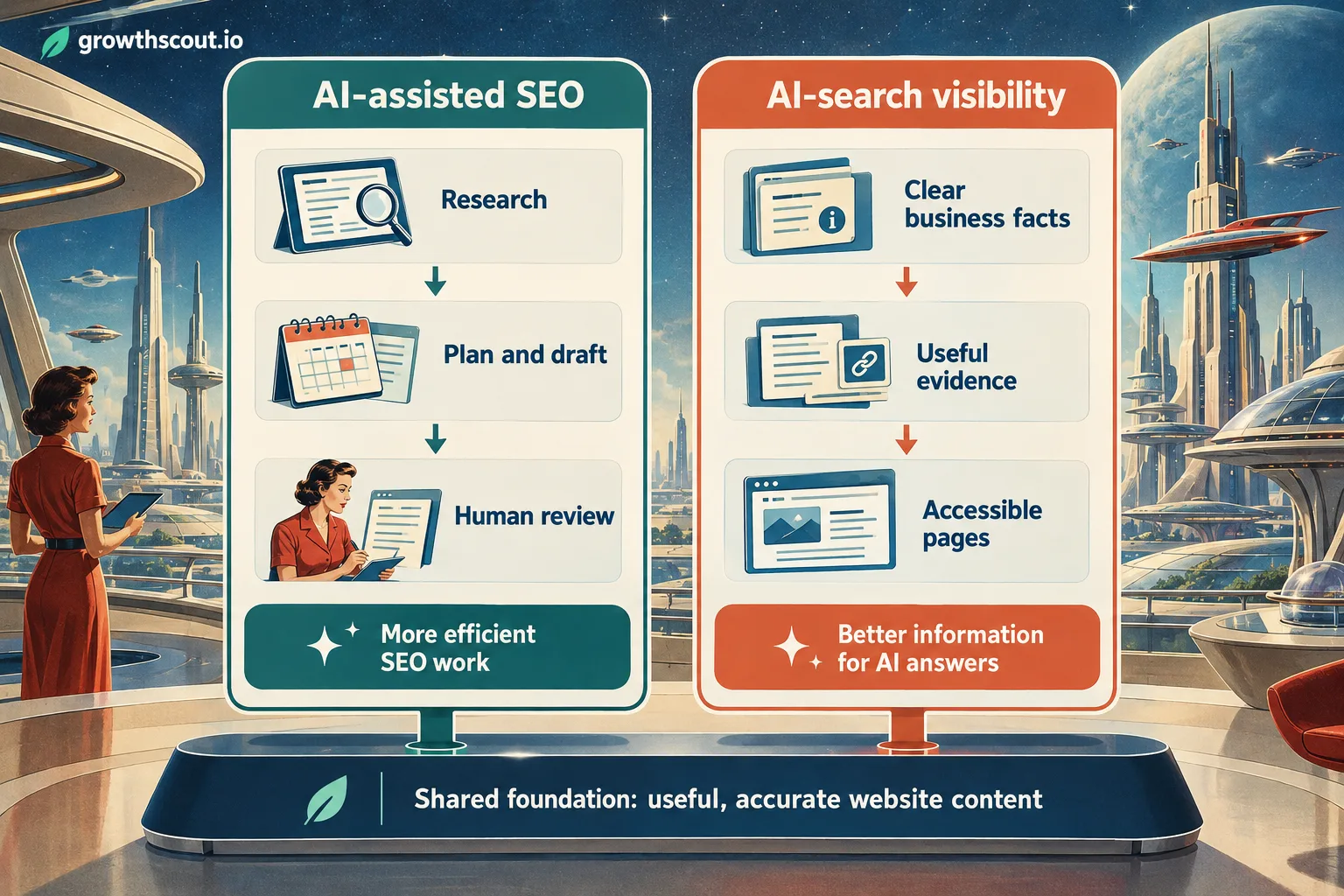
These tracks overlap, but neither guarantees the other. A faster workflow can produce unhelpful pages. A carefully researched, manually written explanation can provide useful information for search systems.
Where AI can help with SEO work
The most useful starting point is a defined task with reliable inputs and an accountable reviewer. We would consider AI assistance for:
- Keyword research support: suggesting related questions or grouping an existing query export. Validate demand and intent against actual search evidence rather than treating generated ideas as measured opportunities.
- Content planning: comparing proposed topics with an inventory of published pages, then suggesting which need an update rather than another URL.
- Brief preparation: organising a reader question, approved product facts, supporting sources and expert input into a working outline.
- Draft support: producing a first explanation, proposing titles or identifying passages that need clarification.
- Review preparation: summarising page changes or surfacing claims an editor needs to verify.
Capabilities depend on the tool and the information it can access. A writing assistant without your website inventory cannot reliably establish whether a proposed article duplicates an existing page. A generated keyword list does not establish search volume.
Our rule is simple: use AI to prepare a decision, but keep responsibility for the decision explicit.
Google's guidance on generative AI content recognises research and structure as useful applications. It also calls for manual fact-checking and warns that generating many pages without adding user value may violate its scaled-content abuse policy.
That makes editorial acceptance a better operational measure than draft count. If preparation gets faster but correction work increases, the workflow may not be saving time overall.
What improving visibility in AI answers involves
For this track, the question is not, “Did we use AI?” It is, “Can someone find and verify a clear answer about our business?”
Consider a consultancy that wants to be considered for a particular service. Its website should explain what that service includes, which customers it suits, relevant limitations and the evidence supporting its expertise. Broad claims such as “innovative solutions for every business” provide little help with a specific buying decision.
We recommend looking at three connected needs:
Clarity: Describe the offer, audience, location where relevant, and important constraints consistently. A reader should not have to reconcile conflicting service descriptions across several pages.
Useful evidence: Add the material that makes an explanation credible, such as a documented method, a properly scoped case study, first-hand examples or an expert explanation. Formatting an unsupported claim as a bullet does not make it stronger.
Access: Check whether intended pages are available to the relevant search systems. Provider controls differ, so avoid treating “allow AI” as one universal setting.
For example, OpenAI distinguishes OAI-SearchBot from GPTBot: the former supports ChatGPT search, while the latter concerns potential use in foundation-model training. Those settings are independent. Search visibility and training permission are not interchangeable decisions.
Google also documents a Search generative AI control for inclusion in features including AI Overviews and AI Mode. Review the relevant property settings with the people responsible for your website rather than assuming ordinary search access answers every participation question.
These are foundations for eligibility and useful information, not promises of inclusion. You do not control which sources a system selects for a particular answer.
For deeper implementation guidance, our AI Search Optimisation framework expands the page-level work beyond this initial choice of priorities.
Which AI SEO approach should your business prioritise?
Choose according to the constraint you can actually observe, not the label attached to a tool.
Your team cannot keep up with useful work
Prioritise AI-assisted SEO when you already know which pages matter but cannot research, brief or maintain them efficiently.
For instance, an editor might spend substantial time turning approved sources and expert notes into briefs. Assisting that preparation is a contained opportunity. Measure total effort through approval, including corrections, rather than timing only the initial generation.
Do not scale publication until the team can maintain the same factual and editorial standards.
Your main goal is conventional organic growth
Start with the organic opportunity itself. Are important pages discoverable? Do they answer the right search intent? Is the next useful action clear?
AI assistance may help investigate these questions, but buying an AI tool does not determine whether the next action should be a technical fix, an existing-page update or a new article.
We would prioritise a confirmed problem on a commercially important page over speculative content production. Measure relevant search performance alongside qualified enquiries, purchases or the outcome your team has agreed matters.
Your business is missing or misrepresented in relevant AI answers
Prioritise an AI-search information review when sampled customer questions reveal something actionable: an outdated description, an unexplained capability, or a lack of evidence for a relevant use case.
An omission alone does not prove a content defect. Inspect the question and sources before deciding what to change. Perhaps the question is outside your actual offering, or existing evidence points elsewhere.
The useful response is a specific improvement to accurate information, not a promise to make every answer name your brand.
Both capacity and visibility are constraints
Combine the approaches, but choose one primary outcome for the first pilot. Use AI to organise the research and prepare the update; use a reviewer to approve the evidence and claims; evaluate workflow efficiency and visibility separately.
This prevents a faster process from being mistaken for a better market outcome.
A practical example: one business, two different jobs
Imagine a hypothetical UK maintenance provider serving multi-site retailers. Its team has two concerns: preparing service content takes too long, and sampled AI answers describe it as a domestic repair company.
The workflow job is to reduce preparation effort. The team supplies its actual service catalogue, existing pages and approved expert notes. AI helps organise those inputs into a brief for an existing commercial-maintenance page. An editor checks that the proposal does not invent coverage or duplicate another page.
Success here means a useful brief reaches approval with less total effort and no loss of accuracy.
The visibility job is to improve the information describing the business. The company checks whether its priority pages explain commercial scope, geographic coverage, exclusions and multi-site delivery. Where the evidence supports it, the team adds those details and corrects outdated public descriptions it controls.
It then reviews the same relevant questions again, keeping the platform, wording and market context recorded. Success would be more accurate representation across repeated observations, not simply a larger number of published pages.
The same page update can serve both jobs. However, a reduction in briefing time does not establish improved visibility, and one corrected answer does not establish more sales.
This example is a proposed operating model, not a customer result or a forecast.
Connect both tracks through a small pilot
We suggest choosing one business area and a limited set of existing pages before expanding. The purpose is to learn whether the work is useful and sustainable, not to demonstrate a predetermined win.
Write a short pilot brief containing:
- Primary goal: State whether you are testing efficiency, organic growth or accurate AI-search representation.
- Evidence and scope: Identify the page, customer question, observed problem and supporting business facts.
- Approved intervention: Define what AI may prepare and who approves the resulting changes.
- Measures and review: Record the baseline, change date, observations and the next decision.
Keep the measures distinct:
| Goal | Useful pilot measures | Interpretation limit |
|---|---|---|
| Workflow efficiency | Total time per approved brief or update; substantive corrections | Faster generation alone excludes review effort |
| Organic growth | Relevant page impressions, clicks and qualified on-site outcomes | A change over time does not establish causation |
| AI-search representation | Repeated mentions, linked sources and factual accuracy for selected questions | A sample does not represent every user or answer |
For Google, use its documented Generative AI performance report to inspect impressions in supported Search features, including AI Overviews and AI Mode. Google notes that the report may not appear when a site lacks sufficient impressions. Those impressions are not a cross-platform count of recommendations, citations or conversions.
For manual AI-answer checks, record what you asked and what happened. Keep prompted brand checks separate from unbranded discovery questions: asking about your company directly tests a different situation from asking for suitable providers.
Set review frequency to the decision. Review a draft before publication; check that a changed page is accessible promptly; evaluate search and business outcomes over a period appropriate to the site's traffic. We would not declare a visibility strategy successful or unsuccessful from one day's answers.
At the review, choose among continuing, revising or stopping the pilot. If AI saves preparation time but creates repeated factual corrections, tighten the inputs. If answers remain inaccurate, inspect the available evidence before commissioning more content.
Common misunderstandings that waste budget
“An AI tool is an AI-search strategy.” A tool supplies capabilities. Your strategy still needs a customer question, a justified intervention and an outcome to evaluate.
“More AI-generated content means more AI visibility.” Production volume does not establish usefulness. Google's guidance warns against producing content for many query variations without meaningful added value, and says no special AI text file or schema is required for its generative search features. See its AI search guidance.
“A citation means the system recommends us.” A linked page may support an explanation without endorsing the business. Inspect the answer rather than reporting every source link as a buying recommendation.
FAQ
Is AI SEO the same as GEO or AEO?
Not necessarily. Generative engine optimisation (GEO) and answer engine optimisation (AEO) are overlapping labels associated with answer-led visibility. AI SEO can also mean using AI in the SEO workflow. Google's AI search guide discusses the terminology, but the practical safeguard is to specify the intended work and outcome in any brief or proposal.
Do we need to rewrite every page for AI search?
We would not start there. Select a business-critical area, establish what is unclear or missing, and improve the pages that should answer those questions. A website-wide rewrite without a diagnosed problem makes the intervention harder to evaluate and maintain.
What should we ask an AI SEO provider?
Ask which of the two jobs it performs, what inputs it needs, who checks claims, what changes require approval and how it measures success. Request an example that connects an observed issue to an actual recommendation. A draft count or visibility score alone cannot explain that connection.
Start with evidence about your own business
If AI-search representation is your immediate concern, our free public AI visibility checker provides a starting snapshot. The opening form asks for your website, business name, category or service, and customer country. Use a category description without your brand name to frame the discovery question.
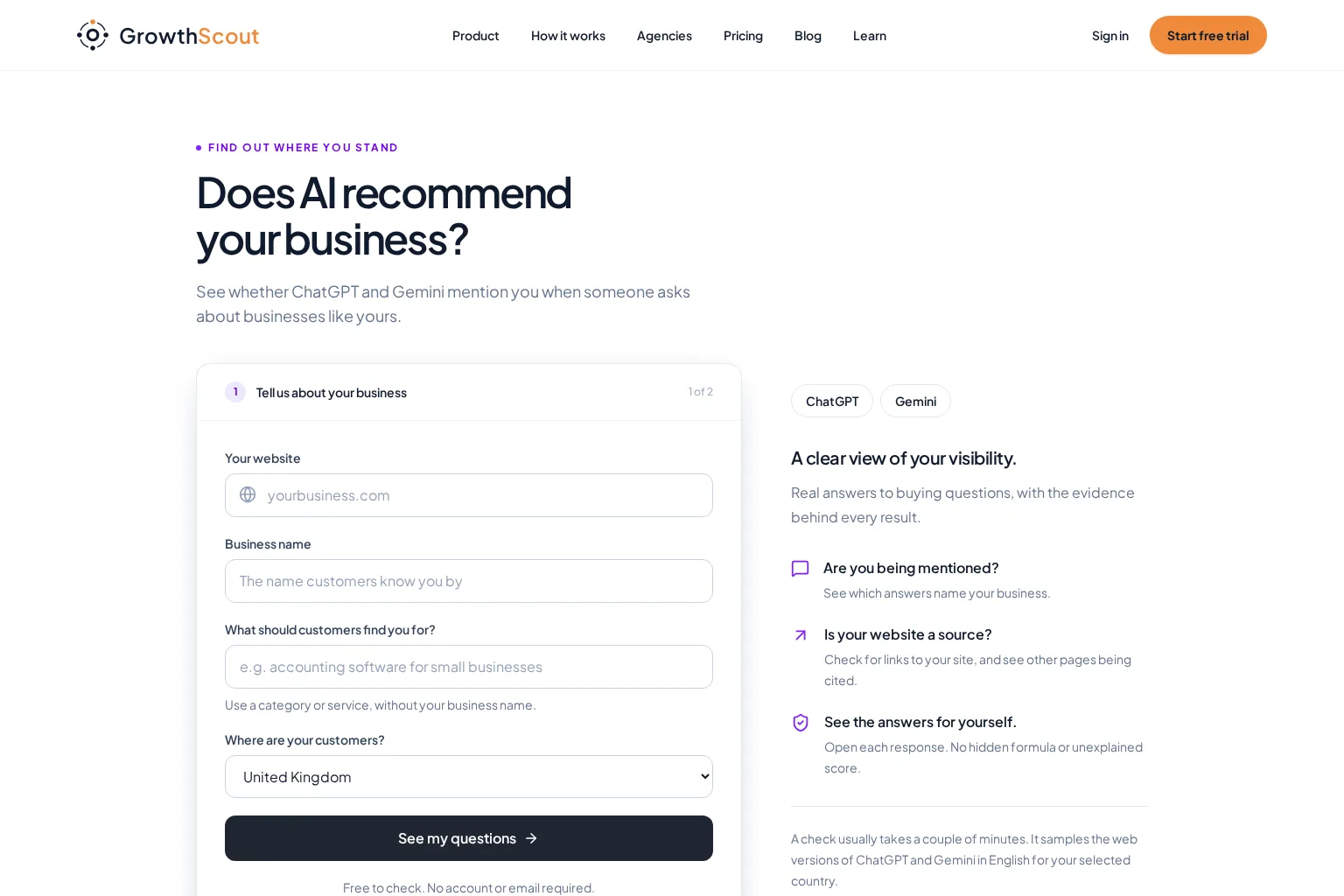
The checker asks three category-based questions on the web versions of ChatGPT and Gemini, once per platform. It records name matches and source links; it is not an overall ranking or continuous tracking service. Common business names can produce ambiguous matches.
Repeat checks return the saved report, and an updated report requires a paid plan. Shared report links are public, so submit only public business information. These limits are explained on the checker page.
Use the snapshot to select a question worth investigating, then connect it to a page and evidence your team can improve. Whether your priority is faster SEO work or better AI-search representation, make the next action specific enough to review.
Sources
- Google Search Central: Optimise your site for generative AI features in Google Search
- Google Search Central: Guidance on using generative AI content
- OpenAI: Overview of OpenAI crawlers
- Google Search Console Help: Search generative AI control
- Google Search Console Help: Generative AI performance report
- GrowthScout: Public AI visibility checker and methodology