
TL;DR
To write an article, decide who it is for and what they should learn or do. Narrow the topic, gather trustworthy material, outline the answer, draft the introduction and sections, check every important claim, revise for clarity, and review the published page. The worked example below shows what each decision produces.
A blank page is rarely the real obstacle. Usually, the writer has a topic but has not decided which question the article will answer, what belongs in it or how to tell when it is finished. We can make those decisions before polishing a single sentence.
This guide works for a website article, a magazine-style explainer or a practical business blog post. The publication may change the tone and format, but the underlying task is the same: make a useful promise to a particular reader and fulfil it. If your assignment calls for a news report, academic paper or school-exam response, check that format's separate requirements before applying this general process.
Table of contents
- Before you start: collect the inputs
- 1. Define the reader and the article's promise
- 2. Narrow the topic until it can be answered
- 3. Research the answer and track your evidence
- 4. Build an outline and write a working headline
- 5. Draft the answer before polishing the opening
- 6. Make each section specific and support its claims
- 7. Revise in separate passes
- 8. Check the page and publish the finished article
- A short article example, from promise to paragraph
- Frequently asked questions
- Turn the draft into an article someone can use
- Sources
- Recommended Reads
Before you start: collect the inputs
You need a place to draft, a topic or reader question, access to sources you can inspect, and someone who can check specialist facts when necessary. If the piece will go on a website, also find out who can approve it and who can publish it. You do not need a perfect headline or a prescribed word count to begin.
Write a one-line assignment: “For [reader], explain [specific question] so they can [outcome].” Keep that sentence visible while you work. The first six actions below take you from a reader question to a checked draft; the final two turn it into a publishable article.
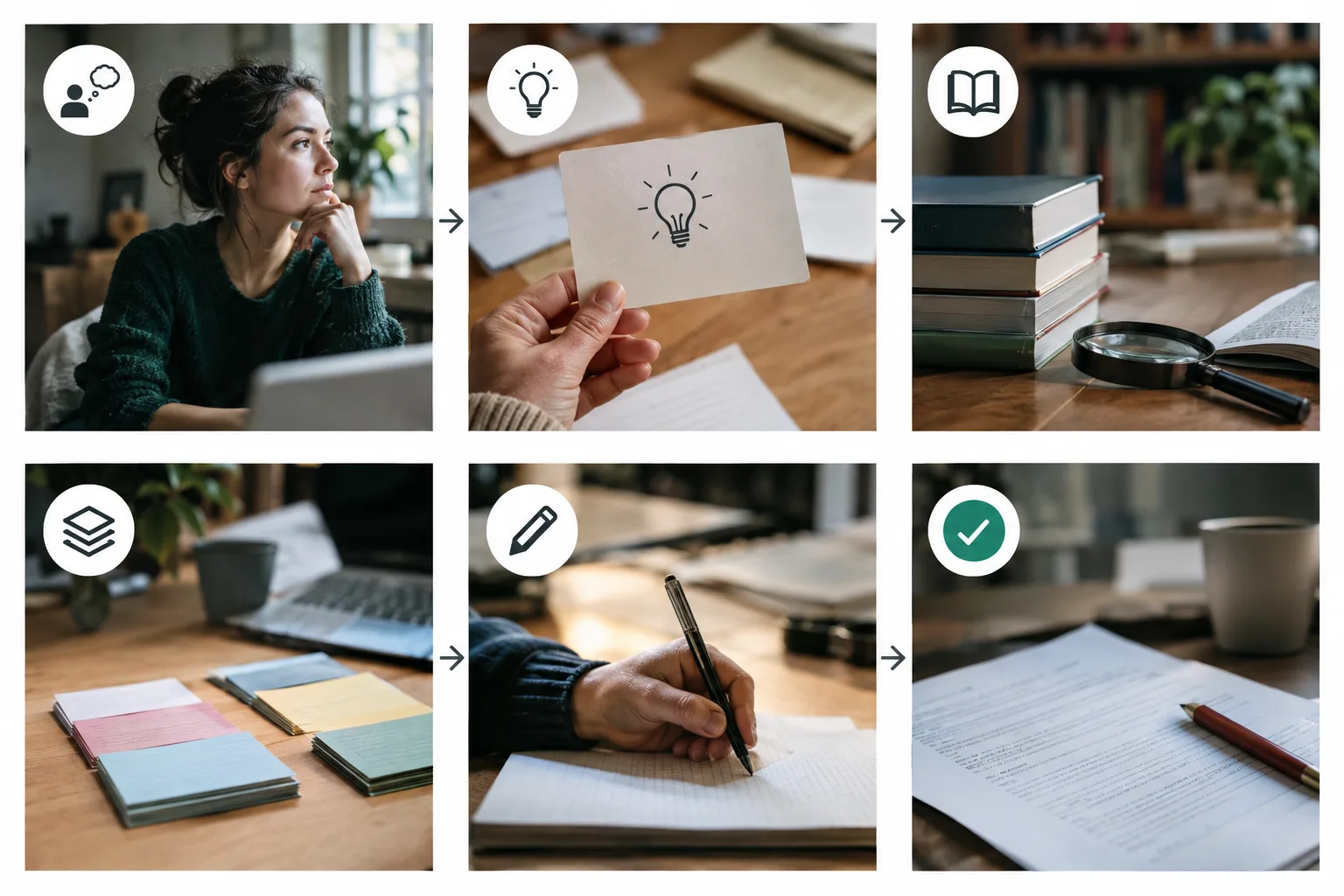
1. Define the reader and the article's promise
Choose one person you can picture using the piece. What do they already know? What are they stuck on? A first-time event organiser needs different detail from a manager who runs events every week. Next, state the result the article should deliver. “Understand meetings” is too vague; “prepare an agenda participants can act on” gives the writer a job.
Try this sentence: “This article will help a new account manager prepare a client kickoff agenda that covers decisions, owners and next steps.” You now have an audience, a task and boundaries. You can leave out meeting-room equipment and broad theories of client relationships unless they directly help with that task.
Ask a colleague to read the promise without explanation. If they cannot identify the reader and the expected outcome, rewrite it before researching. Purdue OWL's prewriting guidance likewise starts by asking writers to clarify purpose and narrow what they want to say.
2. Narrow the topic until it can be answered
List three to five questions the reader must settle to achieve the promise. For our example, those might be: Who should attend? What information should be gathered beforehand? Which decisions belong on the agenda? What should happen after the meeting?
Now draw a boundary. This article is about preparing the agenda, not running the entire client relationship. If a question needs its own explanation, note it as a possible separate article rather than forcing it into a paragraph. A good angle is not the biggest topic you can name; it is the smallest useful task you can complete without withholding an essential step.
Your result should be a one-sentence angle and a short list of questions. If the list mixes several different reader goals, such as preparing the meeting, choosing project software and handling a contract dispute, split it. You can connect those pieces later where a link genuinely helps the reader.
3. Research the answer and track your evidence
Start with material close to the question: an existing procedure, a person who performs the task, an original study or a primary document. For a client kickoff article, ask an experienced account manager which agenda items are routinely missed and examine an approved example, with permission to use it. Then use independent sources for any broader factual claims. Do not turn an anecdote into a universal rule.
Keep a simple source log with claim, source, date checked and what still needs verification. For instance, “Our team sends a draft agenda before the meeting” can be presented as your team's practice if confirmed internally; “all successful kickoffs require a draft agenda” would need evidence you probably do not have. When an important fact cannot be checked, qualify it or remove it.
The output is not a pile of links. It is a small set of usable facts, examples and open questions attached to particular sections. If all you have are other people's articles repeating one another, return to the original source or interview someone with relevant experience before drafting.
4. Build an outline and write a working headline
Put the questions in the order a reader would encounter them. For the agenda example: decide the meeting outcome, identify attendees, collect inputs, draft agenda items, and confirm owners and follow-up. Under each heading, jot down the action, the example or evidence it needs, and what the reader should have when that section ends.
Use a working headline that describes the article rather than promising everything about the topic: “How to Prepare a Client Kickoff Agenda” is clearer than “The Ultimate Guide to Better Meetings.” You can refine it after the draft if the answer becomes more specific. Purdue OWL's outlining guide recommends grouping related ideas, ordering them logically and labelling the resulting sections. Cambridge International's article-writing guide also connects organisation and language to audience and purpose.
Read only your headline and headings. Could a reader predict the route through the article? If two headings promise the same answer, combine them. If a step requires information you have not introduced, change the order.
5. Draft the answer before polishing the opening
Write the main sections from the outline. For each one, tell the reader what to do, why it matters here and what a finished result looks like. Start with the section you can explain most clearly; the introduction can come later. This prevents you from spending an hour perfecting an opening for an article whose actual answer is still unsettled.
Here is a possible instruction in our agenda article: “Ask the client which decision they need from the kickoff, then place that decision near the top of the agenda. If they need to approve a launch date, list the proposed date, the unresolved dependency and the person who can approve it.” That passage offers a concrete action and the information needed to perform it. It does not pretend every client follows the same procedure.
Once the sections exist, write a short introduction that names the problem and previews the help. For example: “A kickoff agenda should make the decisions for the meeting visible before everyone joins. Start with the outcome, gather the questions that could block it and give each item an owner.” If you cannot write that opening honestly, the body may still be trying to answer too many questions. Revise the scope before adding a dramatic hook.
6. Make each section specific and support its claims
Replace general advice with an action, example, comparison or limit. “Communicate clearly” does not tell a reader what to write; “send the proposed agenda and ask participants to flag missing decisions” does. Where you make a factual claim, link the source close to the sentence it supports, not just in a bibliography. If you use an internal example, identify it as an example rather than a proven industry standard.
Check whether a diagram or image would clarify a relationship that prose cannot show quickly. A process visual can show sequence; a real screenshot can show where to click in a verified interface. Do not include decoration that makes the page longer without making the task easier. Google's people-first content guidance asks whether a page adds original value, shows clear sourcing and leaves its intended reader able to achieve their goal.
Read one section in isolation. Can somebody follow it without relying on a sentence hidden elsewhere? If not, bring the missing prerequisite forward or point clearly to the earlier step.
7. Revise in separate passes
First revise the argument and structure: does every section fulfil the headline, and does the sequence make sense? Next review evidence: check quotations against originals, distinguish observation from opinion, and have a subject expert confirm claims about their work. Then edit language: remove repeated explanations, replace vague nouns and read awkward passages aloud. Proofread spelling, punctuation and formatting last. Polishing a paragraph you later delete is wasted effort.
We use a useful challenge question: “Where would a reader stop and ask, ‘How do I actually do that?’” Find that place in the draft and add the missing action or example. Purdue OWL's revision checklist similarly separates evaluating the main point, reader and evidence from tightening sentences and correcting mistakes.

The deliverable is an accurate draft someone else can understand. If feedback says the piece is confusing, ask the reviewer to mark where they lost the thread; do not assume another line edit will fix an outline problem.
8. Check the page and publish the finished article
Give the publication-ready version one final, practical inspection. Use this pre-publication checklist:
- Does the headline describe the answer the article actually gives?
- Do the opening and headings let a reader find the useful part quickly?
- Are examples labelled, factual claims checked and sources linked to the relevant passages?
- Do links lead to working, relevant destinations, and do images have useful alternative text?
- Does the article end with the reader's next action rather than an unrelated sales pitch?
- Have the responsible editor and subject reviewer approved it, if your process requires approval?
- Does the live page display correctly on a phone as well as a desktop screen?
Publish, open the public page, and test the important links and formatting rather than assuming the editor preview matches the final result. Record who will correct a broken link or outdated fact. If you lack publishing permission, hand the approved copy and source notes to the person who has it. The result is not merely a document marked “done”; it is an article readers can actually use.
A short article example, from promise to paragraph
Suppose your assignment is “How to Prepare a Client Kickoff Agenda.” This is an illustrative piece, not an account of a real client's process. Its reader is a new account manager; its promise is a draft agenda that makes the meeting's decisions and owners explicit.
A usable mini-outline could be:
- Agree on the decision the kickoff must enable.
- Gather the inputs and questions participants need in advance.
- Arrange agenda items so unresolved decisions come before routine updates.
- Assign an owner and expected output to each item.
- Send the draft for corrections and capture the final version.
Sample opening: “A kickoff meeting is easier to use when participants can see what needs deciding before the call begins. Build the agenda around those decisions, not a list of presentations. Here is a way to prepare one that gives every item a purpose and an owner.”
Sample body passage: “For each proposed agenda item, write the question the group must settle. Replace ‘Timeline discussion’ with ‘Confirm the first review date and who can approve a change.’ If nobody can explain the decision or the information needed to make it, move the item to a separate update or remove it.”
The opening names the task; the passage turns a vague item into an action. Test this skeleton with someone who has not seen your brief. If they cannot tell what they would send before the meeting, add a filled-in agenda item or a simple template. Do not add background paragraphs just to make the piece appear substantial.
Frequently asked questions
What is the basic format of an article?
A useful starting format is a clear headline, an opening that establishes the subject and reader's need, a middle organised into purposeful sections, and an ending that resolves the promise or suggests the next action. The exact shape changes with the publication and task. Cambridge International describes an introduction, developed middle and ending as a common structure, not a rigid template for every topic.
How do I start an article when I have no ideas for the introduction?
Write the reader promise and a rough outline first. Draft one body section you know well, then return to the opening and state the problem and direct answer. You can improve the first sentence after the article's direction is clear.
How long should an article be?
Long enough to deliver its promise with necessary examples and evidence, but not so long that it wanders into a second topic. The publication or assignment may set a limit. For a website article, choose length according to the reader's task rather than assuming a particular number of words earns a better result; Google says it has no preferred word count.
Turn the draft into an article someone can use
Pick one reader question today and write its promise, four or five section headings, and one concrete paragraph. Ask a colleague whether that paragraph helps them do the job. When it does, fill in the other sections and run the checks above.
If your marketing team needs a connected place to plan content and prepare drafts for review, explore GrowthScout's article workflow. The reader's answer, evidence and final editorial decision still deserve your attention.
Sources
- Purdue OWL: Introduction to Prewriting
- Purdue OWL: Why and How to Create a Useful Outline
- Purdue OWL: Steps for Revising Your Paper
- Cambridge International: Writing an Article
- Google Search Central: Creating Helpful, Reliable, People-First Content
- GrowthScout: Content planning and article workflow
Recommended Reads
- Blog Sample Writing: 4 Real Posts and Original Drafts to Learn From, for more examples of article openings and formats.
- SEO Article Writing: A Step-by-Step Process for Marketing Teams, if your next article has a search-focused brief.