
TL;DR
To begin an article, decide who needs it, what question they bring and what your piece will help them do. Open with a relevant detail or problem, give the main answer or angle early, then lead into the first useful section. If the opening could introduce any article on the subject, make it more specific.
The first sentence does not have to be the first sentence you write. When a marketing team has a working headline but cannot find an introduction, the missing piece is often a decision about what the article will actually say. We would rather draft an honest, plain opening and improve it than spend an hour polishing a dramatic hook that promises the wrong thing.
This guide stays with the opening and its handoff to the body. For the wider process of researching, drafting and publishing a search-focused piece, see our SEO article writing workflow.
Table of contents
- Before you start: gather the opening's inputs
- 1. Choose one reader question and one angle
- 2. Lead with something the reader recognises
- 3. State the answer before you preview the journey
- 4. Hand the reader into the first section
- 5. Change the opening to fit the article type
- 6. Revise the opening against the finished body
- Frequently asked questions
- Put the opening into your next draft
- Sources
- Recommended Reads
Before you start: gather the opening's inputs
Bring a working headline, the intended reader, the question they want answered and a rough idea of the article's main point. If the body exists, keep its headings nearby. If it does not, jot down the first two or three things the reader would need after the introduction. You need a draft document, not a specialised writing tool.
Write one sentence in your notes: “For [reader], this article answers [question] so they can [outcome].” For example: “For a content editor, this article explains how to identify outdated instructions in a help article so they can make its next revision accurate.” This is a hypothetical assignment, not a claim about a customer or a tested result. Purdue OWL's prewriting questions similarly ask writers to identify their reader, purpose and the problem before generating prose.
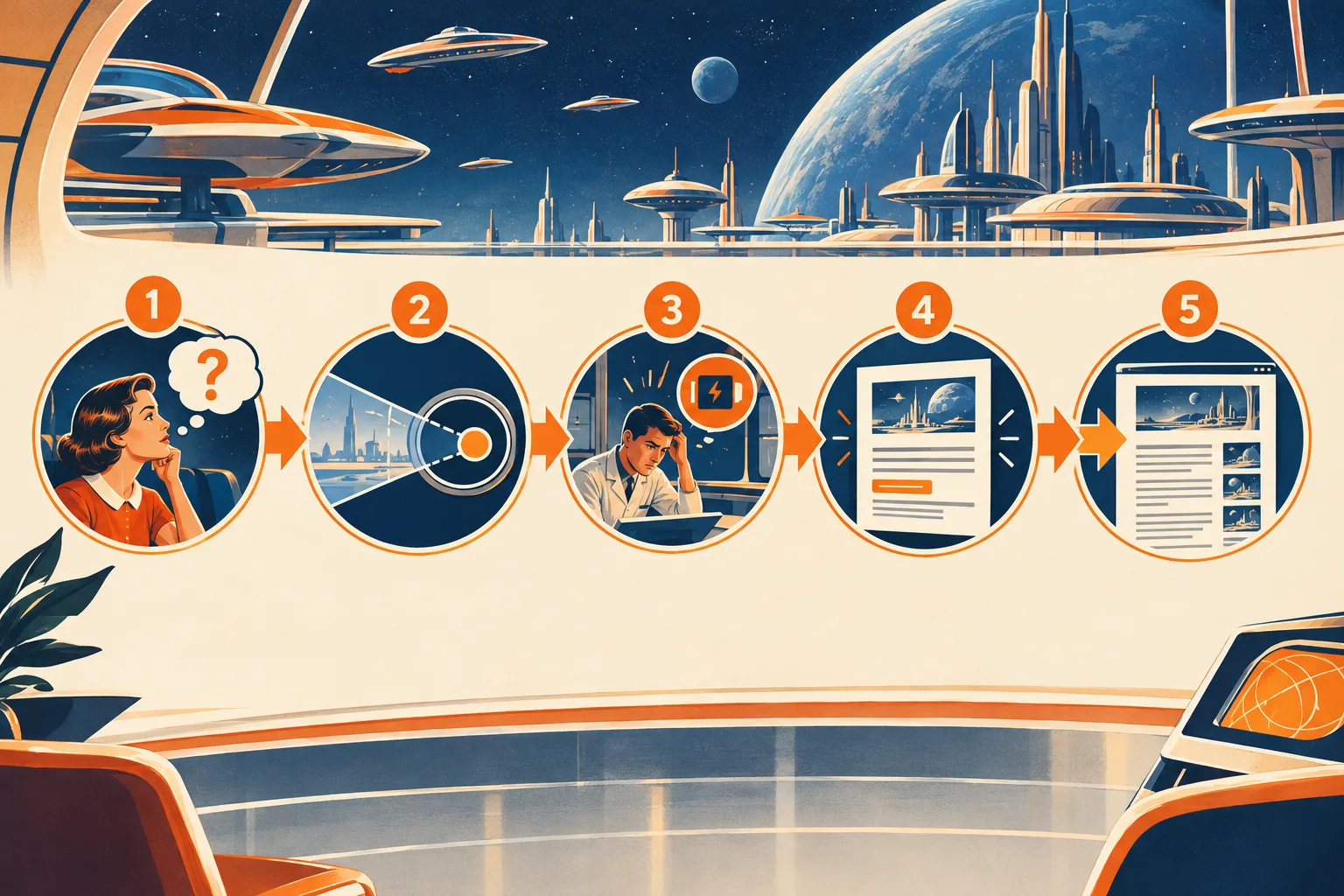
The sequence below moves from that reader question to an angle, a lead, a direct point and a transition. The visual maps the order; the worked sentences show what to put on the page.
1. Choose one reader question and one angle
A topic is not yet an opening. “Updating articles” could mean correcting factual errors, deciding which pages to refresh or persuading a team to allocate editing time. Each calls for a different first paragraph. Complete this sentence: “The point of this piece is that [specific answer or decision], for [specific reader].” If you cannot fill it in without saying “everything you need to know,” narrow the assignment.
Consider a content editor revising outdated help articles. The angle could be: Check the live instructions first, then revise the introduction to describe the task the updated article actually teaches. That gives us a point to state near the top. A page-selection guide for a content manager would need a different point, even if both articles use the word “refresh.”
Expected result: a reader, a question and a one-sentence answer that belongs in this article. Check: could a teammate predict what the first body section will cover from your sentence? If not, the angle is still broad. When several incompatible answers seem equally important, choose the one the headline promises; save the others for another section or a separate piece.
2. Lead with something the reader recognises
Now choose a first line that makes the question feel immediate. You can start with a specific problem, a practical observation, a relevant question or a concrete detail from the work. The choice depends on the article; a hook is a doorway, not a substitute for the answer. Avoid invented statistics, imaginary customer quotes and suspense that hides a simple instruction.
For our hypothetical editor, a problem-first lead might be: “A help article can look polished while its first step no longer matches the product.” The next line should tell readers what they can do about that discrepancy. A question-first version might be: “What should you fix first when a help article's opening still describes an old workflow?” That question works only if the answer follows promptly. In both cases, the detail is relevant to the reader's task, not an unrelated story about the importance of content.
Expected result: one or two lines that identify the situation without overclaiming its frequency or consequences. Check: cover the headline and read the lead aloud. Can you tell whom it is for? If it sounds like an introduction to any marketing article, name a real decision, object or obstacle. If the opening depends on a statistic or product behaviour, verify it before using it.
3. State the answer before you preview the journey
Once you have the reader's attention, say what the article will actually help them do. GOV.UK's guidance on clear web content recommends putting important information first. That is particularly useful for a how-to opening: readers should not need several paragraphs of background to discover the instruction they came for.
Here is a vague draft for the same hypothetical assignment:
In today's fast-moving digital world, content changes all the time. Updating your articles is important. In this article, we will look at ways to improve them.
Here is an opening with a clearer job:
A help article's first paragraph can promise steps the page no longer teaches. Compare the published instructions with the current task, then rewrite the opening around the corrected first action. This guide shows you how to make that opening match the article that follows.
The revision removes a sweeping claim, names the reader's object, gives an action and limits the promise to what the piece covers. It does not claim that this technique increases conversions or rankings. If the article actually teaches a different task, change the example and the promise rather than keeping a polished introduction that no longer fits.

Expected result: a point the reader can use even if they stop after the opening. Check: underline the sentence that answers the headline. If none does, add one. If that sentence requires a definition or qualification to be accurate, put it close by instead of burying it later.
4. Hand the reader into the first section
A preview should explain the route only when it is useful. “We will explore various aspects” tells the reader little. Try naming the first action and the next decision: “First, compare the old opening with the article's current instructions. Then rewrite the lead so it makes a promise those instructions can fulfil.” The first H2 should deliver that first action, not restart the introduction with more background.
The best transition may be almost invisible. If an explainer defines a term in the opening, the next section can show when it matters. If a comparison states the choice at stake, the next section can introduce the shared criteria. For a short article, a direct answer followed immediately by the first heading may be enough; do not append a roadmap merely to make the introduction seem substantial.
Expected result: a reader knows where the article goes next. Check: read the final introduction sentence and the first section heading together. If they repeat the same promise without advancing it, cut one. If the section changes subject abruptly, add the missing connecting idea or reconsider the section order.
5. Change the opening to fit the article type
The same subject can support several legitimate openings, but they should not make the same promise. Below are original illustrative openings, not extracts from customer work or evidence of performance. All three concern an outdated article:
- How-to: “Your help article still describes the old sign-in screen. Open the current flow, list the steps that changed and rewrite the opening so it names the task the page now teaches.” This gives the reader a first action.
- Explainer: “An outdated help article is not necessarily an old article. It is a page whose guidance no longer matches the task a reader must complete.” This defines the distinction before exploring it.
- Comparison: “Should you correct one outdated paragraph or rewrite the article? Compare what has changed in the reader's task, the accuracy of the existing steps and the effort required to keep the page useful.” This introduces decision criteria.
An opinion article might lead with a qualified position rather than a procedure; a reported piece may start with a verified scene or fact. Match the first line to the evidence and format you actually have. Do not borrow a news-style anecdote if nobody reported it, or promise a hands-on tutorial when the body only offers an argument.
Expected result: a lead that prepares the reader for the kind of answer they will receive. Check: label your draft “how-to,” “explainer,” “comparison” or another accurate format. Would the opening still fit if you switched the label? If so, it may be too generic. To see how different formats develop beyond the first paragraph, read our five original blog writing examples.
6. Revise the opening against the finished body
Write a provisional introduction, draft or inspect the core section, then return to the top. Purdue OWL's revision questions ask whether a draft has a clear main point, serves its readers, supports its claims and uses precise language. We apply those questions specifically to the opening.
Use this editorial check before approving it:
- Promise: Does the headline's question receive a useful answer or clear angle near the top?
- Relevance: Does the first detail belong to this reader's problem, rather than to a generic introduction about the industry?
- Accuracy: Can you substantiate any numbers, examples, quotations or product claims in the opening? Are hypothetical examples labelled?
- Handoff: Does the first section do what the opening says it will do?
- Economy: Can you remove a warm-up sentence without losing information the reader needs?
Ask a colleague who has not seen the brief to read just the headline, opening and first heading. Have them say whom the article serves, what it answers and what comes next. If they cannot, do not automatically add a louder hook. Change the angle, answer or section handoff. Google's people-first content questions ask whether a page serves its intended audience and gives them enough information to achieve their goal; a clever opening cannot make up for an article that fails that test.
Expected result: an introduction that accurately represents the finished article. If review reveals that the body answers a different question, revise the body or the headline as well. This is a promise check, not a rule that every introduction must be the same length.
Frequently asked questions
Should I write the introduction first or last?
Write it when you know the point. A rough opening can help you begin, but it is often easier to finalise after drafting the core answer. Then check whether the first paragraph still describes what you wrote.
Does every article need an attention-grabbing hook?
No. A direct definition, a clear answer or a well-chosen problem can be the most useful beginning. Use a more narrative lead when the reader and the evidence warrant it, not because every article supposedly needs suspense.
Put the opening into your next draft
Take one unfinished article, write its reader-question sentence and try two opening lines with different approaches. Keep the version that states the right angle and moves naturally into the first useful section. If your team also needs a connected way to research opportunities, plan articles and prepare editable drafts, explore GrowthScout's research-to-publishing workflow. We can help organise that work; your editor should still decide whether the opening and the finished article keep their promise. ✍️
Sources
- Purdue OWL: Prewriting (Invention) General Questions
- GOV.UK: Create a Clear Structure for Your Content
- Purdue OWL: Steps for Revising Your Paper
- Google Search Central: Creating Helpful, Reliable, People-First Content
- GrowthScout: Research, Content Planning and Article Workflow
Recommended Reads
- 5 Blog Writing Examples: One Marketing Problem, Five Different Posts, to compare introductions across article formats.
- SEO Article Writing: A Step-by-Step Process for Marketing Teams, for the wider research, drafting and editorial workflow.
- How to Write an Article: A Review-Ready Workflow for Marketing Teams, for an end-to-end team handoff.