
Perplexity SEO tools help us monitor whether a brand, page, or third-party source appears in Perplexity answers. The right choice depends on the job we need done: repeatable prompt tracking, citation and source analysis, broad SEO workflows, or agency-ready reporting.
For most in-house SEO teams, Semrush AI Visibility Toolkit is the best fit when traditional SEO and AI visibility need to live in one platform. OtterlyAI is a strong option for prompt-level monitoring and citation analysis at a lower entry price. Scrunch suits teams that need structured AI visibility benchmarks, audits, and source reporting. Rankscale is the most Perplexity-focused choice here for teams that want flexible scheduling, multi-engine coverage, and credit-based monitoring.
Table of contents
- What a Perplexity SEO tool can, and cannot, measure
- How we selected these Perplexity SEO tools
- 1. Semrush AI Visibility Toolkit
- 2. OtterlyAI
- 3. Scrunch
- 4. Rankscale
- How to choose the right tool for your team
- Build a Perplexity monitoring process that leads to better decisions
- Turn observations into a focused content plan
- Frequently asked questions
What a Perplexity SEO tool can, and cannot, measure
A Perplexity SEO tool does not give us a conventional organic ranking report. It repeatedly tests selected prompts, captures the answer, and helps us inspect several related but different signals:
- Brand mention: whether Perplexity names the business in an answer.
- Website citation: whether a page on the business domain is linked or cited as a source.
- Third-party source visibility: which publishers, review sites, communities, or other domains Perplexity references when discussing the category.
- Prompt coverage: the proportion of priority questions where the brand, a competitor, or a target source appears.
- Answer context: how the brand is positioned, which alternatives are named, and whether the answer matches our intended narrative.
These signals should not be treated as interchangeable. A brand can be mentioned without its website being cited. A website can be cited without the brand receiving a meaningful recommendation. And a source may influence the answer even when it is not the page we most want to promote.
We also need to treat every observation as a sample, not a permanent ranking. Prompt wording, location, language, model behaviour, and the search context can change the response. GrowthScout's AI visibility checker makes the same point for its ChatGPT and Gemini checks: results can vary by time, location, personalisation, and wording. That is why a useful Perplexity monitoring programme uses a stable prompt set and compares changes over time.
How we selected these Perplexity SEO tools
We selected four products with official pages showing that Perplexity is within their monitoring scope. We compared them using the same practical criteria: prompt capacity and repeatability, Perplexity coverage, citation or source analysis, competitor context, workflow features, and published pricing.
Published prices below were checked on September 22, 2026. Pricing can vary by billing period, region, usage limits, and add-ons, so confirm the final total before purchasing. We have not treated any tool as a guarantee of citations or recommendations. These platforms diagnose patterns and help prioritise work. They do not control Perplexity's answers.
1. Semrush AI Visibility Toolkit
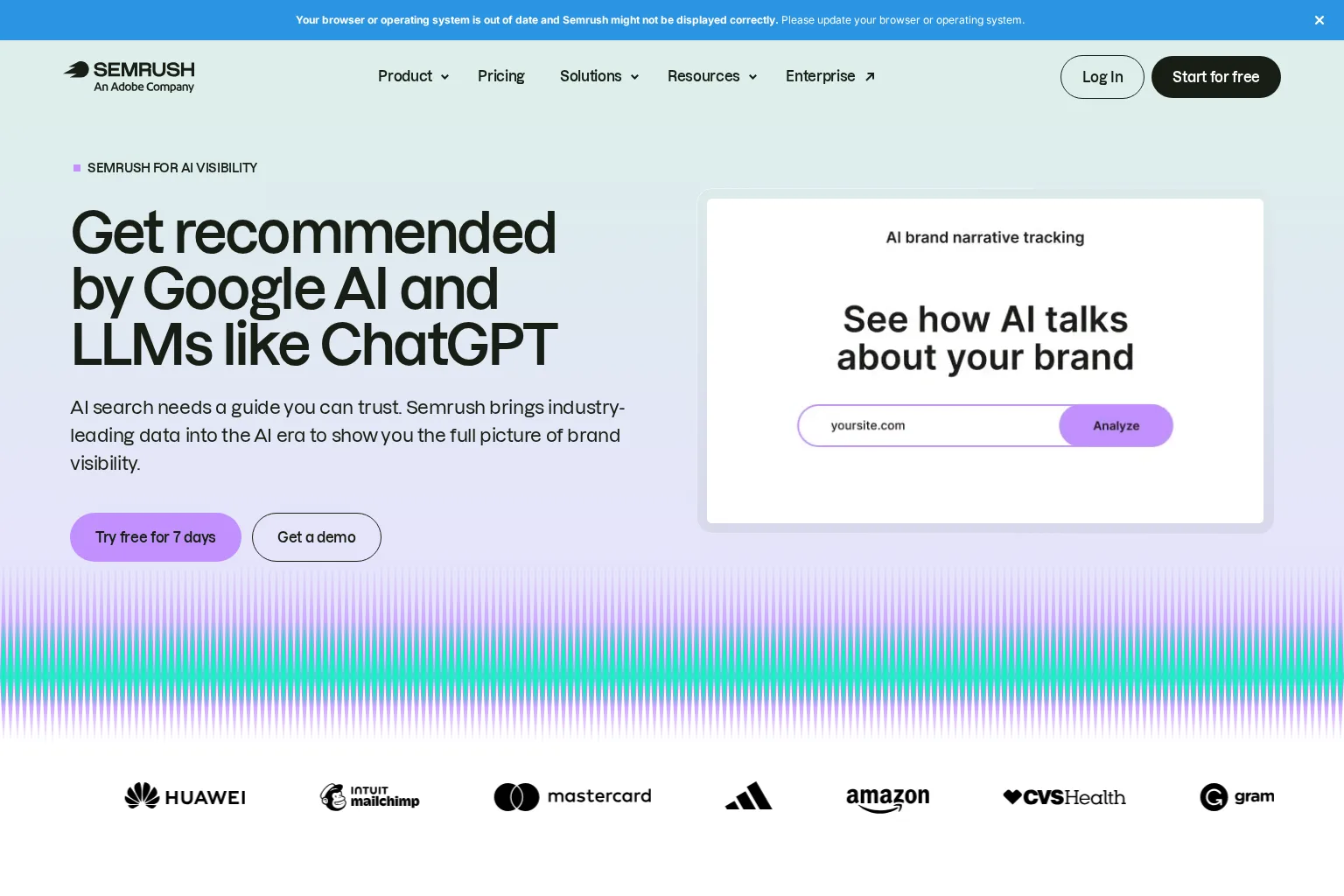
Best use case: SEO teams that want Perplexity monitoring alongside established keyword research, competitor research, site auditing, and reporting workflows.
Key capabilities: Semrush includes Perplexity alongside ChatGPT, Google AI, and Gemini in its AI Visibility Toolkit. The Base plan includes 25 custom prompts with daily AI rankings, one domain for Brand Performance analysis, AI competitor analysis, prompt research, and an AI-readiness site audit. This makes it a practical choice when we need to connect AI-search observations to an existing SEO programme instead of running a separate specialist platform.
Limitations: The standard plan has a defined prompt allowance, and the product covers multiple AI surfaces rather than focusing only on Perplexity. Teams that require hundreds of Perplexity prompts, multiple client workspaces, or highly flexible monitoring frequency should review the available limits and enterprise options closely.
Published pricing: The UK pricing page lists the Base plan at £80.22 per domain per month, billed annually. Enterprise pricing is custom.
Who should choose it: Choose Semrush when the team already uses, or wants to consolidate around, a broad SEO platform and needs Perplexity visibility to inform content, competitor, and technical decisions.
2. OtterlyAI
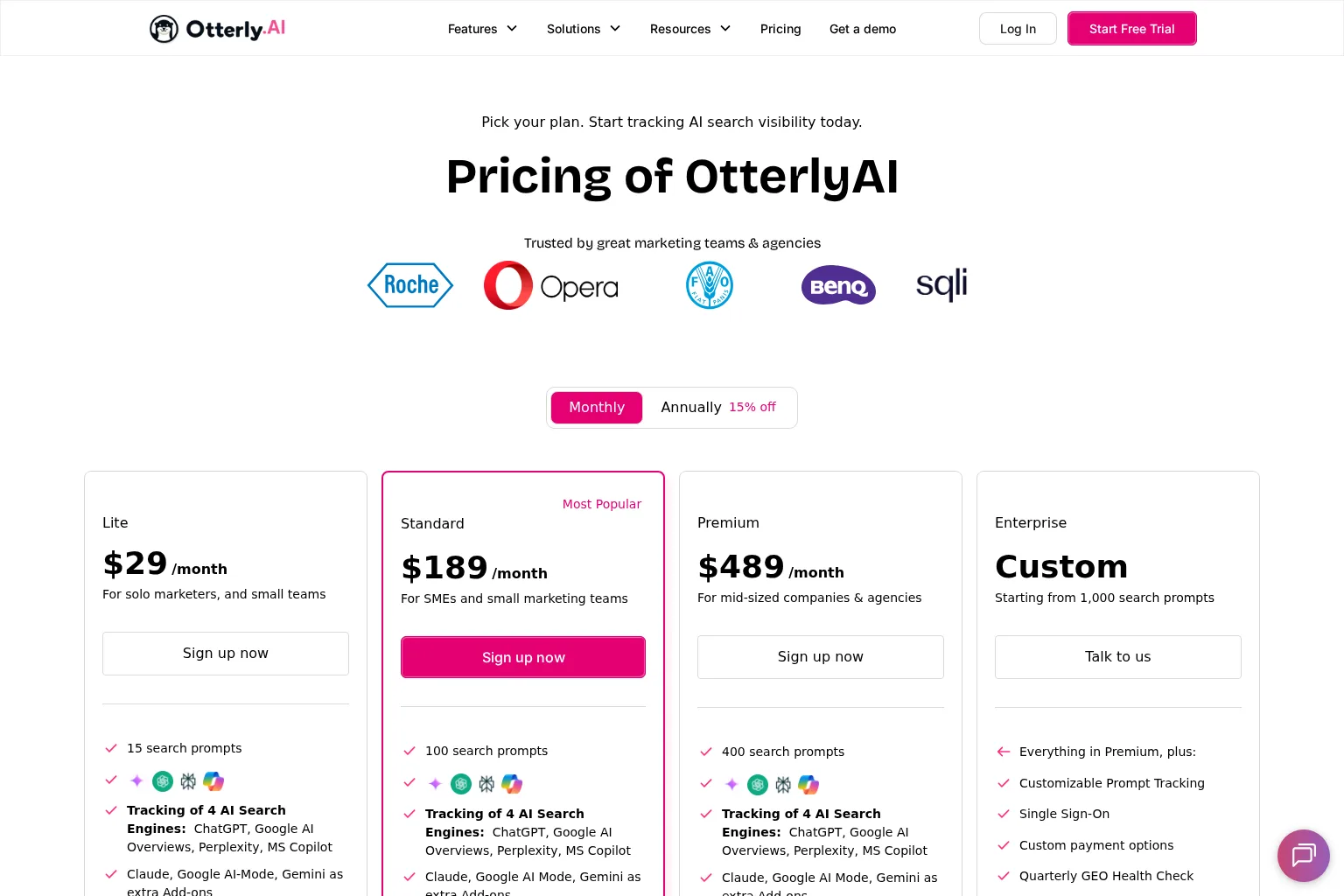
Best use case: Marketing teams and agencies that want daily prompt tracking, source-level investigation, and clear workspace-based monitoring without paying for a full traditional SEO suite.
Key capabilities: OtterlyAI's plans include Perplexity, ChatGPT, Google AI Overviews, and Microsoft Copilot. Its published feature set includes daily tracking, an AI prompt research tool, domain ranking, link citations analysis, GEO audits, reports, and exports. Standard and Premium add unlimited workspaces, API access, MCP access, and agent analytics, which can be useful when an agency needs to separate clients or route findings into other reporting systems.
Limitations: Perplexity is part of a four-engine core package, not a standalone product. Claude, Google AI Mode, and Gemini are paid add-ons, so multi-engine comparisons can increase the final cost. A single prompt tracked across multiple countries should also be budgeted as separate monitoring coverage.
Published pricing: Monthly pricing starts at $29 per month for Lite with 15 search prompts. Standard is $189 per month for 100 prompts, and Premium is $489 per month for 400 prompts. Annual billing is offered at a discounted rate.
Who should choose it: Choose OtterlyAI when our priority is daily prompt and citation monitoring, especially if we want an approachable starting tier and the option to grow into agency workspaces or API-supported reporting.
3. Scrunch
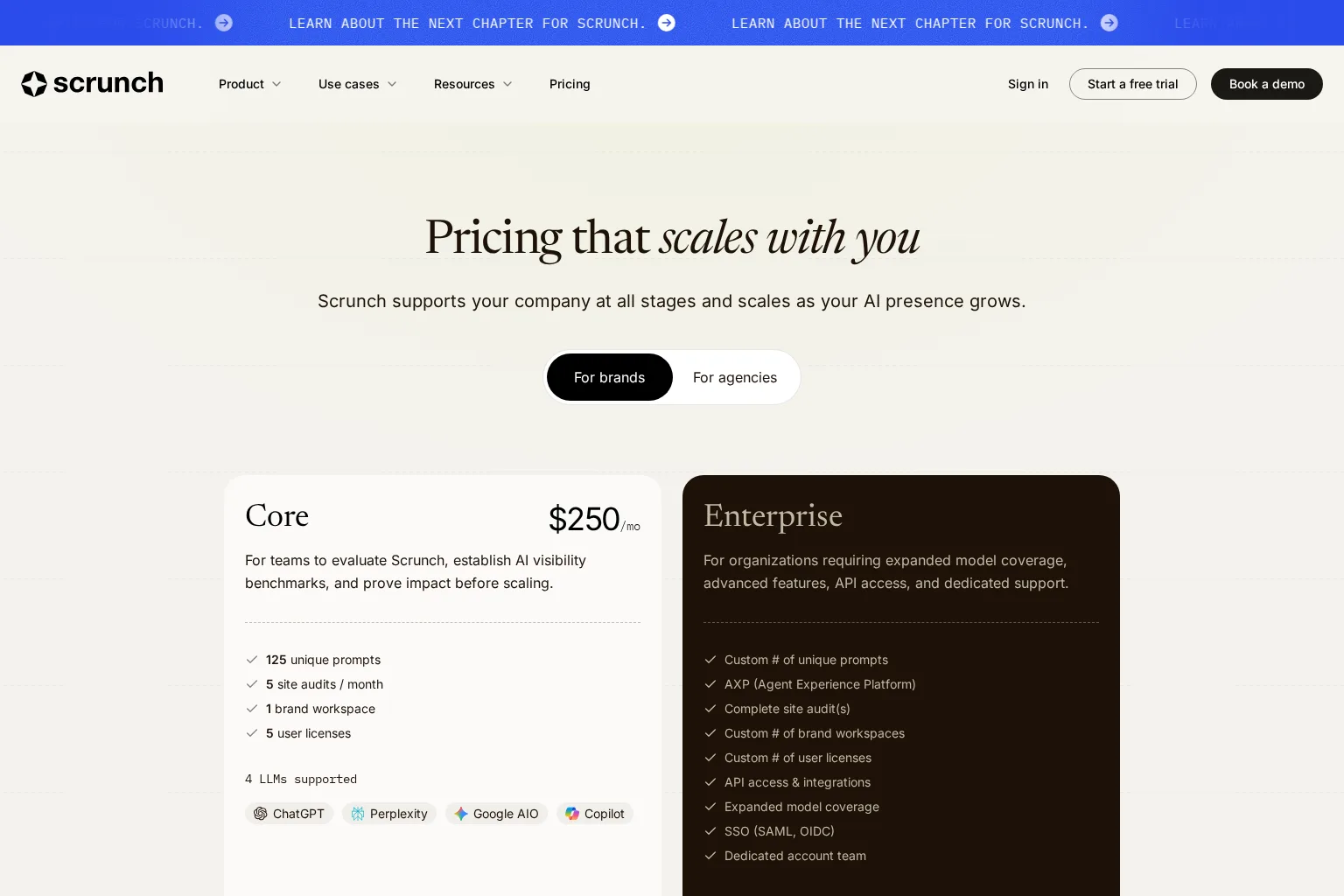
Best use case: Brand and growth teams that need a structured AI visibility benchmark, prompt management, citations or sources, site audits, and a clear route to enterprise governance.
Key capabilities: Scrunch Core supports ChatGPT, Perplexity, Google AI Overviews, and Copilot. It includes 125 unique prompts, five site audits per month, one brand workspace, five user licences, competitor tracking, reporting, citations or sources, and prompt management. Its enterprise plan expands model coverage and adds custom prompt volumes, API access, integrations, SSO, and dedicated support.
Limitations: Core is designed around one brand workspace and one country, language, and persona. That is sufficient for a focused programme, but international brands and agencies will need to assess Enterprise rather than assume the core plan covers every market or client. Its entry price is also higher than a lightweight monitoring tool.
Published pricing: Scrunch Core is listed at $250 per month and includes a seven-day free trial. Enterprise pricing is custom.
Who should choose it: Choose Scrunch when we want a managed AI-search visibility programme that combines monitoring with audits and recommendations, and when collaboration or enterprise controls matter as much as the Perplexity data itself.
4. Rankscale
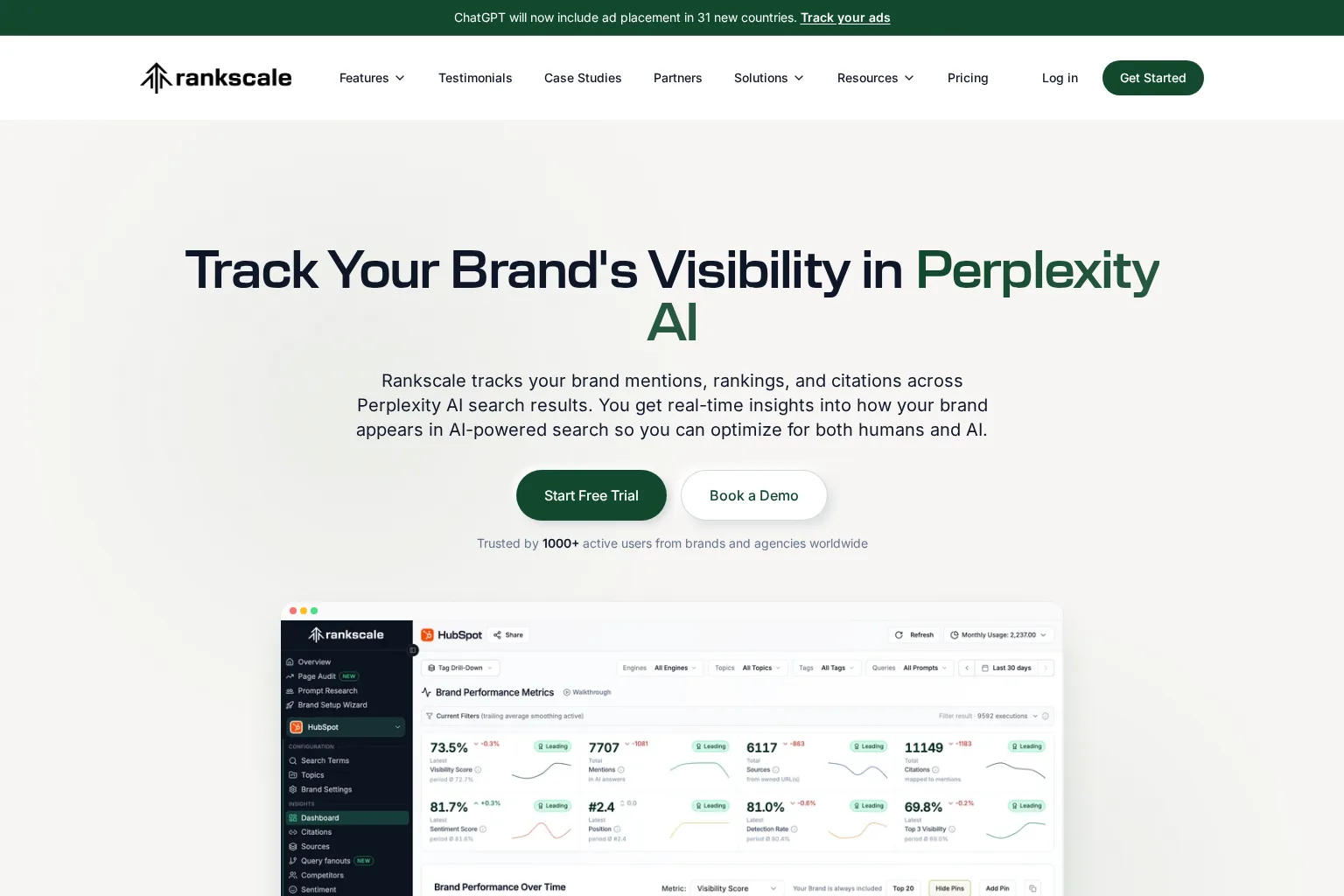
Best use case: Agencies and advanced SEO teams that need Perplexity-specific tracking, flexible schedules, multi-region monitoring, citation analysis, and credit-based control over run volume.
Key capabilities: Rankscale explicitly positions its Perplexity tracker around brand mentions, rankings, citations, competitors, and scheduled monitoring. Its pricing documentation describes coverage for Perplexity and other AI engines, all-region monitoring, schedules from hourly to monthly, page audits, competitor benchmarking, citation analysis, prompt research, and shareable dashboards. The model is useful when monitoring cadence and the number of answer checks need to be tuned to the programme rather than fixed to a small prompt allowance.
Limitations: Credits power monitoring, so comparing plans requires estimating how many prompts, engines, regions, and refreshes we will actually run. A low starting price is not directly comparable with a fixed prompt package unless we model the planned query volume first.
Published pricing: Rankscale lists plans from $20 per month. Pro is $99 per month with 1,200 monthly credits, while Growth is $385 per month and Enterprise is $780 per month.
Who should choose it: Choose Rankscale when Perplexity-specific testing, high-frequency monitoring, geographic flexibility, and agency dashboards are more important than bundling AI visibility into a traditional SEO suite.
How to choose the right tool for your team
Before booking a demo, create a short requirement sheet. We recommend answering these questions first:
- Which prompts actually matter? Start with buying, comparison, alternative, use-case, and problem-solving prompts. Avoid measuring a long unfiltered list of keywords as if each were an AI question.
- Do we need mentions, citations, or both? A team trying to improve brand recall may prioritise mentions. A publisher or SaaS business trying to earn traffic may care more about cited URLs and the sources displacing them.
- How repeatable must monitoring be? Monthly spot checks can guide exploratory work. Weekly or daily tracking is more appropriate for an active programme with enough prompt volume to justify it.
- Do we need to compare locations, languages, personas, or clients? Confirm how the product counts each variation. A prompt tracked in multiple markets may consume multiple prompt slots or credits.
- Who will act on the findings? An SEO team may value audits and keyword research. A content team may need source gaps and prompt ideas. An agency may need separate workspaces, exports, white-label reporting, and API access.
A strong shortlist is usually two tools, not four. Use the same 15 to 30 high-value prompts in each trial, set the same market and language where possible, and inspect the raw answers before relying on a dashboard score.
Build a Perplexity monitoring process that leads to better decisions
The tool is only useful if the team has a disciplined review process. We use this lightweight approach:
- Group prompts by customer decision. Map prompts to jobs such as category discovery, vendor comparison, implementation, alternatives, pricing, and troubleshooting. Our guide to how keywords and prompts work together explains why one keyword can connect to several relevant AI questions.
- Fix the first measurement set. Keep the same priority prompts, country, language, competitor set, and reporting period for the initial baseline. Add new prompts in a separate group so changes in coverage do not distort the trend.
- Review answer evidence, not only scores. Check whether the brand was named, which pages were cited, which third-party domains appeared, and what claims or attributes Perplexity associated with each option.
- Turn gaps into distinct work items. A missing owned page may require a clearer answer to a customer question. A competitor's third-party citation may point to a review, industry publication, documentation resource, or community discussion that deserves outreach or a stronger alternative asset.
- Recheck after meaningful changes. Update the content or supporting evidence, allow time for discovery, then compare the same prompt group. Do not attribute a change to one edit without considering normal answer volatility.
This process separates diagnosis from execution. Visibility platforms tell us where the gaps are. The next work may be content planning, updating a product page, strengthening documentation, earning credible third-party coverage, or clarifying a comparison. A tool cannot make Perplexity cite a page on command.
Turn observations into a focused content plan
If we find that Perplexity repeatedly cites competitor pages for a specific question, we should not simply copy their format. Read the cited pages, identify the question they answer, verify what evidence they provide, and decide whether we can create a more useful, more accurate, or more complete resource.
Then turn the opportunity into a brief with a defined reader, intent, source requirements, and success signal. For example, a SaaS team could track 20 comparison prompts, identify three repeated source gaps, publish or improve the relevant pages, and monitor that same set for brand mentions and owned-domain citations over the following review cycles.
Ready to establish a baseline? Use Scout's free AI visibility checker for a directional ChatGPT and Gemini snapshot, then use the prompt and keyword relationships to build a measurement plan for the questions that matter most. It is not a Perplexity report, but it is a useful starting point for making AI visibility work more specific.
Frequently asked questions
Can we track Perplexity manually instead of using a tool?
Yes, manual checks are useful for exploratory research and quality review. They become unreliable when we need to compare dozens of prompts, markets, competitors, or reporting periods. A platform adds repeatability, historical views, and structured evidence. We should still open individual answers periodically to validate what the tool has recorded.
Is a Perplexity mention the same as a citation?
No. A mention means the answer names the brand. A citation means Perplexity links to or references a source. They can occur together, separately, or not at all. Track both when the goal is both brand recognition and traffic or source authority.
Which Perplexity SEO tool is best for agencies?
It depends on the agency workflow. Rankscale is compelling for flexible run volume, schedules, regions, and dashboards. OtterlyAI offers multiple workspaces from Standard, while Scrunch has an agency-focused route and enterprise controls. Semrush is a strong option when clients also expect traditional SEO research, audits, and reporting in the same ecosystem.
Should we optimise only for Perplexity?
Usually not. Perplexity is one useful AI-search environment, but customer discovery can also happen through ChatGPT, Google AI experiences, Gemini, Copilot, and standard search. Start with the channels your audience actually uses, then keep the prompt set and evidence review consistent across the environments that matter.