
Perplexity visibility tracking is not conventional rank tracking. Instead of recording a blue-link position, it captures how an answer engine represents your brand across a consistent set of buyer prompts: whether you are named, cited, linked, recommended, or displaced by a competitor.
For teams deciding which platform to use, the practical question is simple: can the tool preserve the evidence behind a change? A useful tracker should retain the answer, cited URLs, prompt settings, date, competitors and historical context, not just reduce results to one visibility score.
Perplexity’s own product guidance describes answers as including citations that link back to original sources. That makes source-level monitoring particularly valuable, but it does not make a citation a guaranteed outcome or a measure of business impact. We recommend using it as directional evidence alongside referral analytics, conversions and customer feedback.
This comparison is for marketing, SEO and agency teams that want a repeatable way to monitor Perplexity visibility. We selected products with public Perplexity-specific pages and evaluated each on the same criteria:
- Prompt and answer evidence: Can you track a controlled set of prompts and inspect the response context?
- Citation and source detail: Can you see cited domains, URLs, links or citation position?
- Competitive analysis: Can you compare your brand against competitors?
- Change monitoring and reporting: Are trends, schedules or client-ready reporting supported?
- Trial and pricing approach: What can you verify from the vendor’s public Perplexity page?

Table of contents
- What to measure before choosing a tracker
- 1. SE Ranking Perplexity Visibility Tracker
- 2. Keyword.com Perplexity Tracker
- 3. PromptRush Perplexity Visibility Tracker
- 4. LLM Pulse Perplexity Tracking
- How to run a fair Perplexity tracker trial
- Visibility tracking is not visibility improvement
- Frequently asked questions
- Choose the tool that preserves the evidence
What to measure before choosing a tracker
Set your measurement design before opening a trial. Otherwise, you risk comparing dashboards instead of comparing the quality of the evidence each one produces.
Start with 20 to 50 stable prompts grouped by buyer intent:
- Commercial prompts: “best [category] for [use case]” and comparison questions.
- Informational prompts: problems and capabilities buyers research before shortlisting vendors.
- Branded prompts: your name, product categories and common alternatives.
- Competitor prompts: questions that name key competitors, where it is commercially appropriate to monitor them.
Track at least five fields per prompt: brand mention, citation or link, cited URL, competitor presence and answer context. Add date, country, language and Perplexity mode when your tool supports them. Keep those conditions consistent between checks. AI-generated answers can change with wording, time, location, product settings and source availability, so a single run is a sample, not a durable ranking.
For prompt design, start from customer needs rather than copying a keyword list. Our guide to how keywords and prompts work together explains why one keyword can map to several useful AI questions.
1. SE Ranking Perplexity Visibility Tracker
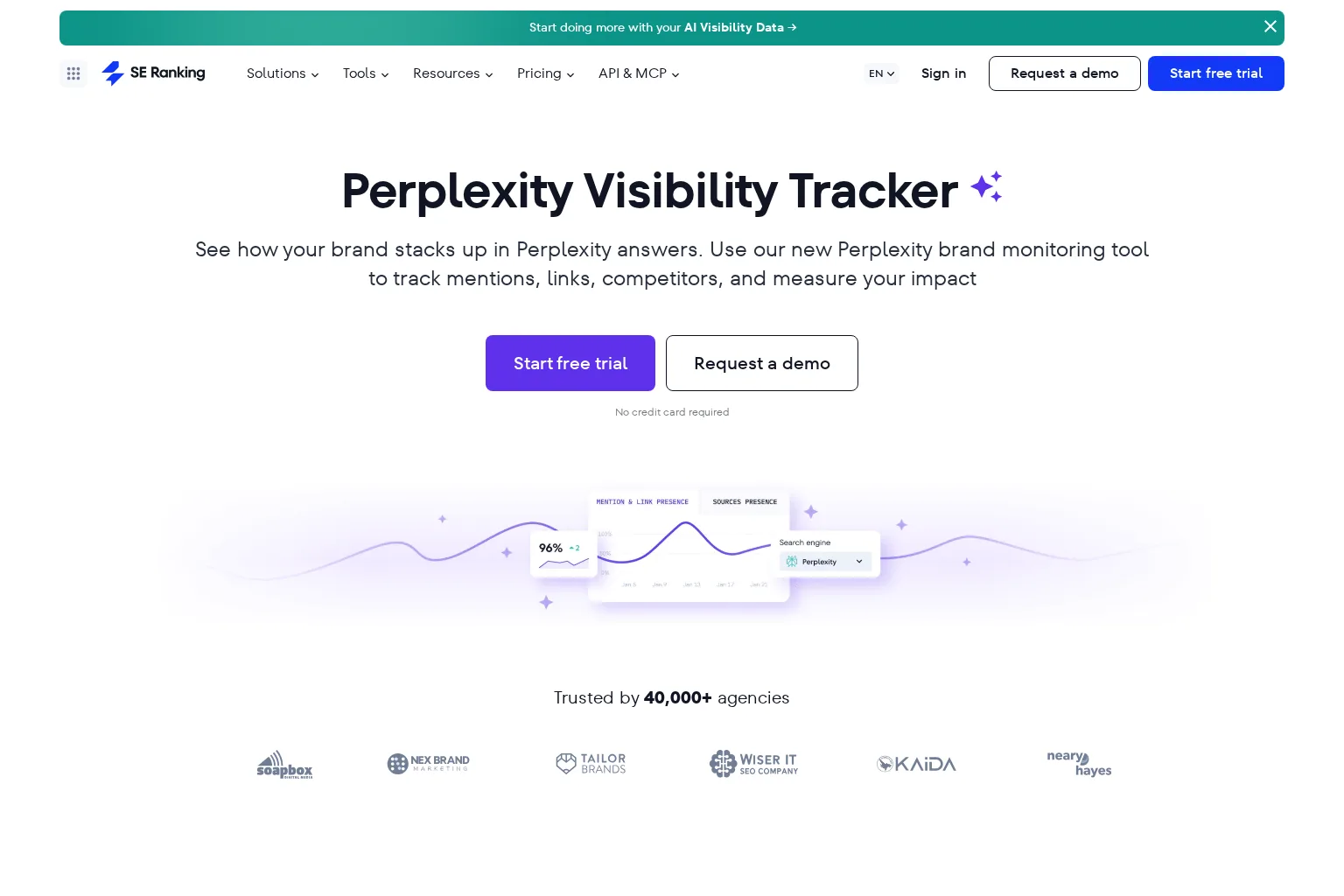
Best for: SEO teams and agencies that want Perplexity tracking inside a broader AI-search and SEO toolkit.
Key capabilities: SE Ranking’s Perplexity page describes tracking for brand and website presence, answer text, website links, mentions, competitor comparisons, historical trends, cited domains and URLs. It also states that monitoring can be configured across countries and languages. That makes it a strong fit when localisation matters or when a team wants Perplexity data next to other search workflows.
What to validate in a trial: Build the same prompt set you will use in every contender. Confirm that the platform preserves answer-level evidence, that its competitor setup matches your market and that country and language selections behave as expected. Review how a link, a mention and a position are defined before exporting results to a client report.
Limitations: The public product page says daily data updates are planned, which is not the same as a contractual service level. Treat feature claims and refresh timing as trial-validation items, especially if reporting cadence is critical.
Pricing approach: The Perplexity product page promotes a no-card free trial but does not state a Perplexity-specific price. Confirm plan limits, tracked query allowances and AI-toolkit inclusions directly with SE Ranking before purchase.
Who should choose it: Choose SE Ranking when you want an established SEO platform with Perplexity mention, link, source and competitor monitoring, especially for multi-market programmes.
2. Keyword.com Perplexity Tracker
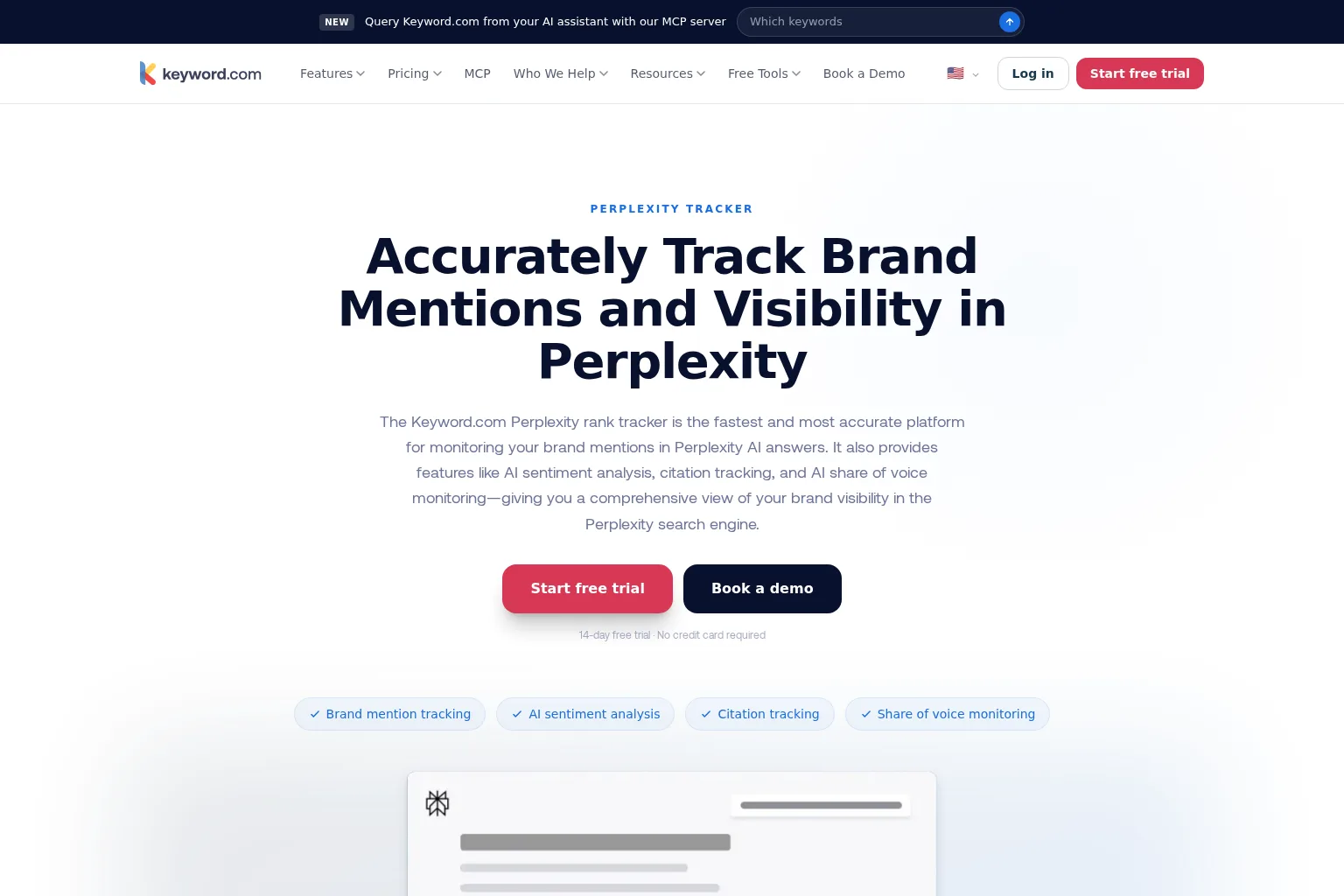
Best for: Teams that prioritise prompt organisation, share-of-voice reporting and client-facing evidence.
Key capabilities: Keyword.com presents a Perplexity tracker with brand mention tracking, citation tracking, sentiment analysis, share of voice and competitor comparison. Its page says prompts can be organised by topic and tag, and it offers client-ready reporting plus an API. It also says monitoring cadence can be hourly, daily, weekly or monthly, depending on the plan and objectives.
What to validate in a trial: Inspect a sample answer for every important prompt type. Check whether citations link to the precise URLs you need, whether answer capture is sufficiently complete and whether reports expose the raw evidence behind a score. Agencies should test white-labelling, exports and permissions during the trial rather than assuming they are included at every tier.
Limitations: Sentiment and share of voice can be helpful summaries, but they should not replace prompt-level review. A brand may be named in a negative comparison, or appear through a third-party citation that does not reflect the page you are trying to improve.
Pricing approach: Keyword.com publicly offers a 14-day free trial with no card required on its Perplexity page. It does not list Perplexity-only pricing there, so confirm tracking volume, reporting access and AI visibility features on the current plan before committing.
Who should choose it: Choose Keyword.com if your decision depends on clear prompt taxonomy, reporting workflows and the ability to inspect individual Perplexity results alongside wider AI-search tracking.
3. PromptRush Perplexity Visibility Tracker
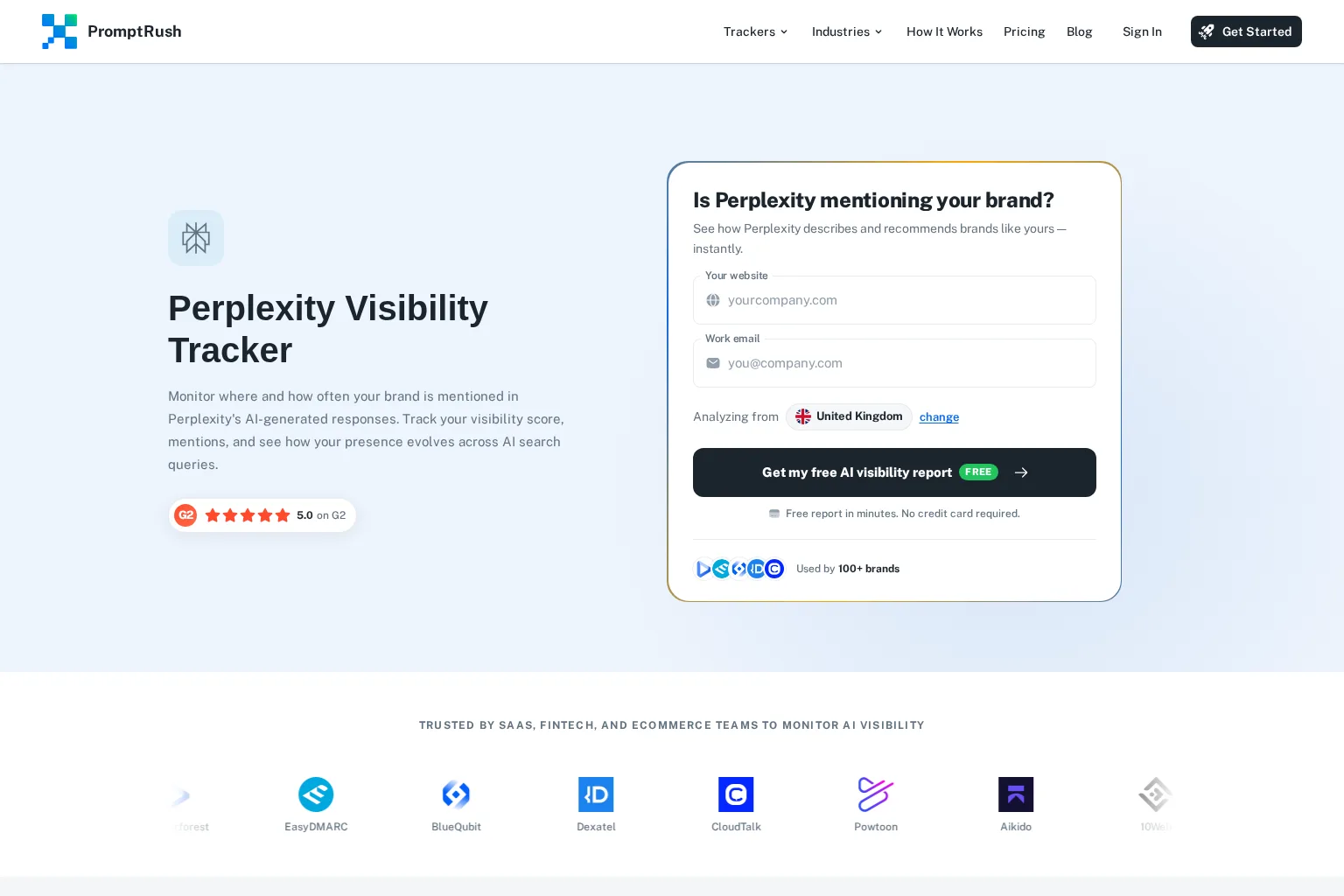
Best for: Growth teams that want to turn Perplexity source patterns into content, digital PR and mention opportunities.
Key capabilities: PromptRush focuses its Perplexity proposition on brand mentions, visibility score, cited sources, share of voice, competitor positioning and change over time. Its product page describes grouping tracking by prompts and topics, then aggregating cited domains to show sources that influence category answers. It also positions Perplexity within a multi-engine AI visibility offering.
What to validate in a trial: Review whether source aggregation is actionable for your category. You should be able to move from a category-level domain list to the exact prompts, answer context and citation URLs that produced the pattern. Test how the tool differentiates your owned URLs, third-party review sites, publishers and community sources.
Limitations: A source that appears frequently in answers is a research priority, not automatic evidence that a placement will improve visibility. Check editorial relevance, audience fit and the relationship between that source and the specific prompts where you are absent.
Pricing approach: The product page offers a free report without a credit card and links to pricing, but does not publish a Perplexity-specific plan price on the tracker page. Confirm prompt limits, refresh cadence and cross-engine access before purchase.
Who should choose it: Choose PromptRush when source discovery and competitor citation patterns will directly inform your content and digital PR roadmap.
4. LLM Pulse Perplexity Tracking
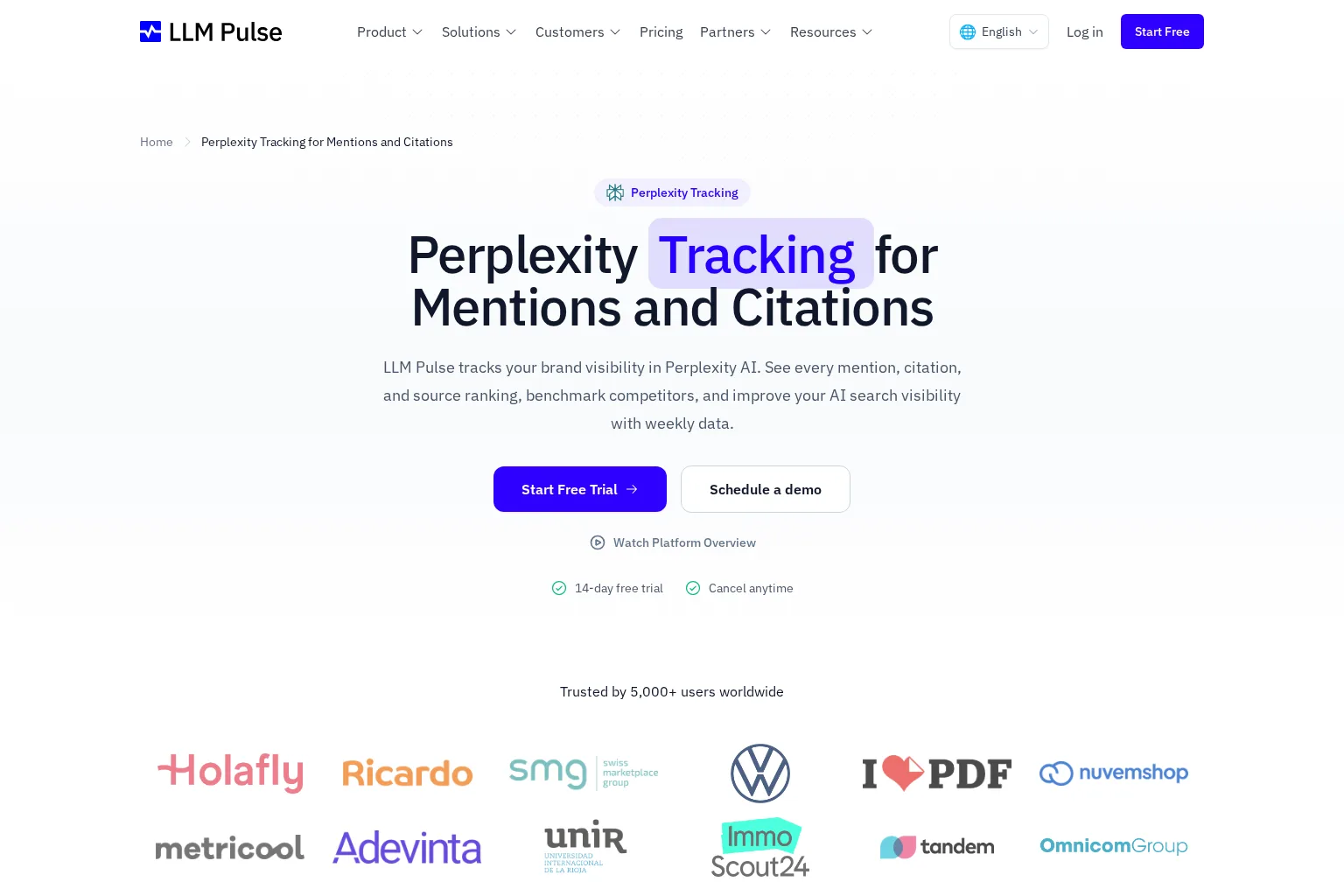
Best for: Teams seeking Perplexity-specific monitoring with weekly data, source-ranking detail and competitor benchmarking.
Key capabilities: LLM Pulse says its Perplexity tracking includes mentions, citations, source rankings, competitor benchmarks, trends and regular answer capture. Its page also says it records full citations with URL, response position, surrounding context and a primary or supporting-source designation. The workflow described is straightforward: configure brand, competitors and queries, then review response and citation data over time.
What to validate in a trial: Test whether the exact citation fields are available in the plan you are evaluating and whether the weekly cadence fits your publishing and reporting rhythm. Ask for clarification on which Perplexity experiences are monitored, how query settings are normalised and how missed or failed runs appear in reporting.
Limitations: Weekly monitoring is often sufficient for strategic content iteration, but it may not suit teams expecting daily campaign diagnostics. Do not infer causation from a trend line alone. Record publication dates, PR activity and major prompt changes so you can interpret movements responsibly.
Pricing approach: The official Perplexity page advertises a 14-day free trial and says you can cancel anytime. It does not show a Perplexity-specific tier price, so confirm query volume, competitor allowances and reporting features before purchase.
Who should choose it: Choose LLM Pulse when citation context, source ranking and a clear weekly monitoring workflow matter more than an all-in-one traditional SEO suite.
How to run a fair Perplexity tracker trial
A short, controlled trial will tell you more than a feature checklist. Use the same brand, competitor set and prompt portfolio in every product.
- Freeze your prompt set. Do not rewrite prompts between platforms unless a tool cannot support a required setting. Label each prompt by intent and funnel stage.
- Record testing conditions. Note country, language, mode, date and any device or personalisation settings offered by the tool.
- Score evidence quality. For ten high-value prompts, can you retrieve the full answer, exact citations, source URLs and surrounding mention context without relying on a summary metric?
- Test a competitor gap. Find one prompt where a competitor appears and you do not. Can the platform show who was cited, why the competitor may be present and what URL or source pattern to investigate?
- Test reporting. Export a view that a stakeholder can understand. It should distinguish observed mentions and citations from recommendations about what to do next.
- Review pricing against your monitoring design. A low entry price can become expensive if your needed prompt volume, markets, competitors or report seats are add-ons.
Visibility tracking is not visibility improvement
A tracking platform measures what happened in a defined sample. It does not itself make your content more likely to be cited. Use the findings to decide what to investigate:
- Missing brand mentions on commercial prompts may indicate a coverage, positioning or third-party validation gap.
- Citations to a competitor’s category page may reveal an unmet comparison or use-case question.
- Repeated reliance on a review site can justify improving your profile, reviews or factual product information there.
- Citations to your pages without a brand mention can reveal content that is trusted as evidence but weakly connected to your brand in the answer.
We recommend documenting each action with its original prompt and evidence. Then watch the next scheduled runs, rather than declaring success from one favourable answer. If you need a broader baseline outside Perplexity, our AI visibility checker shows a sample of how ChatGPT and Gemini mention a business and cite its website. It is a separate snapshot, not a Perplexity tracker.
Frequently asked questions
What is Perplexity visibility tracking?
It is the practice of running a stable set of prompts in Perplexity and recording whether your brand appears in the answer, as a citation or link, in what context and alongside which competitors. The useful unit of analysis is the evidence for each prompt, not a single overall score.
Is a Perplexity citation the same as a Google ranking?
No. A Google ranking refers to a result’s position in a search-results page. Perplexity visibility tracking examines generated answers and their cited sources. Both can inform SEO work, but their measurement methods and user experiences differ.
Which metrics matter most?
Start with brand mention rate, citation or link rate, owned-URL citation share, competitor presence, cited-source patterns and change over time. Add referral traffic and conversions separately so you do not mistake visibility for commercial performance.
How often should we check Perplexity visibility?
Weekly monitoring works well for most content and brand programmes. Use a more frequent cadence only when your tool supports it and you have a real decision that depends on faster feedback. Consistent conditions matter more than maximum frequency.
Can we track competitors without copying their strategy?
Yes. The goal is to identify unanswered buyer questions, source types and visibility gaps, not to imitate a competitor’s pages. Review the original Perplexity answer and citations, then decide what genuinely useful content, product information or third-party proof your audience needs.
Choose the tool that preserves the evidence
The best Perplexity visibility tracking platform is the one that captures the raw material your team needs to make decisions: stable prompts, actual answers, citations, source URLs, competitor context and a reliable history.
For a broader SEO and AI-search workflow, start with SE Ranking. For reporting and prompt organisation, evaluate Keyword.com. For source-led content and digital PR opportunities, consider PromptRush. For weekly citation context and source ranking, trial LLM Pulse.
Whichever option you select, begin with a narrow, well-labelled prompt set. A smaller set of buyer questions with strong evidence is more valuable than a large dashboard full of unexplained visibility scores.