
Choosing an SEO platform for agencies is not about finding the longest feature list. It is about creating a repeatable operating system for research, planning, delivery, measurement, and client communication across every account.
For this comparison, we assessed platforms against four agency-critical criteria: multi-client keyword and competitor research, content workflow support, client-ready reporting, and the ability to scale technical SEO or specialist work. We also considered pricing structure, because seat limits, project limits, add-ons, and per-client fees can change the economics of an agency quickly.
We selected six established options with clear agency use cases, plus Scout for teams that want to centralise content planning and AI-search visibility alongside SEO workflows. No single platform wins every category. The right choice depends on whether your bottleneck is strategy production, data depth, reporting, or technical governance.

Table of contents
- How we would choose an agency SEO platform
- 1. Scout
- 2. Semrush
- 3. Ahrefs
- 4. SE Ranking
- 5. AgencyAnalytics
- 6. Lumar
- The best SEO platform for agencies, by operating model
- Questions to ask before you buy
- Build a more scalable agency SEO workflow
How we would choose an agency SEO platform
Start with the workflow you need to improve most:
- Content-led agencies need a consistent path from opportunity discovery to prioritised briefs, drafts, and publishing.
- Full-service SEO agencies usually need broad keyword, competitor, backlink, rank tracking, and audit capabilities.
- Reporting-heavy agencies need branded dashboards, automated delivery, and reliable integrations more than another keyword database.
- Enterprise technical SEO specialists need deep crawling, issue prioritisation, and governance for large or complex websites.
A useful buying process is to run one live client through the platform before rolling it out. Test the same tasks each team member repeats: research a keyword cluster, build a content plan, assign work, review outcomes, and prepare the monthly client update. If the platform creates duplicate work between those steps, it is unlikely to become your operating system.
1. Scout
Best for: Agencies that want to centralise SEO workflows, content planning, article production, and AI-search visibility across client websites.
Key capabilities: Scout is positioned around managing SEO workflows and content planning across multiple client sites, with competitor review, keyword opportunity analysis, content-plan generation, SEO article creation, and support for improving visibility in AI platforms. That makes it a strong fit when we want a connected workflow from strategic opportunity to published content, rather than separate tools for planning and execution. We can use Scout as the central workspace, then keep client strategy and production moving through one process.
Limitations and considerations: Scout is most compelling when content-led organic growth and operational consistency are central to the agency offer. Agencies that require a mature standalone backlink database, highly specialised crawl diagnostics, or a large cross-channel reporting library may still pair it with a specialist platform.
Pricing approach: Confirm plan scope and commercial terms directly with Scout during onboarding, especially for the number of client websites and the workflow automation you need.
Who should choose it: Choose Scout if your agency loses time translating keyword research into plans and publishable work. It is particularly relevant for teams standardising content operations and adding AI-search visibility to client strategy. You can also create a Scout account to assess the workflow against a real client brief.
2. Semrush
Best for: Full-service agencies that need a broad SEO toolkit with client management and reporting options.
Key capabilities: Semrush combines keyword research, competitor analysis, position tracking, backlink analysis, and site auditing in its SEO toolkit. Its agency offering also supports multi-user access, domain-based projects, and branded reporting through My Reports. It has additional toolkits for content, local, social, advertising, traffic analysis, and AI visibility, which can suit agencies that want to consolidate a broader marketing stack.
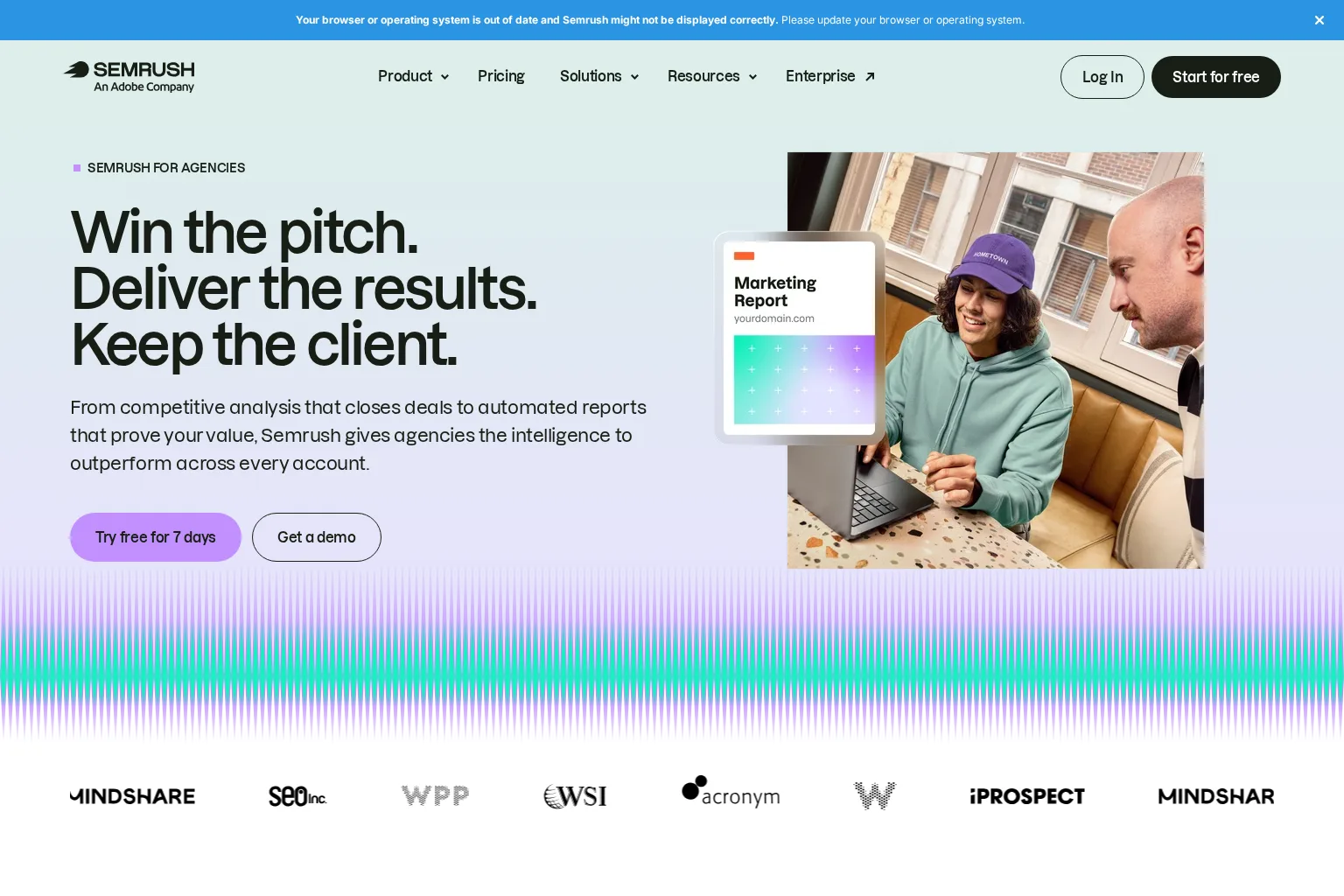
Limitations and considerations: The breadth is valuable, but the commercial model can become complex. Agencies should map required toolkits, users, monitored websites, reporting requirements, and add-ons before comparing total cost. The platform can also require deliberate process design to avoid teams using different tools for the same client decision.
Pricing approach: Semrush uses tiered SEO plans, with Business positioned for agencies and mid-market companies. Annual billing, additional users, reporting, and specialist toolkits can affect the final price.
Who should choose it: Choose Semrush when we need wide SEO coverage in one vendor, especially for agencies combining research, technical checks, rank tracking, competitive intelligence, and client reporting.
3. Ahrefs
Best for: Agencies that prioritise search demand, competitor, backlink, and content-performance analysis.
Key capabilities: Ahrefs provides Site Explorer, Keywords Explorer, Rank Tracker, Site Audit, project portfolios, and reporting capabilities. Its higher plans increase client-site capacity, crawl credits, tracked keywords, historical data, users, and API access. Ahrefs also offers content and reporting add-ons, making it a credible choice for agencies that want strong research depth with scalable monitoring.
Limitations and considerations: Ahrefs is excellent for investigation and SEO intelligence, but it is not inherently a complete agency delivery workflow. Teams often need a separate task, content-production, or client-management system to turn insights into accountable work. Usage, user, and project limits deserve scrutiny for agencies with many active accounts.
Pricing approach: Ahrefs uses tiered subscriptions from Lite through Enterprise, with optional products such as Content Kit, Report Builder, and project boosts. Compare monthly versus annual pricing and calculate the cost of additional users before committing.
Who should choose it: Choose Ahrefs if the agency's advantage comes from deeper competitive research, link intelligence, content opportunity analysis, and portfolio-level SEO monitoring.
4. SE Ranking
Best for: Growing agencies that want an all-round SEO suite with agency-specific white-label and client-access options.
Key capabilities: SE Ranking covers core SEO activities including rank tracking, auditing, competitor research, backlink analysis, and AI-oriented search visibility. Its Agency Pack adds white-label interface options, branded reporting, client seats, lead-generation functionality, and scheduled reports. This gives agencies a practical path from operational SEO data to a more branded client experience.
Limitations and considerations: Important agency features sit in the Agency Pack, so test the base subscription and add-on together. Agencies should also confirm which project, keyword, API, and client-seat limits apply to their plan before standardising on it.
Pricing approach: SE Ranking uses flexible subscription plans. The Agency Pack is a separately purchased annual add-on for eligible annual subscriptions.
Who should choose it: Choose SE Ranking when we want a balanced SEO platform with a clearer agency layer than a pure data tool, particularly for branded reports and controlled client access.
5. AgencyAnalytics
Best for: Agencies whose primary operational pain is aggregating marketing data and delivering polished client reporting.
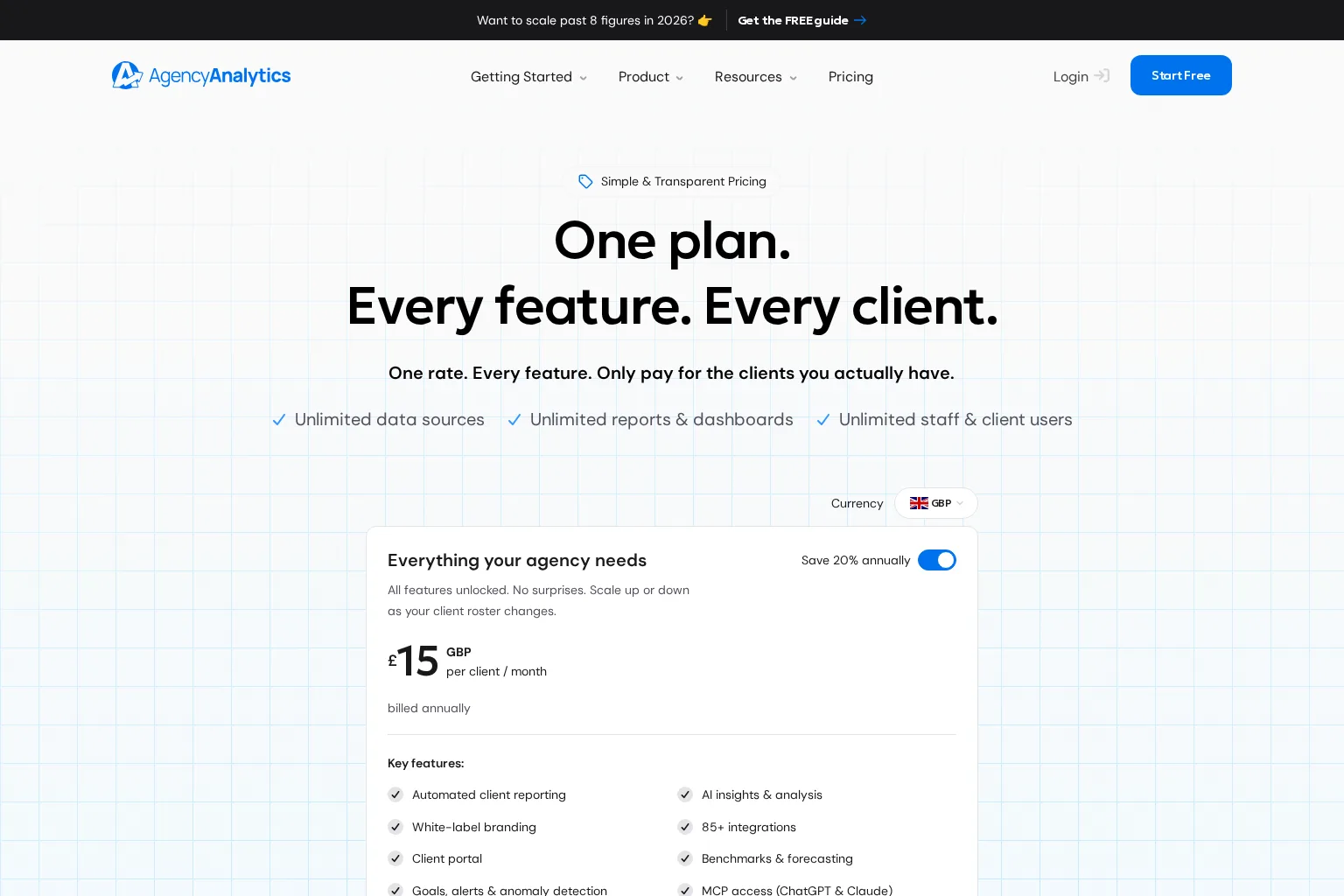
Key capabilities: AgencyAnalytics is built around client dashboards and automated reports. It supports a large set of data-source integrations, client portals, white-label branding, custom domains and email, unlimited staff and client users, plus optional rank tracking and AI tracking. It is designed to make recurring reporting and client visibility a repeatable process.
Limitations and considerations: This is a reporting-first platform, not a replacement for a dedicated keyword, backlink, or technical SEO research environment. Most SEO agencies will pair it with Scout, Semrush, Ahrefs, SE Ranking, or another core SEO tool.
Pricing approach: AgencyAnalytics uses a per-client pricing model. Its published plan includes core reporting and dashboard features, while rank tracking and AI tracking are optional add-ons. Forecast the cost using your expected client count and tracking volume.
Who should choose it: Choose AgencyAnalytics when client-facing reporting, data consolidation, and presentation quality are the constraints holding the agency back.
6. Lumar
Best for: Technical SEO agencies and enterprise-focused teams responsible for complex, large-scale websites.
Key capabilities: Lumar focuses on scalable technical SEO analytics and optimisation workflows. Its platform covers website crawling, technical health analysis, reporting, and prioritisation, with additional capabilities for AI-search related analysis and website optimisation concerns such as accessibility and performance.
Limitations and considerations: Lumar is a specialist technical platform rather than a complete content production or agency reporting system. Content-led agencies will typically need a planning platform alongside it, while smaller clients may not need its depth.
Pricing approach: Lumar directs teams to select the features and plan that match their needs, so request a tailored quote based on crawl scale, websites, and technical workflow requirements.
Who should choose it: Choose Lumar if technical SEO governance, high-volume crawling, and prioritising complex website issues are central to your agency's value proposition.
The best SEO platform for agencies, by operating model
Our practical shortlist looks like this:
- Choose Scout for an integrated content-led SEO workflow across client sites, especially when planning and execution are fragmented.
- Choose Semrush for broad, all-round SEO and marketing capabilities under one vendor.
- Choose Ahrefs for research, competitor intelligence, backlinks, and portfolio-level SEO analysis.
- Choose SE Ranking for a balanced SEO suite with white-label agency options.
- Choose AgencyAnalytics for automated, branded reporting and multi-source dashboards.
- Choose Lumar for enterprise technical SEO depth and website-governance workflows.
For many agencies, the strongest stack is not one tool. It is one central workflow platform plus one specialist data or reporting layer. For example, we might use Scout to turn opportunities into content plans and publishable work, Ahrefs or Semrush for investigative research, and AgencyAnalytics for client-facing reporting. The goal is not to buy more software. It is to reduce the handoffs that slow client outcomes.
Questions to ask before you buy
Before signing a contract, ask each vendor:
- Can we view every client, owner, priority, and next action without building manual spreadsheets?
- Which limits apply to client sites, projects, tracked keywords, crawl volume, users, and exports?
- Are branded reports, client access, API access, and AI-search tracking included or charged separately?
- Can the platform support our actual handoff from research to brief to draft to approval to publication?
- What will the total monthly cost be after we add the clients, users, toolkits, and tracking capacity we expect in six to twelve months?
Build a more scalable agency SEO workflow
The best platform is the one your strategists, writers, account managers, and clients will actually use every week. Start with the bottleneck that costs the most time or creates the most client uncertainty, then test one workflow end to end.
If your agency needs a clearer system for content planning, SEO workflow management, and AI-search visibility, explore Scout's approach to sustainable organic growth and use it to create more consistent execution across client websites. For additional guidance, visit the GrowthScout blog.