
UK SEO agencies rarely need one tool to do every task. They need a dependable way to move from research to delivery across multiple client websites, without losing the context, controls and reporting each account requires.
This comparison covers five UK SEO agency tools with distinct strengths across the workflow: multi-client content operations, research and visibility data, backlink analysis, technical auditing, and agency reporting. It is not a universal ranking. The right choice depends on where your delivery process currently slows down.
We selected the tools below because their official product information supports a clear agency use case and a verifiable approach to features and pricing. We assessed each against the same practical criteria:
- Multi-client structure: Can the agency separate projects, permissions, data or client views?
- Research and prioritisation: Does the tool help with keyword, competitor, opportunity or visibility analysis?
- Technical and content workflow: Can it support audits, planning, briefs, production, review or publishing?
- Reporting and collaboration: Does it help teams explain progress to stakeholders?
- Pricing model: Are limits, add-ons and billing commitments understandable before purchase?

Table of contents
- Start with the workflow, not the feature checklist
- 1. GrowthScout: Best for client-specific content planning and production workflows
- 2. Semrush: Best for broad search research, tracking and scalable reporting
- 3. Ahrefs: Best for competitor, backlink and content opportunity analysis
- 4. Screaming Frog SEO Spider: Best for repeatable technical audits and QA
- 5. SE Ranking: Best for agencies that want client-facing reporting and collaboration options
- How to assemble a sensible SEO agency stack
- Questions to ask during a trial or demo
- The right UK SEO agency tool is the one that protects client context
Start with the workflow, not the feature checklist
A feature checklist can make almost every platform look interchangeable. It is more useful to map the work your agency completes for each client:
- Discover: collect keyword, competitor, backlink and technical evidence.
- Decide: turn that evidence into a prioritised roadmap, rather than an unfiltered export.
- Deliver: create briefs, drafts, audits, fixes and link-building tasks with clear ownership.
- Review: give strategists and clients an appropriate approval path before publishing.
- Measure: connect activity to rankings, organic performance, technical progress and emerging AI-search visibility.
A small agency may be well served by a specialist stack. A larger delivery team may need an integrated platform to reduce duplicated context and hand-offs. In either model, keep a clear source of truth for each client. Do not make writers reconstruct the strategy from disconnected spreadsheets, audit exports and chat threads.
1. GrowthScout: Best for client-specific content planning and production workflows
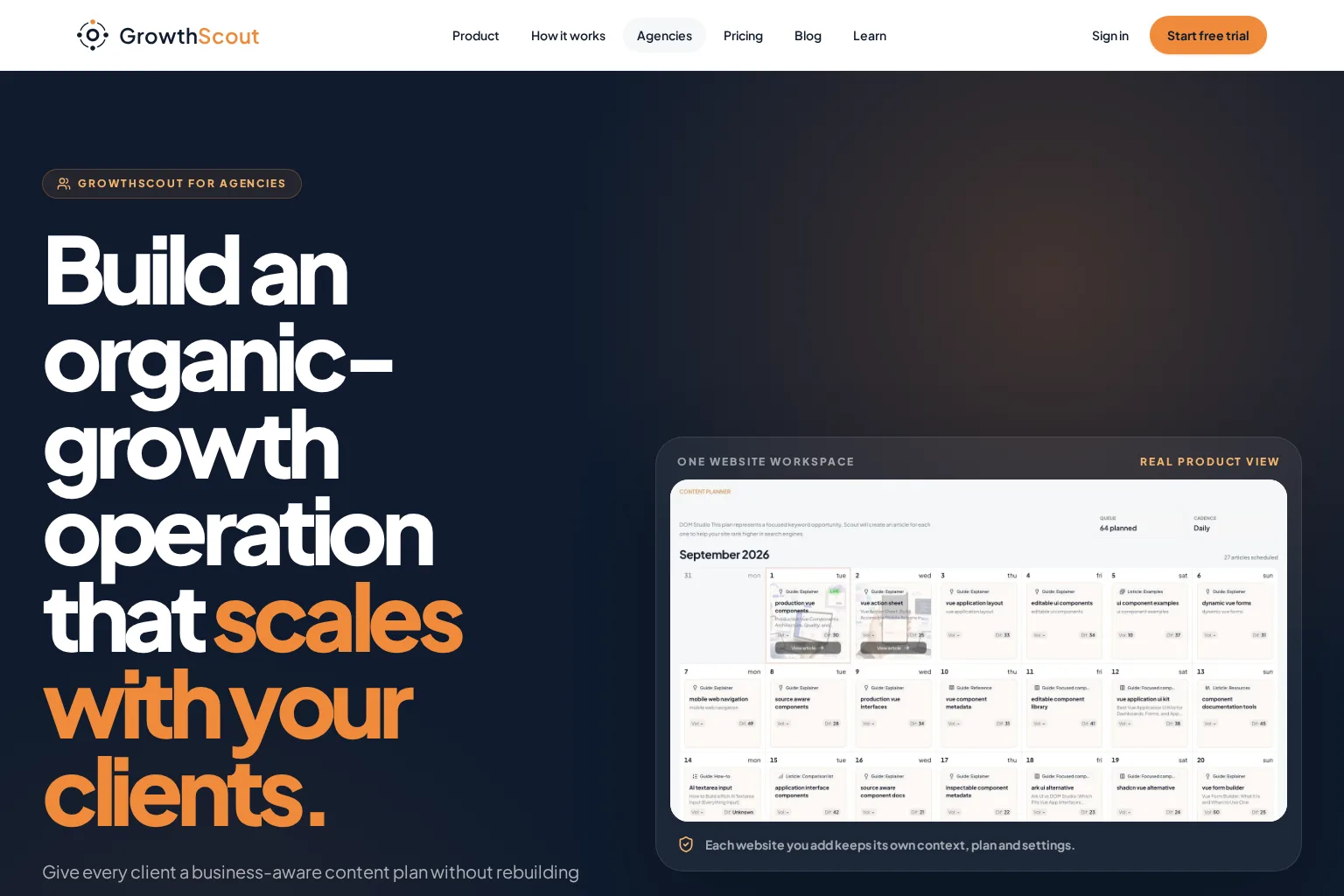
Best use case: Agencies that want a separate organic-content workspace for each client website, from site context and opportunity planning through article review and delivery.
Key capabilities: GrowthScout keeps website knowledge, opportunities, content plans and publishing settings distinct for every website. Its agency workflow is built around crawling the selected site, reviewing prioritised opportunities, planning a calendar, producing articles, and reviewing work before manual, WordPress or webhook delivery. It also supports website-specific writing and image settings, which helps prevent one client’s guidance from leaking into another client’s output.
Limitations: It is not a full replacement for deep backlink intelligence or a desktop-scale technical crawler. Dedicated client approval, cross-client dashboards, agency-wide defaults, roles and shareable reporting are described as planned or exploratory, not current capabilities. That distinction matters when your buying process requires mature account governance today.
Pricing approach: The product uses an initial website plan and separate paid checkout for additional client websites. We recommend confirming the current recurring total, client-site capacity and publishing setup during the trial or checkout flow.
Who should choose it: Choose GrowthScout when your primary bottleneck is turning researched opportunities into quality-controlled content delivery across client sites. Our agency workflow overview explains the current multi-website model and the parts of the dedicated agency experience that are still on the roadmap.
2. Semrush: Best for broad search research, tracking and scalable reporting
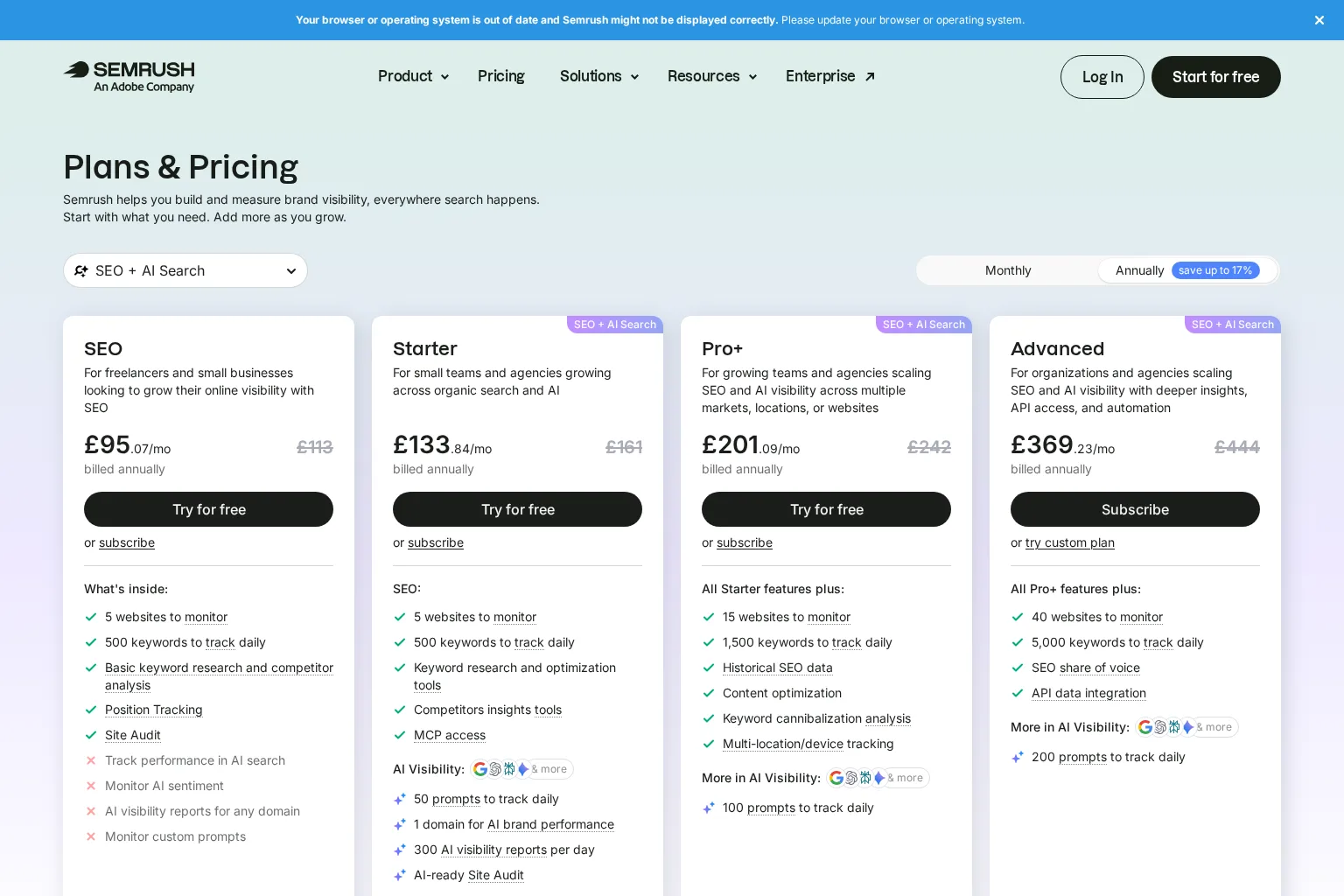
Best use case: Agencies that want a wide SEO platform for keyword and competitor research, position tracking, site auditing, visibility monitoring and report delivery.
Key capabilities: Semrush combines keyword research, competitor insight tools, position tracking and site audit functionality in its SEO plans. Its current UK pricing page also presents AI visibility features such as prompt tracking, AI visibility reports and monitoring across several AI-search products. For agency reporting, Semrush offers report add-ons with scheduling, PDF export, integrations, branding and white-label options depending on the tier.
Limitations: Capacity is managed through plan limits for websites, tracked keywords, prompts and users. Useful reporting and collaboration capabilities can sit in add-ons, so the headline subscription price is not necessarily the full agency cost. It is also data-rich enough that teams need a defined reporting template to stop dashboards becoming noise.
Pricing approach: Pricing is tiered in GBP, with annual-billing options shown on the pricing page. Website, keyword and prompt allowances increase by tier, and additional users or report products may be billed separately.
Who should choose it: Choose Semrush if your agency needs a broad research and reporting backbone, especially when different teams need a common view of rankings, competitors, technical findings and AI-search signals.
3. Ahrefs: Best for competitor, backlink and content opportunity analysis
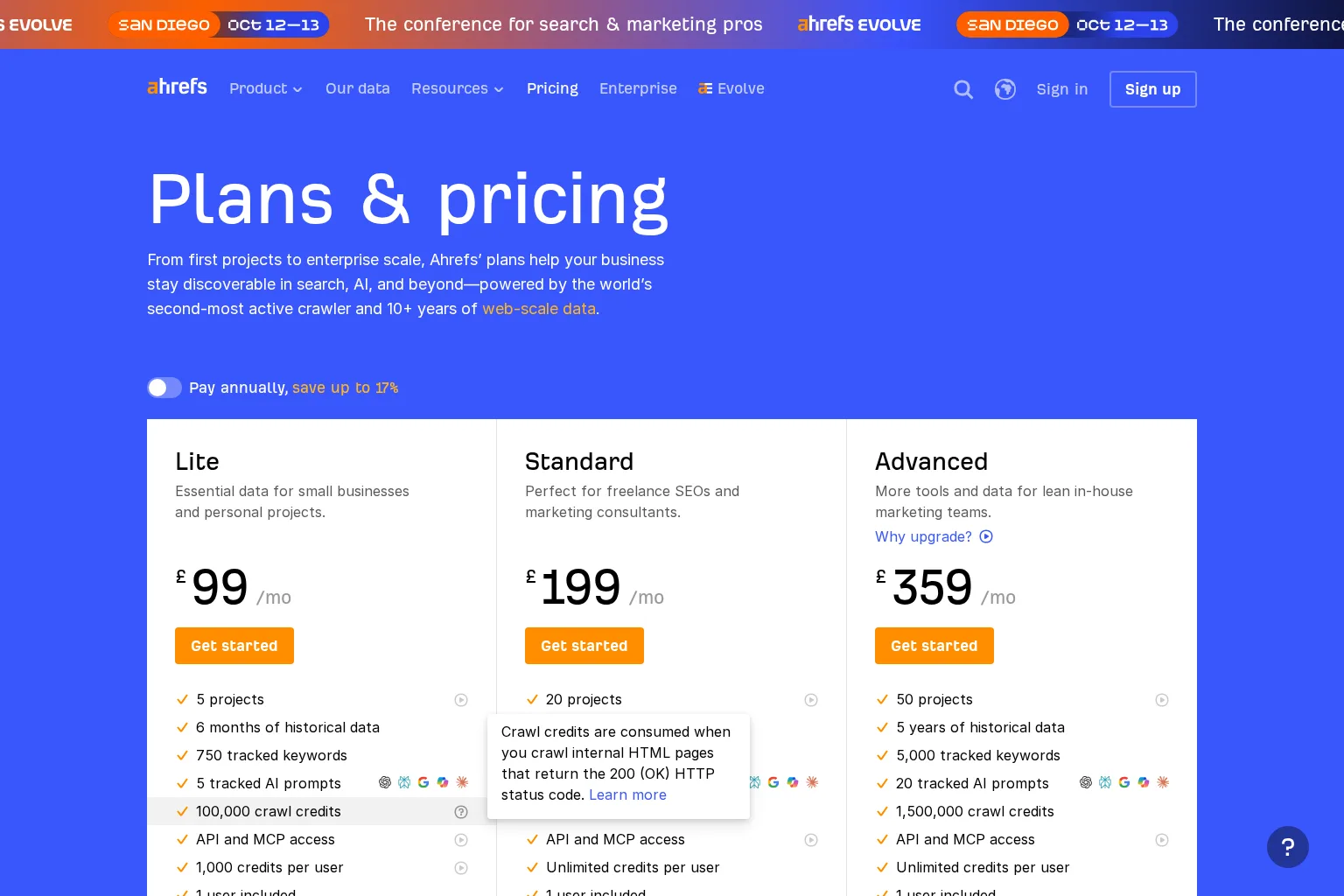
Best use case: Agencies that place heavy weight on competitor research, link intelligence, keyword discovery and ongoing portfolio analysis.
Key capabilities: Ahrefs includes Site Explorer, Keywords Explorer, Site Audit, Rank Tracker, Competitive Analysis, Report Builder and web analytics in its plan lineup. Higher plans add portfolio-level capabilities and greater project, keyword, crawl and user allowances. It also offers tracked AI prompts and a separate Brand Radar product for teams that need another view of brand visibility in AI environments.
Limitations: Ahrefs is strong at evidence gathering, but it is not designed to run an end-to-end editorial approval and publishing process for every client. Agencies will often pair it with a planning, project-management or content-workflow system. Its credit, project and user limits also need careful modelling when many strategists work across many accounts.
Pricing approach: Ahrefs lists GBP monthly pricing by tier, with projects, tracked keywords, crawl credits, user capacity and historical-data access varying by plan. Some AI-monitoring capacity is presented as a separate package or add-on.
Who should choose it: Choose Ahrefs if your strongest need is deciding what competitors rank for, where they earn links and which content or authority gaps are worth prioritising. We would pair it with a tool that carries the approved plan into briefing, production and review.
4. Screaming Frog SEO Spider: Best for repeatable technical audits and QA
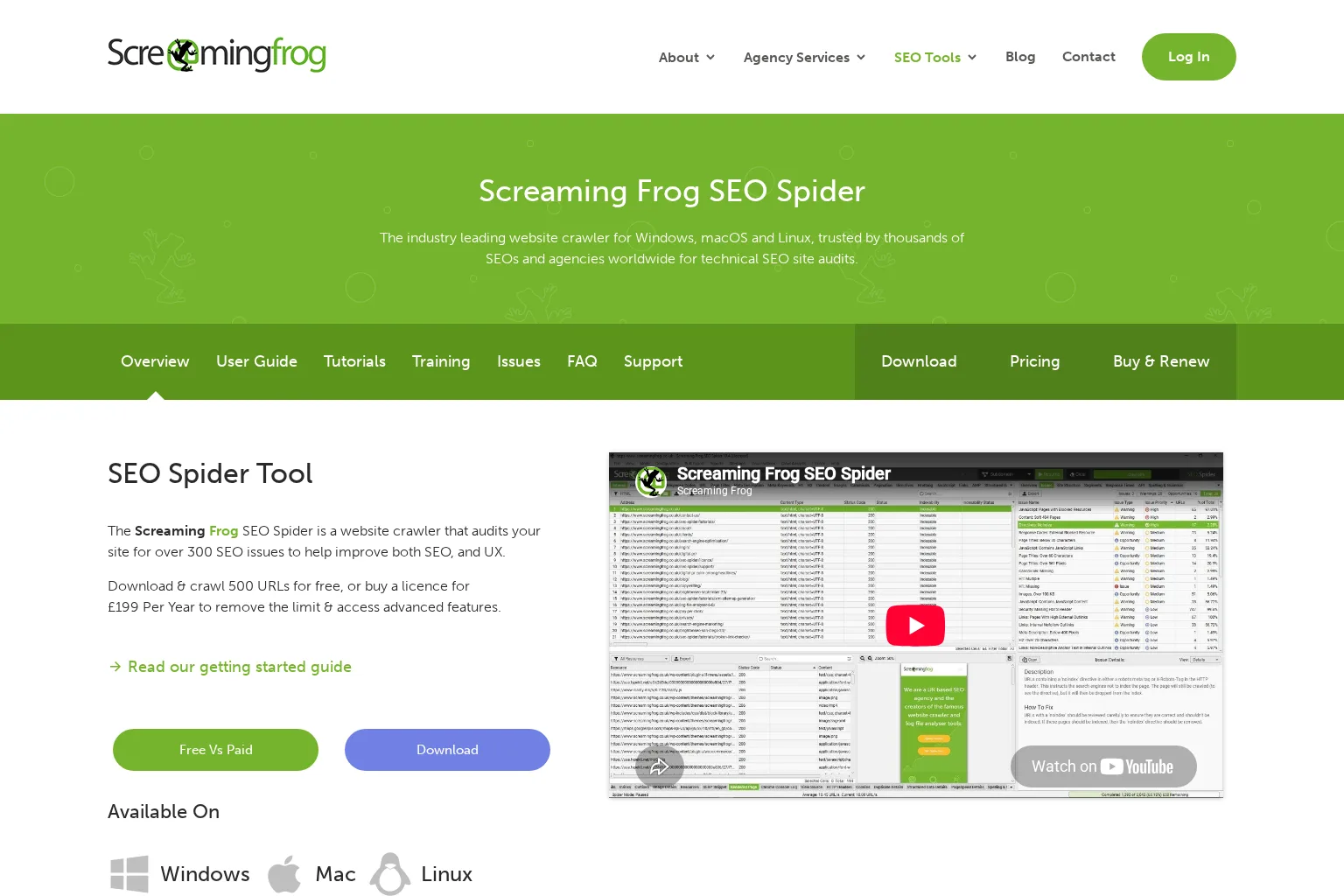
Best use case: Agencies that need flexible, detailed crawling for technical audits, migrations, content checks and pre-launch quality assurance.
Key capabilities: Screaming Frog SEO Spider crawls websites to identify a wide range of SEO issues, including broken links, redirects, metadata, directives, canonicals, duplicate content, hreflang, JavaScript rendering and site architecture. It can integrate with Google Analytics, Google Search Console and PageSpeed Insights, schedule audits, compare crawls and export data for developers or reporting workflows.
Limitations: This is a specialist crawler, not an all-in-one agency operating system. It requires analysts who can configure crawls, interpret results and turn a large issue list into practical client recommendations. It does not replace keyword-market research, backlink prospecting, client reporting or editorial production.
Pricing approach: The official site offers a free version capped at 500 URLs and a paid annual licence for higher-capacity use and advanced workflows. Check licence terms and the current renewal price before standardising it across an agency.
Who should choose it: Choose Screaming Frog when technical analysis is a recurring part of your retainers and your team needs crawl-level evidence, rather than simplified health scores alone. It is especially valuable as the technical layer in a wider tool stack.
5. SE Ranking: Best for agencies that want client-facing reporting and collaboration options
Best use case: Agencies looking for a broad SEO platform with rank tracking, research, auditing, reporting and agency-specific add-ons.
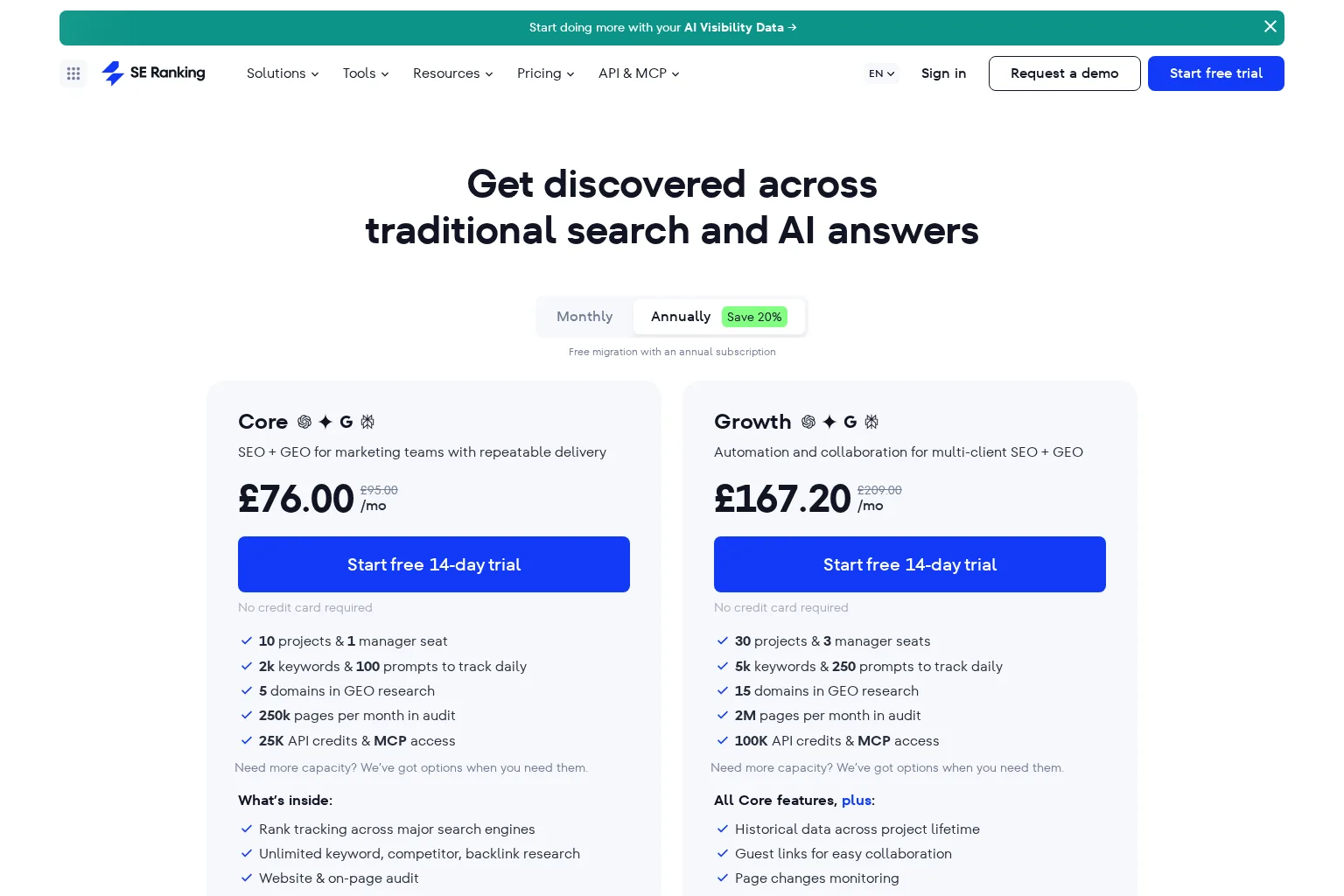
Key capabilities: SE Ranking’s plans combine rank tracking, keyword, competitor and backlink research, website and on-page auditing, plus integrations with analytics and search-data platforms. Its higher-tier workflow includes more projects, manager seats, historical data, guest links and page-change monitoring. The Agency Pack add-on is positioned around white-label reporting, client-facing tools, client seats and scheduled reporting.
Limitations: Agency-specific functionality is not necessarily included in the base plan. Agencies should calculate the complete setup, including the Agency Pack, extra seats, keyword limits and AI-search capabilities, rather than comparing only entry-level plan prices. It also will not replace a bespoke editorial process if your clients require detailed document-level approvals.
Pricing approach: SE Ranking presents GBP plan tiers with project, seat, keyword, prompt and audit-page limits. Its Agency Pack is a separately priced annual-billing add-on, while Enterprise terms are custom.
Who should choose it: Choose SE Ranking if client reporting, project capacity and collaboration matter alongside core SEO research and auditing. It can be a practical centre of gravity for an agency that wants more client-facing structure without assembling every reporting component separately.
How to assemble a sensible SEO agency stack
For most UK agencies, the sensible answer is not to buy every platform above. It is to choose one primary workflow system, then add specialist tools where the work demands greater depth.
A practical starting combination could look like this:
- Research-led retainers: Semrush or Ahrefs for market and competitor intelligence, plus a technical crawler for audits.
- Content-heavy retainers: a client-specific planning and production workflow, backed by Semrush or Ahrefs for research validation.
- Technical SEO retainers: Screaming Frog as the diagnostic layer, with a platform that turns fixed issues into visible client reporting.
- Reporting-led retainers: SE Ranking or Semrush, provided you price the reporting, branding and seat requirements into the retainer.
Treat AI-search visibility as an additional monitoring category, not a substitute for search fundamentals. A useful tool should let you understand whether a client is appearing in relevant AI responses, but the delivery plan still needs solid technical hygiene, useful content, recognisable expertise and measurable search performance.
Questions to ask during a trial or demo
Before committing, ask each vendor these questions with a real client workflow in mind:
- Can we keep every client’s projects, context, users and exports separate?
- Which limits apply to websites, keywords, crawl volume, users, client seats and reports?
- Which reporting, white-label, API or AI-search features cost extra?
- Can our strategists turn research into an approved plan without copying data between systems?
- What is the review path before work is published or sent to a client?
- Can we export raw data if a client leaves or our stack changes?
- Which integrations are native, and which depend on connectors, webhooks or manual files?
- Does the billing model match our retainers, especially annual commitments and per-user charges?
We recommend running one representative client through a short proof of concept. Include the actual research, audit, content-planning, review and reporting steps your team performs. The best platform is the one that reduces rework without weakening strategic judgement.
The right UK SEO agency tool is the one that protects client context
A strong tool stack should make your agency faster without making its work generic. Choose broad platforms for research and reporting depth, specialist crawlers for technical certainty, and workflow software for the hand-offs that determine whether good strategy becomes consistent delivery.
If your team needs a client-specific content operation from research to reviewed publishing, explore GrowthScout for agencies. We keep each website’s context, plan and settings separate so your team can repeat the process without repeating generic work.