
TL;DR
For AI mention tracking, choose a tool that preserves the actual buyer question, AI answer, brand mention and source links, then lets you compare the same prompts over time. OtterlyAI is a specialist monitoring option; SE Ranking combines AI results with broader SEO projects; Ahrefs Brand Radar pairs custom prompts with a large research index; GrowthScout connects a smaller weekly prompt set to content planning. We compare documented capabilities, not results from a hands-on trial. Start with a representative prompt set before paying for more coverage.
Someone asks an AI assistant for the best option in your category. It names two competitors, links to a third-party guide and never mentions you. Is that an opportunity, a bad prompt, or just one answer that will look different tomorrow? A brand-name search cannot answer that question. Neither can an alert for mentions on public web pages.
AI mention tracking means checking whether and how your brand appears in AI-generated answers to a defined set of questions. Useful records distinguish an answer-text mention from a citation or source link to your website. Traditional web, social and media monitoring instead finds published mentions across those channels. The two jobs can complement each other, but a web alert cannot tell you what an assistant answered to a prospective customer's question. Our free AI visibility checker explicitly separates names in answer text from website links in sources; it also cautions that a small sample is not an overall ranking.
Table of contents
- How we selected and compared these tools
- 1. OtterlyAI: best for a dedicated prompt-monitoring programme
- 2. SE Ranking: best for combining AI mentions with SEO delivery
- 3. Ahrefs Brand Radar: best for research breadth plus custom prompts
- 4. GrowthScout: best for connecting a focused prompt set to content planning
- Run the same buyer-prompt test in every finalist
- Turn missed mentions into specific content opportunities
- Frequently asked questions
- Sources
- Recommended Reads
How we selected and compared these tools
This list is for business marketers and agencies deciding whether to buy ongoing AI-answer monitoring, extend an existing SEO platform or keep a modest in-house baseline. We selected four identifiable products with public documentation for AI prompt or answer tracking and a distinct buying reason. GrowthScout is our product, so we apply the same criteria to it and flag where the publicly documented offer is narrower. We reviewed official product and pricing pages, not logged-in accounts; we did not run a controlled accuracy test. Availability and plan limits deserve a checkout or demo check.
The shared criteria are: prompts and AI-platform coverage; separate brand mentions and citation links; competitor and historical comparisons; useful exports or workflows; and the real cost of prompts, seats, platforms and billing terms. A feature advertised somewhere on a vendor's site is not necessarily in its entry plan. Location controls and refresh frequency also matter: a daily check in one country is not interchangeable with a weekly check in another. Sentiment can add context when supported, but read the answer before accepting an automated label.
| Tool | Best starting fit | Distinctive documented strength | Main buying question |
|---|---|---|---|
| OtterlyAI | Dedicated cross-platform monitoring | Daily prompt checks and citation analysis | Which engines are included rather than add-ons? |
| SE Ranking | SEO teams and multi-project agencies | Prompt-level AI results alongside SEO research | What do the base plan and AI Search add-on each include? |
| Ahrefs Brand Radar | Research-led teams needing breadth and custom questions | Separate indexed discovery and tracked prompts | How many checks do your prompts, platforms and locations consume? |
| GrowthScout | Teams turning a small prompt set into planned content | Weekly tracking inside a research-to-publishing workflow | Is ten weekly prompts enough for your intended sample? |
A mention and a link are not four ways of saying the same thing. Across your saved answers you may find neither, a brand mention alone, a website citation without a name, or both. Record those outcomes separately before combining them into any score.

1. OtterlyAI: best for a dedicated prompt-monitoring programme
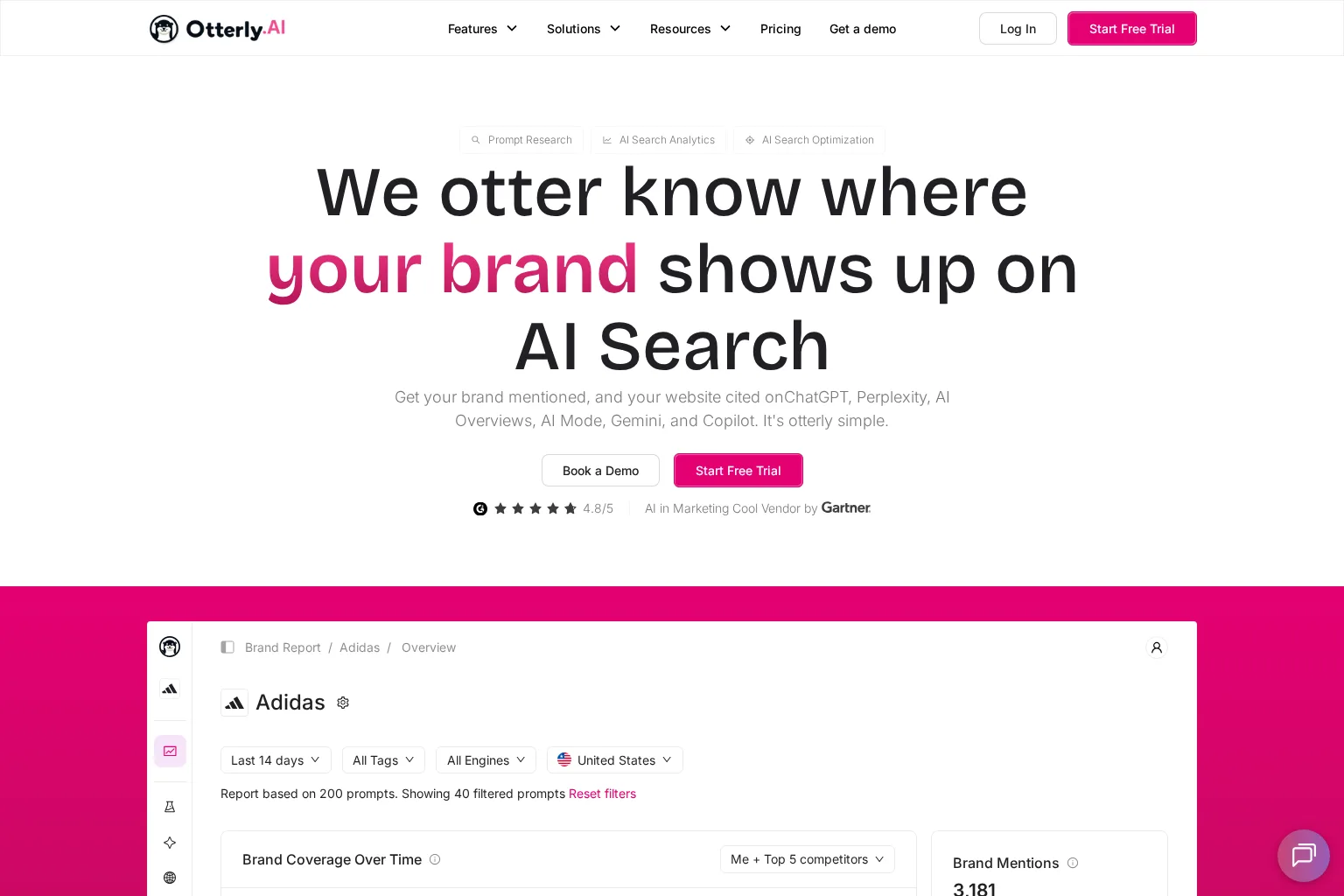
Best for: A team that wants recurring AI-answer checks, competitor context and link-source analysis without making a general SEO toolkit the centre of the job.
OtterlyAI describes monitoring brand mentions and website citations across AI search products, together with prompt discovery, competitor comparisons and recommendations. Its pricing page is more useful than a broad platform list when planning a trial: the displayed Lite monthly option includes 15 search prompts, daily checks and four base engines, ChatGPT, Google AI Overviews, Perplexity and Microsoft Copilot. Gemini, Google AI Mode and Claude are shown as add-ons on that tier. The same page lists link citation analysis, exports and one workspace on Lite; its higher tiers expand prompts and workspaces.
The published Lite monthly price is $29/month; a different annually presented monthly equivalent appears on the page, so do not compare them as the same commitment. Extra engines and more prompts can change the total. For an agency, check how client workspaces and reporting fit the actual tier rather than assuming unlimited team members means unlimited client setups. These details come from OtterlyAI's plan comparison.
The limitation to test is the quality of your own prompt set. Fifteen prompts can support a focused category, but counting brand-name prompts will tell you little about discovery by people who do not already know you. Choose OtterlyAI when the primary need is repeatable, answer-level monitoring; ask for a sample export showing the prompt, engine, date, brand detection and cited URL before committing.
2. SE Ranking: best for combining AI mentions with SEO delivery
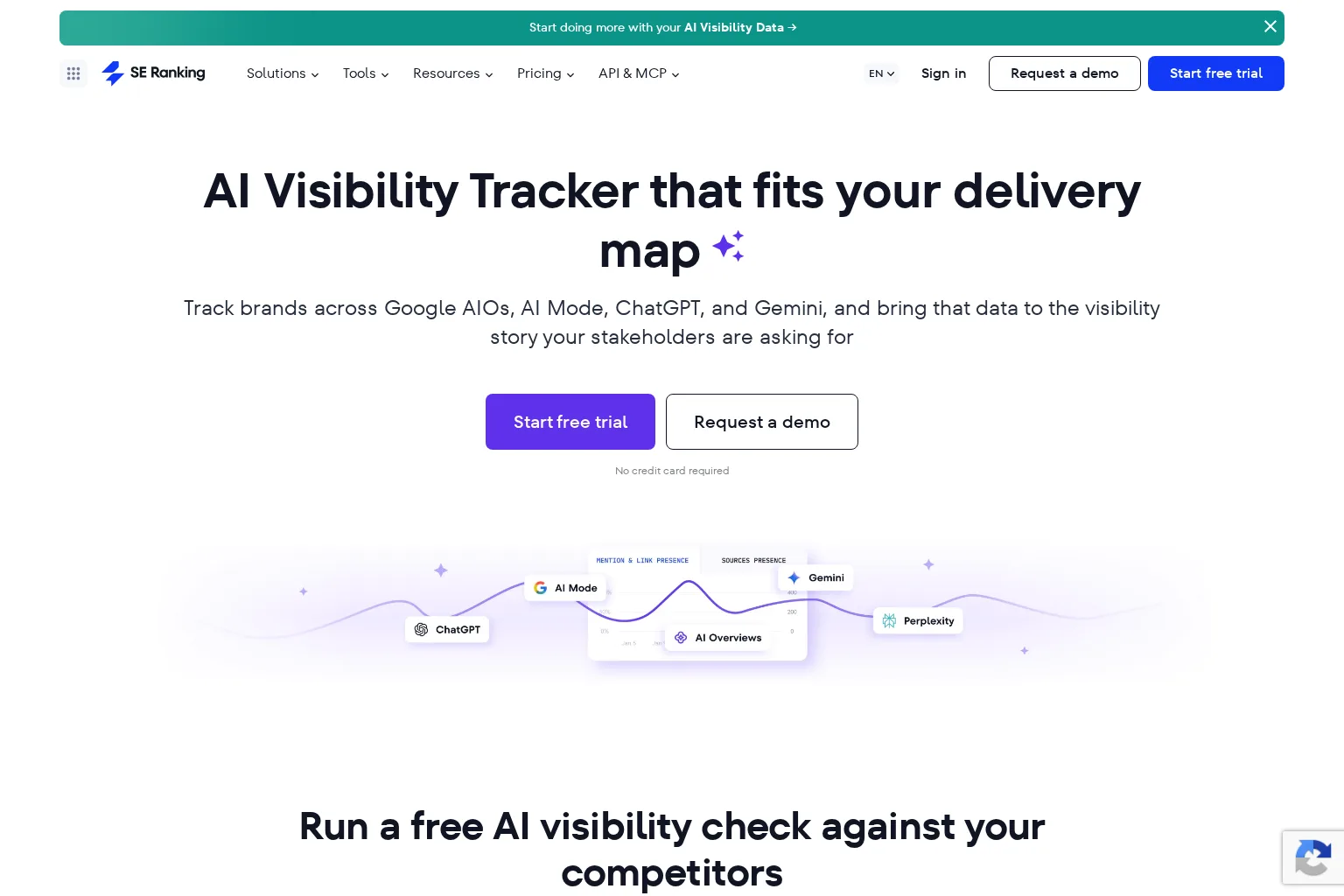
Best for: An SEO team or agency that already needs project-level research and reporting, and wants to investigate AI mentions and links alongside that work.
SE Ranking's AI Visibility Tracker describes tracked prompts, answer copies, linked and unlinked brand references, competitor comparisons, source analysis and historical views. Its listed answer surfaces include Google AI Overviews, AI Mode, ChatGPT, Gemini and Perplexity. Crucially, its Sources documentation distinguishes domains cited across your prompts from the per-prompt brand-presence view. That separation helps answer two different questions: “Was our business recommended?” and “Which pages supplied the answer?” The Sources table can be exported as CSV or Excel.
On the UK subscription page, Core shows 100 prompts tracked daily, five AI platforms and one manager seat; Growth shows higher project, prompt and seat limits. A separately listed AI Search add-on increases capacity and includes SE Visible features such as sentiment trends. Its annual and monthly billing displays differ. Ask for a quote showing the base tier, any add-on, manager seats and the actual billing commitment; a discounted monthly equivalent on an annual contract is not a rolling monthly plan.
SE Ranking makes particular sense when an agency needs to move from a cited competitor page to a client report and an SEO action. It is less straightforward if you want only a handful of low-maintenance prompt checks. In a demo, inspect an original response and its linked sources, then make sure the historical chart uses the same engine, market and prompt set for both dates.
3. Ahrefs Brand Radar: best for research breadth plus custom prompts
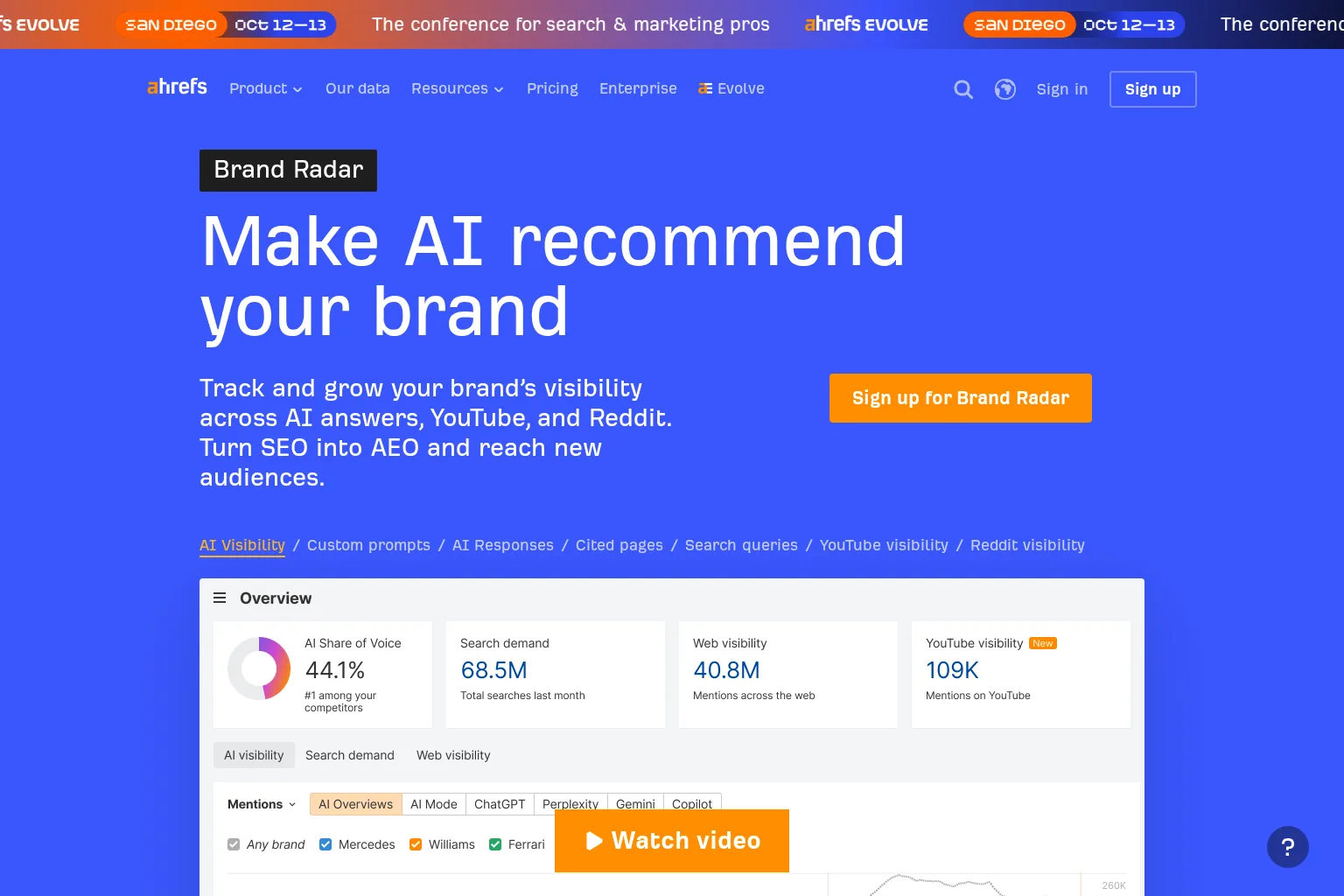
Best for: A team that wants to explore where a brand appears beyond its own handpicked questions, while still monitoring a small, commercially important prompt set.
Ahrefs Brand Radar presents two different workflows. Custom Prompts track questions you define, with tags and selectable update cadence; the AI Visibility Index lets you investigate an existing collection of AI responses and compare brands. The product describes mentions and citations as different measures and lists AI Overviews, AI Mode, ChatGPT, Perplexity, Gemini and Copilot for its indexed coverage. Do not treat an indexed research view as if it were a scheduled check on every exact question your sales team cares about.
Its pricing information says paid Lite plans and above include limited tracked prompts, while larger custom-prompt packages and the index have separate pricing. Custom packages start at $50/month and the index is advertised from $199/month. A prompt run on each platform in each location consumes checks, and overage terms apply to some packages; price the proposed combination rather than multiplying one headline figure by an assumed number of brands. Verify your tier's included allowance before purchasing an additional package.
This is a strong candidate when competitor and topic discovery matter as much as a recurring alert. The trade-off is interpretive: a broad index is an opportunity-finding instrument, not proof of how every visitor would experience an AI product today. Ask whether a discovered question can be added to a tracked, location-specific set and exported with the underlying answer and cited page.
4. GrowthScout: best for connecting a focused prompt set to content planning
Best for: A business whose immediate need is to connect a modest AI visibility sample with keyword research, a content calendar and reviewed article production, rather than buy a dedicated monitoring suite.
Our published GrowthScout plan includes 10 AI prompts tracked weekly, keyword research, a 30-day plan, competitor research for planned articles and article drafts. Our guide to keywords and prompts explains why a tracked answer is a sample and why estimated keyword search demand must not be reported as a count of AI conversations. That connection is the point of this option: inspect the buyer question and observed gap, then decide whether an existing page needs work or a new, useful answer deserves a place in the calendar.
Our public AI visibility checker asks three category-based questions on ChatGPT and Gemini once per platform, distinguishes name matches from website source links and warns that results can change with wording, time, location and personalisation. It is a one-off snapshot, not the same as a recurring ten-prompt programme. The publicly accessible GrowthScout materials do not establish that the paid prompt workflow offers the same cross-platform depth, citation exports, location controls or daily refresh as the specialist products above. If those are must-haves, request a demonstration instead of assuming them.
Our published offer is a 3-day trial with 3 AI article drafts, then £74/month per website for the Growth plan, which lists 31 AI article drafts per month and says you may cancel anytime. Additional website capacity is purchased separately, with the current price shown in the in-app checkout; do not treat an undisclosed price as zero. Check the GrowthScout plan terms for your website before subscribing. Choose this option if planning and publishing useful content from the observed questions matter more than a large, high-frequency prompt database.
Run the same buyer-prompt test in every finalist
A polished dashboard can hide a weak question set. Begin with 12 to 20 buyer questions if the tool and your budget allow it, split across discovery, comparison and decision stages. This is a practical test design, not a claim that those questions represent all AI conversations. For a limited plan, take the most important subset and keep it stable. Our keywords-and-prompts guide shows why one keyword can correspond to several different questions without giving any single prompt a measured search audience.
Suppose you sell appointment software for independent dental practices. “What is Acme Dental Scheduler?” only tests brand recall. Better discovery questions include “What scheduling software helps a two-location dental practice reduce no-shows?”; a comparison question could ask which systems integrate with an existing practice-management setup; a decision question might ask what to check before changing vendors. Use your actual customer language, products and constraints. Avoid inserting your brand into every question, or a high mention rate may simply reflect the prompt design.
For each shortlisted tool, enter the same questions, country or region, language, engine and competitor names. Record its refresh cadence and whether it retains the full response. Compare the following on a few real answers:
- Detection: Does it separate a brand name in prose from a link to your domain? Can you correct false matches for a common company name?
- Evidence: Can you open the full answer, cited URL, date, engine and original prompt? Is the linked page yours, a competitor's or a third-party source?
- Continuity: Can the team freeze a baseline prompt set while adding new discovery questions separately? Can it distinguish a failed check from a genuine non-mention?
- Operations: Can you export per-prompt evidence, separate clients, assign an owner and understand prompt or check limits before renewal?
Do not collapse unlike checks into one percentage. If you use a presence rate, define it as valid answers mentioning your brand ÷ valid answers for the same prompt group and engine. Report citation rate separately. If the prompt list, location, engine mix or matching rules change, annotate the break rather than presenting the result as an uninterrupted trend.
Turn missed mentions into specific content opportunities
When a rival appears and you do not, inspect the actual answer first. Perhaps the assistant linked to the rival's pricing explanation, a neutral buyer's guide, a local directory or an authoritative comparison. A missing mention is not proof that a new article will cause inclusion. It is a clue about the question, evidence and sources worth investigating. SE Ranking's Sources guide describes how cited pages and domains can reveal relevant content and outreach opportunities.
Map each promising question to an existing page, a possible new page and the underlying keyword topic. Check whether your product genuinely fits the need and whether the page answers the concrete decision criteria, such as integrations, supported use cases or limitations. Where a third-party source is repeatedly cited, consider whether accurate product information or legitimate outreach would help its readers. Do not assume you can control its editorial choices.
A weekly review can track five fields per prompt group: valid checks, mention rate, citation rate, competitor presence and the next action with an owner. For an agency, keep client workspaces and markets separate and include two example answers in each report. Review trends monthly using unchanged prompt cohorts; investigate a single surprising answer, but do not announce a lasting win or loss from that one sample. When discussing impact, put AI-answer presence beside actual site outcomes, not in place of them: Google distinguishes Search Console impressions and clicks from Analytics visits.
Frequently asked questions
Can I track AI mentions for free?
Yes, you can manually ask a consistent set of questions, save each answer and source link in a spreadsheet, and repeat at scheduled intervals. That avoids a paid tracking subscription, but takes time and provides only the checks you performed. Our free AI visibility checker offers a small ChatGPT and Gemini snapshot; it does not continuously re-run your prompts for free. Some vendors offer free previews or trials, but read their limits before treating them as a monitoring programme.
Is an AI visibility tracker the same as brand mention monitoring?
Not necessarily. General brand monitoring looks for published references on websites, social platforms or in media. An AI visibility tracker samples answers to prompts and may record how the response describes the brand and which pages it cites. If you need both jobs, verify that a product actually collects both kinds of evidence rather than inferring it from “AI-powered monitoring.”
How often should I review the results?
Match your review to the refresh you bought. Keep a weekly operational log and a monthly comparison of unchanged prompt groups; check noteworthy losses against the underlying answers before acting. A tracker that runs daily does not require daily content changes. Document changes to engine, location, prompt wording and matching rules so stakeholders can interpret the trend.
The right choice depends on what happens after a missing mention. Trial two finalists with the same buyer questions and inspect the answer records, not just their headline visibility scores. If the clearest next step is better content rather than a larger monitoring contract, explore GrowthScout's research-to-publishing workflow or begin with the free AI visibility snapshot. We would rather you see the limits of that snapshot up front than confuse it with ongoing tracking.
Sources
- OtterlyAI platform overview
- OtterlyAI pricing and plan limits
- SE Ranking AI Visibility Tracker
- SE Ranking AI Results Tracker: Sources documentation
- SE Ranking subscription and add-on details
- Ahrefs Brand Radar
- Ahrefs plans and pricing
- GrowthScout product and plan overview
- GrowthScout AI visibility checker
- GrowthScout guide to keywords and prompts
- Google: Using Search Console and Google Analytics data for SEO
Recommended Reads
- 4 SEO Productivity Software Options Compared by Workflow, Not Feature Count: Explore how monitoring fits into research, editorial review and publishing.