
TL;DR
Choose an AI search visibility tool by testing whether it can explain a change and support your next decision, not simply display a score. Our shortlist covers Peec AI for prompt-led analysis, Scrunch for citation investigation, and Profound for visibility and accuracy reviews. Run identical buyer questions through your finalists, inspect the answers, repeat the checks and test reporting access. A free snapshot is a starting point, not recurring tracking.
A dashboard says your visibility increased. Can your team explain which questions changed, which platform produced the answers and whether your business was mentioned, linked or recommended?
This comparison addresses that purchasing problem. We want evidence that survives a client meeting, editorial planning session and budget review. The three platforms below are candidates for a controlled pilot, not a universal ranking. Use the scorecard to decide which fits your audience, reporting needs and existing SEO workflow.
Table of contents
- How we selected these tools
- 1. Peec AI: pilot the path from a prompt to an explainable trend
- 2. Scrunch: pilot the distinction between answers and cited pages
- 3. Profound: pilot visibility reporting alongside brand accuracy
- Run the same buyer pilot in every finalist
- Check reporting and commercial terms
- Turn one finding into an approved action
- Start with a transparent baseline
- Sources
- Recommended Reads
How we selected these tools
This list is for businesses evaluating recurring AI-answer monitoring, especially teams turning observed gaps into content or research decisions. We selected three platforms with official documentation describing prompt-led analysis, competitor context and source investigation.
We reviewed public pages and documentation on 4 November 2026. We did not access paid accounts, run an accuracy benchmark or test the vendors against each other. Our recommendations are editorial judgements about documented workflows.
The shared criteria are coverage, inspectable evidence, repeatability, reporting access and the route to action. Instead of comparing headline prices, we identify what to verify in the configuration you would buy.
| Tool | Workflow to pilot | Acceptance question |
|---|---|---|
| Peec AI | Prompt-led analysis | Can we explain a trend using individual answers? |
| Scrunch | Citation investigation | Are answer presence and cited-page presence distinct? |
| Profound | Visibility and accuracy reviews | Does the package support our reporting requirements? |
1. Peec AI: pilot the path from a prompt to an explainable trend
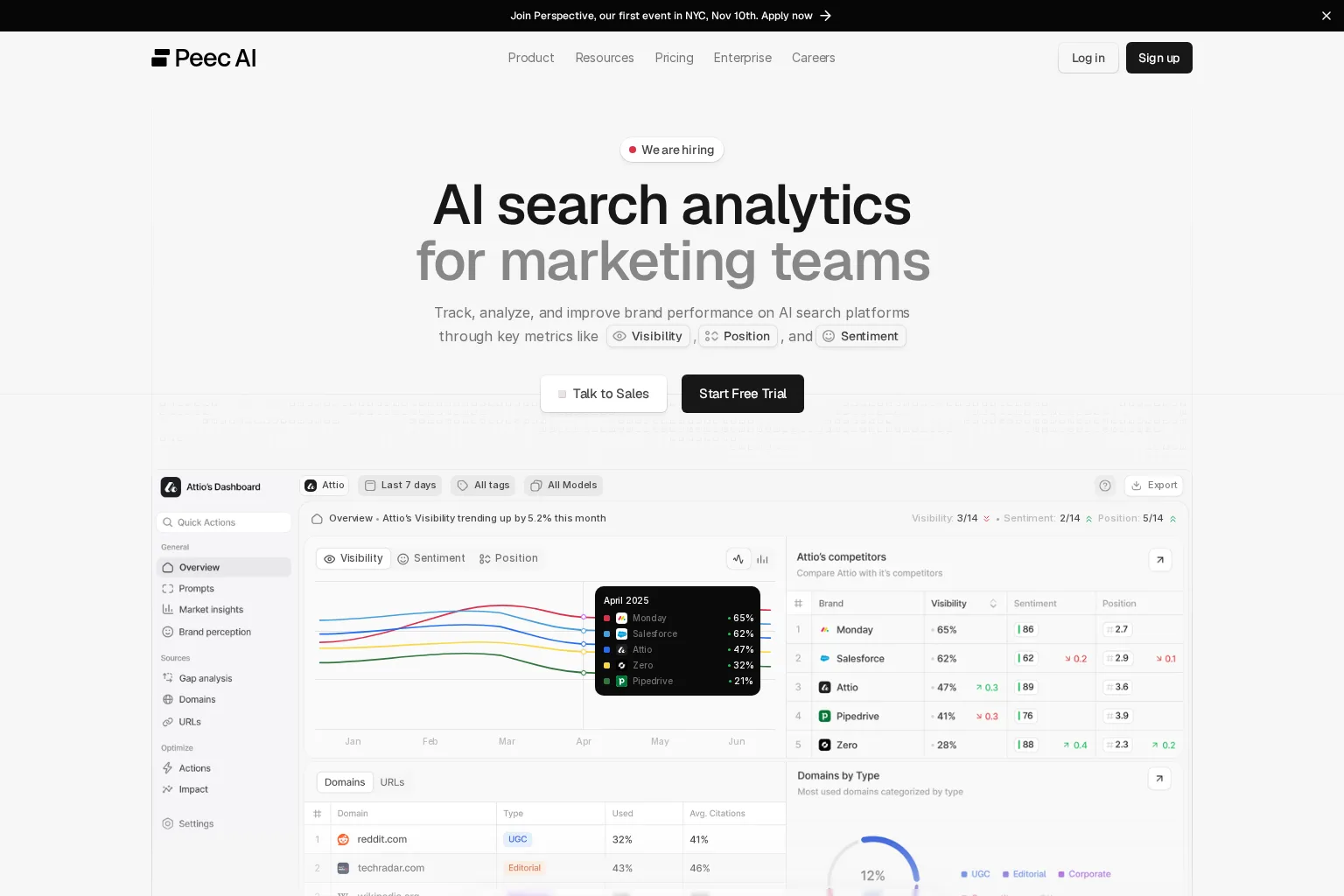
Best starting fit: Marketing teams investigating buyer questions and explaining changes through underlying answers.
Peec AI's chat documentation describes records containing the answer, platform, location, run success, mentioned brands and source information. It distinguishes cited sources from other source URLs and links placed directly in the answer. That makes it worth considering for an evidence-first pilot.
Its brand plans allocate capacity by prompts, selected models and projects. Starter lists 50 prompts, three selected models, daily tracking and one project. A platform-wide coverage list does not establish everything included in that configuration.
Choose a commercial question where you know the competitors. Open several answer records and check whether the summary reflects the text. Ask a colleague to find the same evidence without your help.
Limitation to investigate: A URL in a source view is not automatically a clickable recommendation for your business. Check Peec's definitions and verify which fields survive the export your team will use.
We would shortlist Peec when analysts need to move frequently between trends, prompts and answers. Choose it if your team can reproduce an explanation within the proposed allowances. An attractive dashboard is not enough if the reporting owner cannot find the evidence behind it.
2. Scrunch: pilot the distinction between answers and cited pages
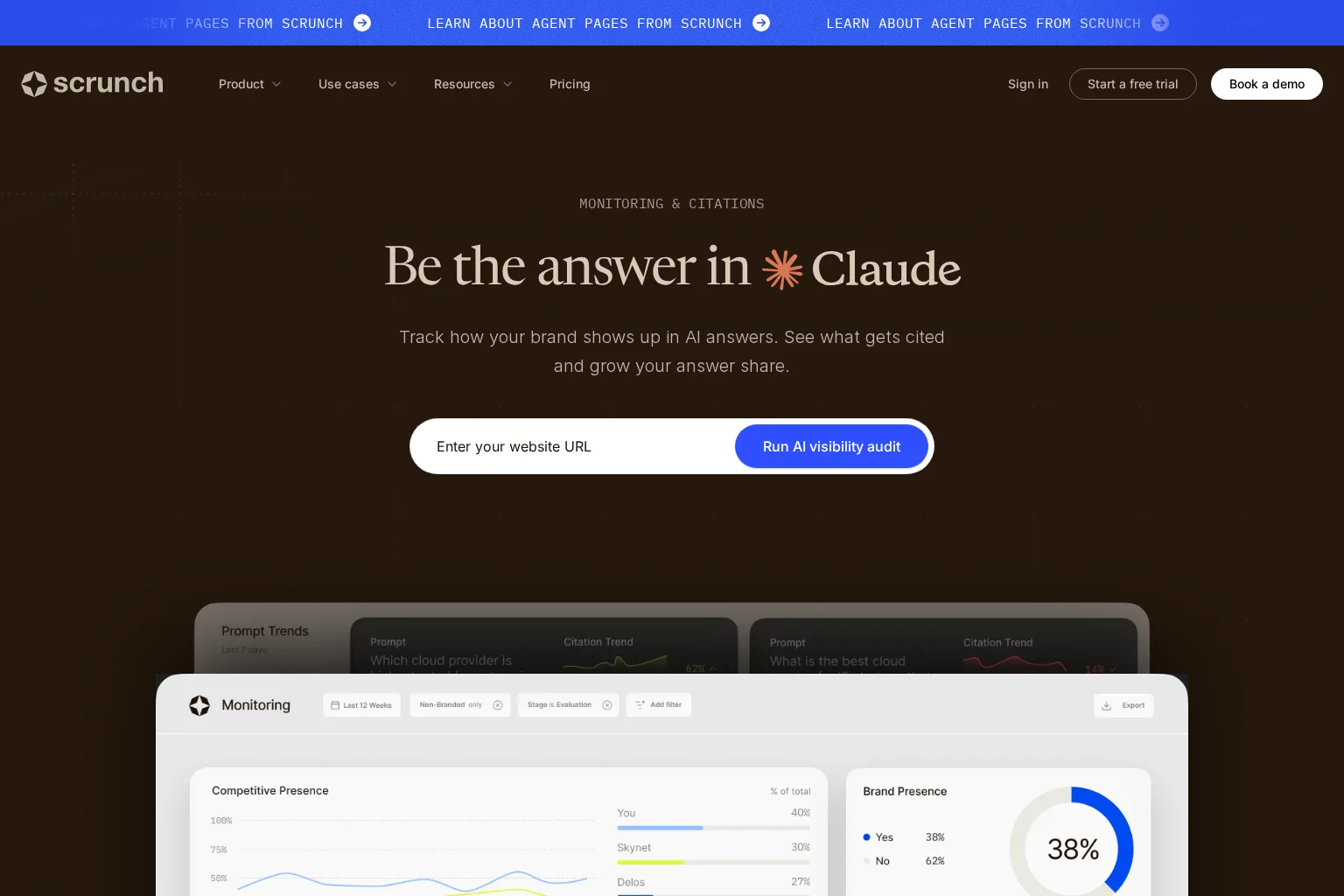
Best starting fit: Teams investigating which external pages and competitors appear around their category.
Scrunch's monitoring page describes competitive presence, trends and cited-domain and URL analysis. Its coverage documentation includes ChatGPT, Perplexity, Google AI Overviews and Google AI Mode, with availability potentially varying by subscription tier.
An important distinction appears in the Citations tab guide: citation-level presence means your brand appears on the cited page, not necessarily in the AI answer. The guide also describes grouping, ownership filters and detailed or summary exports.
Your business could appear in an independent comparison that an assistant cites without being named in the response. Calling both events an answer mention would mislead stakeholders.
Limitation to investigate: Ask for those events side by side using your prompt. Confirm that answer detection, cited-page presence and website citations remain distinguishable in exported data.
For the pilot, trace one third-party citation back to its prompts and platforms. Have your content or PR owner explain what the evidence justifies doing. Choose Scrunch if this produces a defensible task more readily than your existing process. Confirm surface coverage and export access in the proposed subscription, not just the demonstration account.
3. Profound: pilot visibility reporting alongside brand accuracy
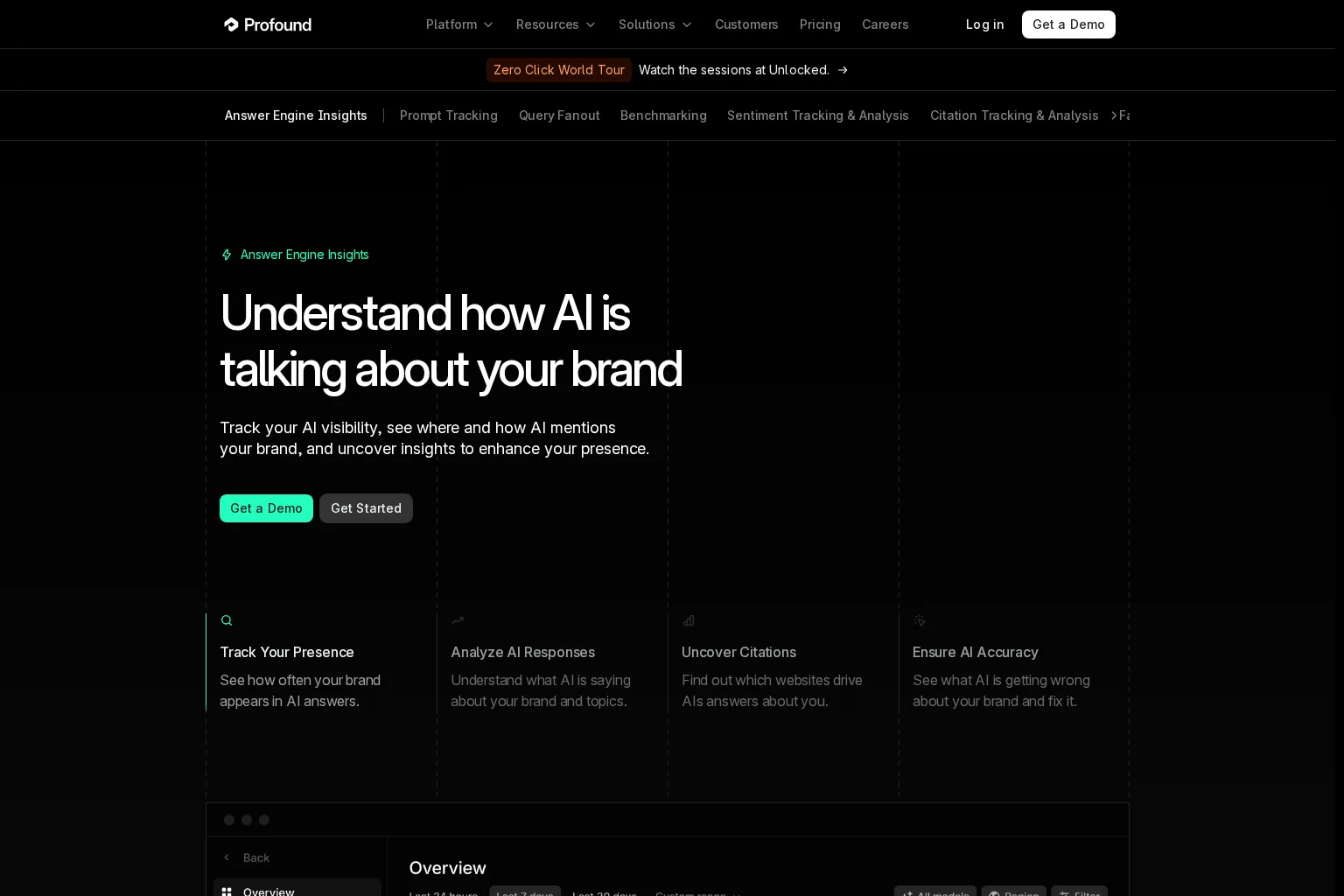
Best starting fit: Businesses reviewing whether AI mentions them and whether its descriptions are accurate.
Profound's Answer Engine Insights combines presence, citation, sentiment and competitive analysis with accuracy investigation. Its product page describes custom prompts, daily runs and browser-based collection. That does not establish that every customer receives the same answer as a monitoring run.
The trial and package page lists 50 prompts run daily for seven days across ChatGPT, Gemini and Google AI Overviews. The trial comparison lists no history, exports or API access; Enterprise lists broader data access and tailored tracking.
Limitation to investigate: A trial can demonstrate answer inspection without demonstrating your eventual reporting workflow. If downloadable evidence is mandatory, request a demonstration of the proposed paid configuration. Do not assume a trial limitation applies to every package, or that a paid feature will necessarily meet your requirements.
We would examine a factual detail, such as a supported integration, alongside discovery questions. When an answer is inaccurate, can the team identify the claim, inspect source context and record a follow-up?
Choose Profound if accuracy and visibility reviews serve real stakeholders beyond the monitoring owner. For a narrow prompt-checking requirement, establish whether the additional workflow and purchasing scope are justified.
Run the same buyer pilot in every finalist
A useful pilot produces evidence, an explanation and a decision. We recommend a seven-day initial evaluation, extending it when reporting needs require more history. This is a purchasing exercise, not a representative study of every AI conversation.
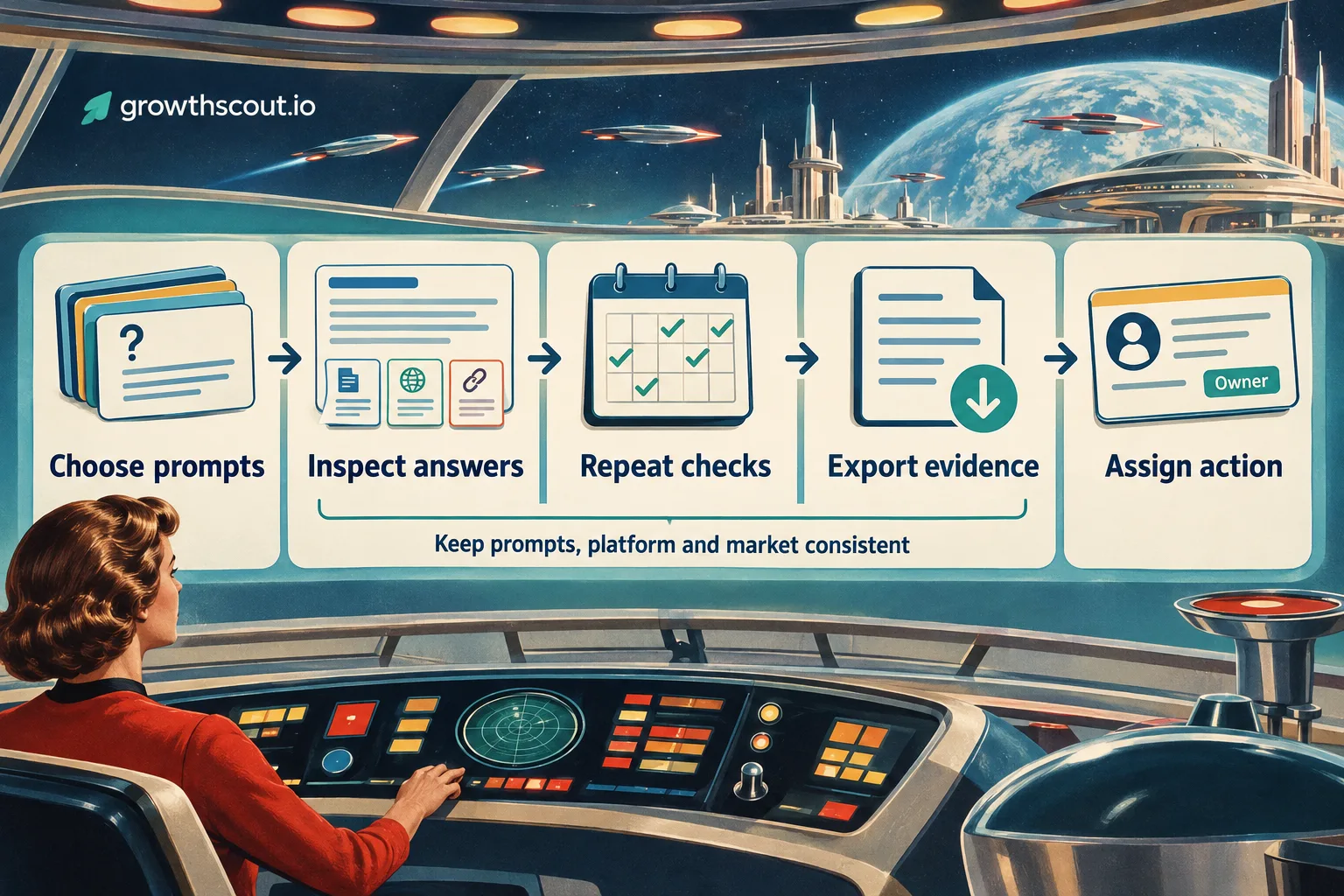
Choose questions before accepting a suggested list
Start with roughly 10 to 15 questions from sales conversations, support requests and buying decisions. Use fewer if trial allowances require it, and remove confidential customer information.
A scheduling software business serving dental practices might test:
- Which appointment systems suit independent UK dental practices?
- What scheduling options support a practice with two locations?
- What should a dental practice compare before switching booking systems?
- What should we check before migrating appointment data?
These are illustrative questions, not measured sources of AI-search demand. Replace them with customer language.
Keep branded questions separate. Asking about your company by name can assess accuracy, but should not dominate discovery measurement. Mark each question's product, audience and market. Keep baseline prompts stable and add exploratory suggestions separately, so additions do not silently change the meaning of a trend.
Inspect the evidence behind the score
Look for the exact question, platform, date, market, full answer and collection success. Check brand appearances, competitors and citation destinations. Preserve any separate indicator for your brand appearing on a third-party source page.
This is an acceptance checklist, not a claim that every product exports every field. Read examples marked present and absent. Include a common-name case if your business could be confused with another organisation. Check whether a critical or passing mention is labelled a recommendation.
Establish the answer type. Assistant responses, web-search responses, shopping results and Google AI Overviews are different observations. Google explains that AI Mode and AI Overviews can use different models and techniques, and Overviews do not trigger for every query.
Ask how absent overviews, empty source lists and failed collections are recorded. They should not disappear into one unexplained zero. A manager should understand a surprising result without requiring the analyst to reconstruct the collection process from memory.
Repeat checks without changing the experiment
Hold wording, country, language and platform selection steady. Record collection method, cadence and expected answers per prompt. Ask which settings you control.
OpenAI's search guidance explains that location and relevant saved memories can influence results. A personalised manual check is therefore a spot-check, not necessarily a replica of the vendor's environment.
Compare the same prompt group within the same platform. Annotate edited questions or changed settings instead of presenting an uninterrupted trend.
Define mention rate as valid answers mentioning your brand divided by valid answers in that cohort. Calculate website-citation rate separately.
In a hypothetical ChatGPT-only cohort, 12 questions run daily for seven days schedule 84 checks. If four fail, 40 mentions among 80 valid answers produce a 50% mention rate. Twenty answers citing your website produce a separate 25% citation rate. These outcomes can overlap.
Show failures and denominators alongside percentages. Neither figure estimates your share of all ChatGPT users or expected visits. Investigate a changed answer without announcing a permanent visibility win or loss.
Score the workflow, not the highest visibility result
Give each criterion 0 for not demonstrated, 1 for workable with manual effort, or 2 for demonstrated in your required workflow. This is our buying rubric, not an independently validated rating system.
| Criterion | Evidence needed |
|---|---|
| Coverage | Required platforms, answer types and markets are included. |
| Inspection | A colleague can locate the question, response and sources. |
| Repeatability | Runs retain settings, timestamps and failure information. |
| Clarity | Mentions, citations and cited-page presence remain distinct. |
| Reporting | The reporting route preserves sufficient evidence. |
| Actionability | A gap becomes a justified task with an owner. |
Nominate non-negotiable requirements first. Missing your main market is not offset by an attractive dashboard. A feature unavailable in a trial is unproven for your purchase, not necessarily absent from every paid plan.
Have the same analyst and stakeholder review all finalists. More mentions do not automatically mean better measurement. Assess whether records are interpretable and useful to the people doing the work.
Check reporting and commercial terms
Request the configuration you would buy. Establish whether allowances count prompts, answers, checks, platforms, locations or a combination. Confirm seats, client workspaces, exports and integrations.
Ask about history retention, downloads before cancellation and what happens when you replace a question or increase refresh frequency. Distinguish rolling monthly billing from an annual commitment displayed as a monthly equivalent.
Have the reporting owner open a sample export in their normal workflow. Can they isolate one client, market and prompt group without reconstructing missing context? Confirm shared reports do not expose another client's information.
Record time spent locating an answer, explaining a change and preparing a report. There is no universal time-saving benchmark here. Your comparison tells you whether the subscription removes work or adds another dashboard. Include these operational findings in the purchasing discussion.
Turn one finding into an approved action
If an answer names a rival and cites a third-party comparison, preserve the question, answer, page and date. A next step might be investigating that publication, correcting public product information or improving an existing explanation. It might be doing nothing because the question is commercially irrelevant.
Require an owner, supporting evidence and a review date. A missed mention alone does not prove a new article will earn inclusion.
Keep visibility beside business outcomes. Google says AI-feature appearances are included in Search Console's overall Web reporting. Review analytics and conversion records alongside monitoring evidence; do not label a visibility score as traffic or revenue.
The best tool makes this handoff clearer, at an acceptable cost and with a scope you understand.
Start with a transparent baseline
Try our free AI visibility checker if you have not inspected any answers yet. It asks three category questions once on each of the web versions of ChatGPT and Gemini. We match business details against results rather than inserting your name into the questions.
This is a snapshot, not continuous tracking. Repeat checks display the saved report; an update requires a paid plan. Anyone with the share link can view results, so enter only public business information.
Save the evidence, identify your decision and pilot recurring tools against it. Buy a workflow because your team can use it, not because a score makes the purchase seem inevitable.
Sources
- Peec AI overview
- Peec AI chat documentation
- Peec AI plans
- Scrunch monitoring
- Scrunch platform coverage
- Scrunch citation documentation
- Profound Answer Engine Insights
- Profound trial and plans
- OpenAI ChatGPT search guidance
- Google AI-feature guidance
- GrowthScout checker and limits
Recommended Reads
- 4 AI Mention Tracking Tools Compared: Mentions, Citations and What to Measure: Explore another shortlist.
- How to Perform a Content Gap Analysis That Drives Organic Growth: Prioritise worthwhile findings.
- Website Content Analysis: How to Find SEO Gaps and Improve Existing Pages: Assess existing pages before creating another.
- AI Search Visibility: What It Is, How It Works, and What Improves It: Understand the broader visibility picture.