
TL;DR
An auto SEO service can reduce the work of finding opportunities, producing articles and getting them published. It cannot replace your judgment about accuracy, site changes or whether the work brought qualified customers. We compare GrowthScout, Auto-Seo.co.uk, SEO.AI and AutoSEO using the same buying criteria. Choose the service that covers your actual bottleneck, lets you control publication and makes its remaining manual work and costs clear.
If your growth team is buying continuous SEO help, “automatic” is an incomplete specification. One service may prepare a month of drafts for your editor; another may publish pages and arrange links with little intervention. Neither arrangement tells you who checks a technical issue, approves a sensitive claim or investigates a page that loses clicks.
This comparison is for in-house growth teams and agencies evaluating an ongoing auto SEO service, not a standalone keyword tool or a general-purpose AI writer. We used the providers’ public product pages and terms, not hands-on account tests. We include our own product, GrowthScout, and apply the same questions to it. Features, allowances and commercial terms should be confirmed for your site and intended plan before purchase.
Table of contents
- What should an auto SEO service actually do?
- How we selected and compared the services
- 1. GrowthScout: best for a site-aware content pipeline
- 2. Auto-Seo.co.uk: best for a defined UK content package
- 3. SEO.AI: best for agent-led publishing with a link-network option
- 4. AutoSEO: best for evaluating a high-frequency content-and-link service
- How to choose: test one real assignment, not four sales demos
- FAQ
- Sources
- Recommended Reads
What should an auto SEO service actually do?
At minimum, ask the provider to show how it moves from site and competitor analysis to a prioritised opportunity, a usable draft and a published or approved page. Then ask what happens after publication. Keyword discovery, content planning, on-page recommendations, CMS delivery, link or mention opportunities and performance monitoring are separate jobs. A service can do some well without doing all of them.
There is an important distinction between automating tasks and running SEO unattended. Google says generative AI can help with research and structure, but creating many pages without adding value may violate its scaled-content policy. It specifically calls for manual fact-checking and review of AI-generated copy and metadata. A publishing switch does not transfer accountability for your site to the software. Read Google’s guidance on AI-generated content.
How we selected and compared the services
We selected four identifiable services with public descriptions of recurring SEO work, content creation and a route toward publication. Each has a different emphasis: a site-aware content workflow, a UK-focused publishing package, an AI agent with a link-exchange network, and a high-frequency content-and-backlink service. This is a comparison of documented scope and questions to verify, not a performance ranking or an independently tested verdict.
For each option, we look at the same five criteria: research and planning; content and review; publishing and optimisation scope; off-site work and measurement; and price, limits and commitments. If a vendor describes a technical audit, we do not assume it also fixes the site. If it promises backlinks, we ask where the links come from and who can reject them. 📌 Before you compare monthly fees, identify who owns each handoff in this framework.

| Service | Best starting fit | Approval and publishing question | Commercial detail to verify |
|---|---|---|---|
| GrowthScout | Teams coordinating site research, a content calendar and article production | Does manual review or supported scheduled delivery fit your editorial policy? | Per-website capacity and drafts |
| Auto-Seo.co.uk | UK businesses seeking regular articles, rank checks and a defined package | Does the promised approval gate apply to every publishing route? | Article, keyphrase and backlink allowances |
| SEO.AI | Teams interested in agent-led publishing and site-network links | Will drafts wait for approval, and can you inspect link placements? | Website count, billing term and VAT |
| AutoSEO | Teams considering high-frequency articles with a backlink service | Can your team inspect every article and link before release? | Written quote, business terms and content rights |
1. GrowthScout: best for a site-aware content pipeline
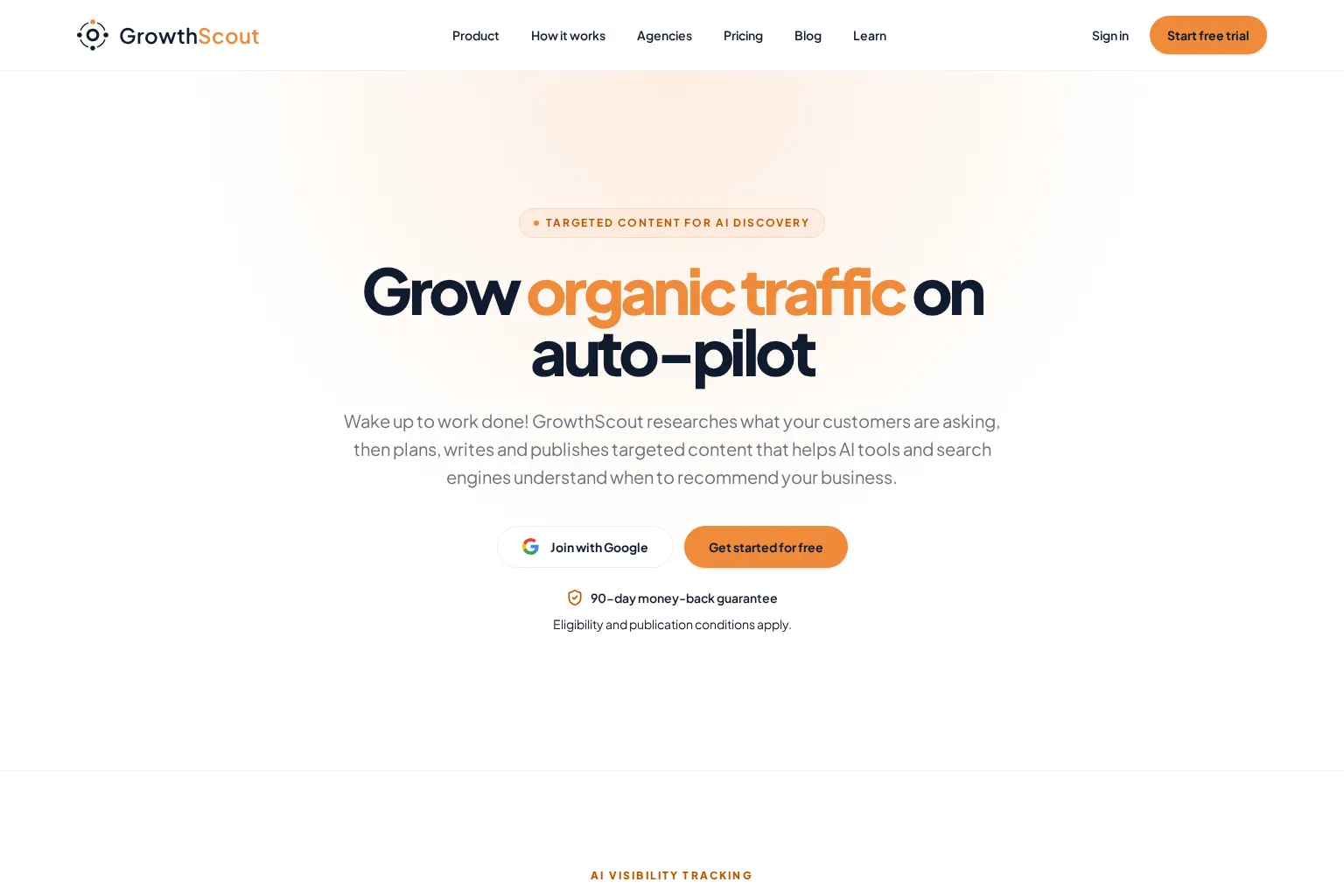
Best use case: A growth team or agency that wants research, a prioritised calendar and business-aware article drafts in one process, with a choice about when to automate publication.
GrowthScout is our product. Our product overview describes website crawling, an audit, keyword and competitor research, a 30-day plan and article drafting informed by the site’s content and stated audiences. A marketer can inspect an article’s brief and reasoning before generation, then edit the copy and imagery. Automatic publishing is optional; documented destinations are WordPress, a webhook or manual transfer. That makes the editorial decision relatively clear: keep automatic publishing off while you review every article, or enable scheduled delivery after validating the workflow.
Scope and limits: The homepage describes weekly tracking of 10 AI prompts on the paid Growth plan and organic performance measured with a connected Google Search Console account. It does not establish that GrowthScout automatically fixes technical problems, provides native keyword-rank tracking, guarantees backlinks or independently assigns every post-publication refresh. Ask to see how your team would turn a performance observation into its next decision. If several client domains are involved, verify website separation and additional capacity rather than treating one subscription as unlimited.
Pricing approach: The published offer is a 3-day trial with 3 AI article drafts, then £74 per month per website, with 31 AI article drafts per paid month on the Growth plan. The site says cancel anytime. Confirm the checkout terms and any additional-website charge before enrolling. Choose GrowthScout when context is being lost between research, planning, review and publishing, rather than when a dedicated link-building or technical-fix service is your primary purchase.
2. Auto-Seo.co.uk: best for a defined UK content package
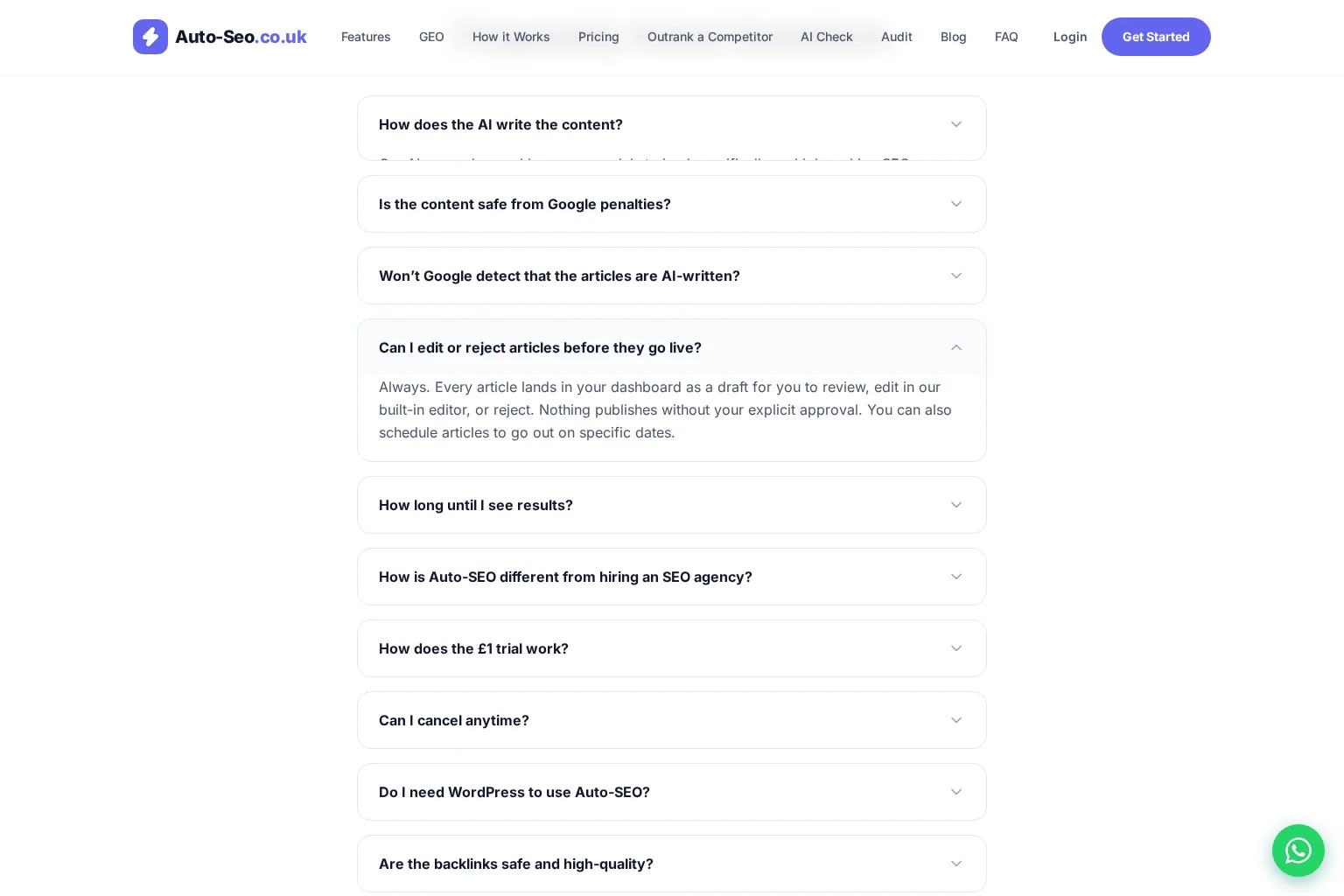
Best use case: A UK small business that wants a stated article cadence, focused keyphrases, backlinks and ranking checks in one package.
Auto-Seo.co.uk describes site and competitor analysis, an SEO plan, article production, internal linking, publishing, backlinks and a dashboard with Google ranking information. Its FAQ says every article arrives as a draft that the customer can review, edit or reject and that nothing publishes without explicit approval. Elsewhere, the same page promotes automatic weekly publishing. Ask for a demonstration of how approval works on a scheduled article and what happens if the reviewer misses a deadline; do not infer a universal hands-off publishing setting from the marketing copy.
Scope and limits: The homepage promotes a technical audit and mentions technical-issue monitoring, but it also says on-site fixes come with a separate fixed-price quote. Treat auditing and implementation as different line items. The page describes backlinks, yet a placement count alone does not establish editorial relevance or link-policy compliance. Request examples of destinations and the ability to decline a placement. For agency work, obtain a specific multi-domain quote and confirm whether reporting can be separated by client.
Pricing approach: Its published Starter plan lists £49 per month, one focused keyphrase, one article per week and two website backlinks per month; the page also offers a £1, seven-day trial and describes the regular plans as cancel-anytime. Higher tiers change the allowances, so compare the tier that matches your workload. Choose Auto-Seo.co.uk if that documented UK-focused package matches your brief and you can validate both the approval gate and the scope of technical work.
3. SEO.AI: best for agent-led publishing with a link-network option
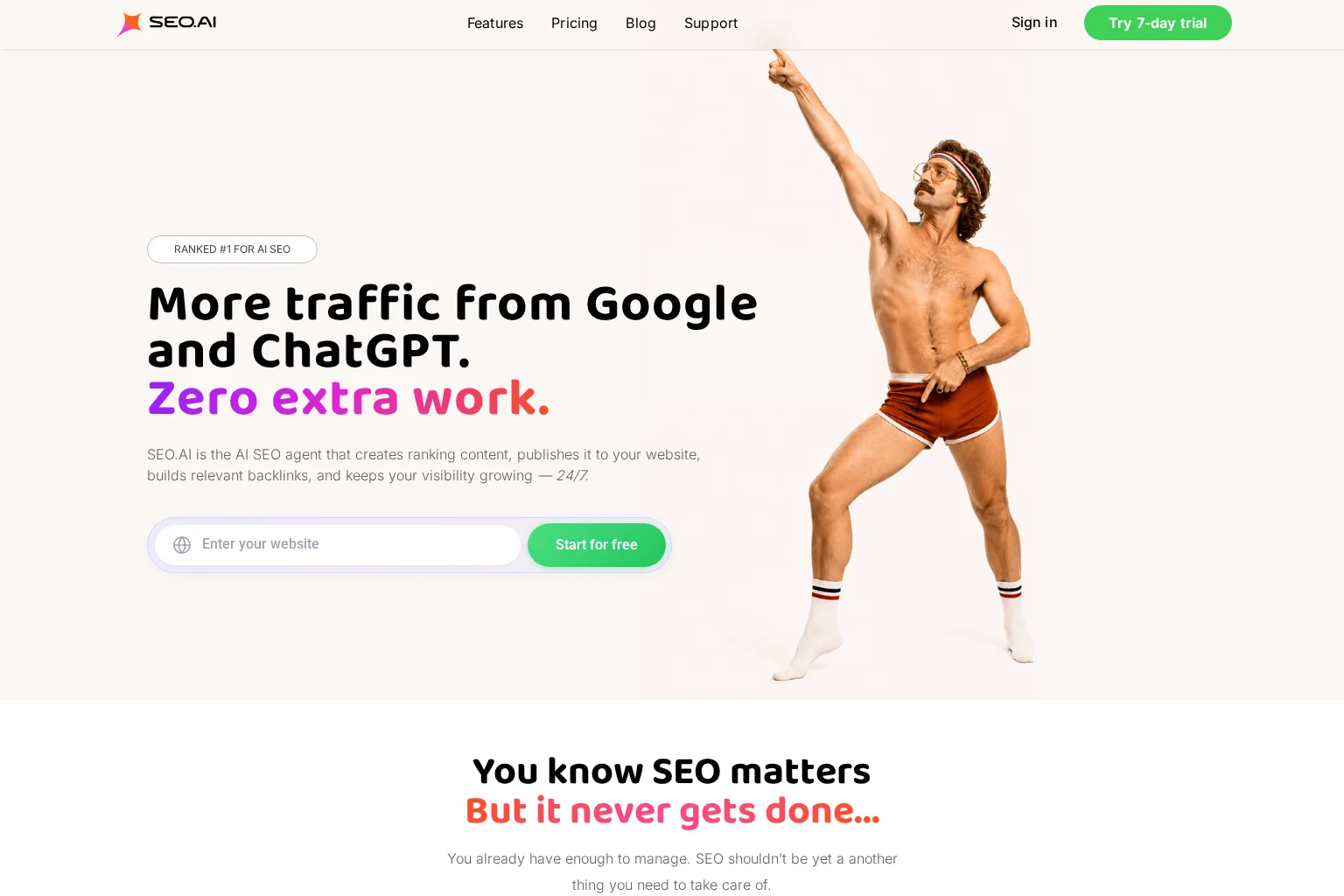
Best use case: A team willing to assess an agent that proposes and publishes search content, with the option to approve drafts and participate in a managed backlink network.
SEO.AI’s product page describes keyword discovery, ongoing page and article creation, CMS publishing, reporting and a link-exchange network. Its FAQ offers automatic publishing, drafts or in-platform review and lists several supported CMS families. That range is attractive when your team’s bottleneck is carrying content through to a live page, but test the actual draft, approval and published URL in your own CMS. A claim of broad CMS support is not a substitute for checking your content fields and permissions.
Scope and limits: SEO.AI explicitly describes exchanging backlinks through its network. Google lists excessive link exchanges and using automated programs to create links among examples of link spam. That does not establish that any particular SEO.AI placement breaches policy; it does make placement quality, editorial independence and control over outgoing links material purchasing questions. Ask for sample domains, whether participation is optional, how links are qualified when necessary, and what the service does if you reject a placement. See Google’s link-spam policy.
Pricing approach: The published pricing page lists $149 per month for one website in one language, and $299 per month for up to three websites or languages on its Multi Site display. It says prices exclude VAT, offers 25% off annual payment, and distinguishes non-binding monthly billing from annual payments binding for the paid period. Confirm the exact site count and invoice currency at checkout. Choose SEO.AI if you want agent-led delivery and are comfortable evaluating its link-network approach against your own risk policy.
4. AutoSEO: best for evaluating a high-frequency content-and-link service
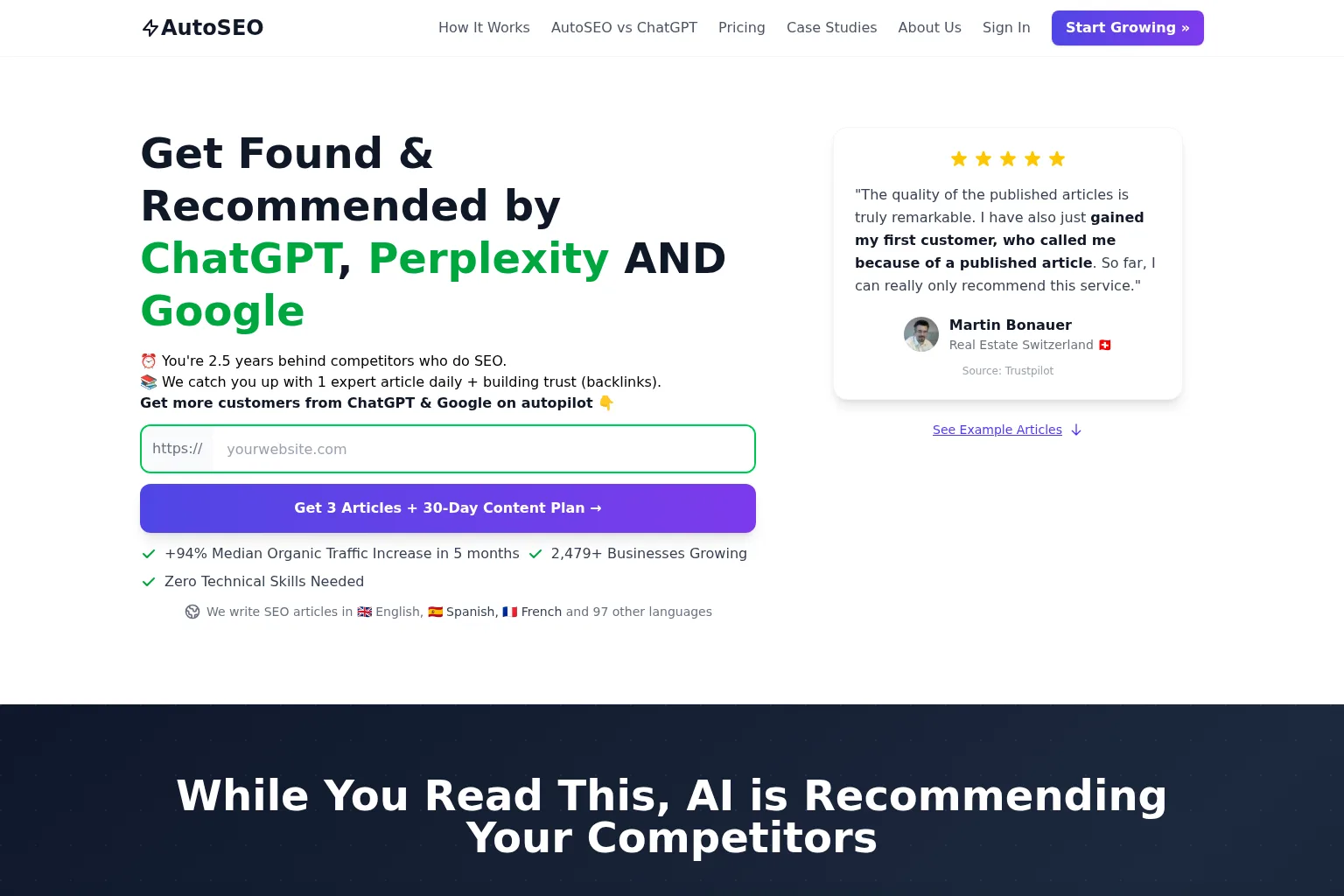
Best use case: A team considering frequent SEO articles alongside outsourced backlink activity, and prepared to review the work and contract carefully.
AutoSEO’s public site markets frequent researched articles and backlink building. Its terms identify AI-generated content, search-term research, article publishing, WordPress integration and a link-exchange network as service components. Those are tangible areas to evaluate, but the terms also place responsibility for checking AI claims and monitoring published content and links on the customer. Ask how topics are selected against your existing pages, who can approve or block an article, whether a scheduled article ever publishes without that action, and what evidence accompanies a reported backlink.
Scope and limits: The link-network terms say placement numbers, timing and location depend on availability and editorial fit, with no promised ranking or traffic result. They also describe potential negative effects from the links. Google’s link-spam guidance makes it worth asking exactly how exchanges are arranged and which sites will link out from yours. For a business purchase, check contractual terms directly: the public terms say they apply to EU consumers and that different terms may apply to business customers.
Pricing approach: Do not compare an article-frequency headline with another service’s monthly price without a written quote for publication frequency, sites, backlinks and billing. AutoSEO’s public terms describe subscription fees by plan, but they are not a verified price for your intended business arrangement. Also clarify what happens to content after cancellation or a refund: the consumer terms distinguish continued rights after cancellation without a refund from a refund that requires removal of delivered articles. Choose AutoSEO only once its editorial controls, link methods and applicable contract are acceptable to your team.
How to choose: test one real assignment, not four sales demos
Start with a single site, one target customer question and one existing page that could overlap it. Give each shortlisted service the same market, audience, CMS and two reviewers. Ask for a proposed opportunity with its evidence. If an existing page already answers the question, the service should be able to explain whether an update is better than another URL. A service that only produces a new article on request has not yet demonstrated strategic prioritisation.
Then trace the proposed work across five checkpoints:
- Research and scope: Can you inspect the target query, competitor examples, current-site coverage and rationale? Separate a technical finding from a promise that it will be fixed.
- Content and control: Who checks facts, product details, originality, links and images? Can a named editor reject the draft and prevent both immediate and scheduled publication?
- Publishing and ownership: Show the exact CMS destination, final URL, metadata and what happens on a failed delivery. Confirm content-use rights, cancellation terms and required access.
- Off-site activity: If backlinks are included, request representative live placements, source-site relevance, link qualification and a clear refusal or removal path. Do not count a link network as a guaranteed increase in authority.
- Measurement and next action: Show who reads page-level Search Console data, who investigates a change and who authorises an update. Google’s Performance report guide explains clicks, impressions, CTR and average position, with filters for page, query, country and date. None of those measures alone proves a new customer was won.
Write down the result for each checkpoint as demonstrated, documented but not tested, or not established. That prevents a polished homepage from earning credit for a feature you cannot use in your plan. Compare the total workload too: subscription, additional sites, review time, technical fixes and any outside reporting or link work. A lower headline price can be the wrong purchase if it leaves your most expensive handoff untouched.
FAQ
Is an auto SEO service the same as an SEO agency?
Not necessarily. These offers combine software automation and varying levels of human support. Ask who actually performs strategy, technical fixes, editorial review, outreach and client reporting. If those activities are outside the subscription, budget for the people or agency that will do them.
Can I leave article publishing entirely unattended?
Some services offer automatic delivery, but the ability to switch it on does not make the result accurate or useful. Google calls for fact-checking and review of AI-generated content and metadata. We recommend proving an approval and live-page inspection process before letting a recurring schedule publish for you. See Google’s AI-content guidance.
What should I measure after starting?
Begin with the pages published or improved, whether they address the intended question, and their clicks and impressions in the relevant Search Console property and market. Add your own lead or sales measures where available. Document the next action when a page changes rather than treating a ranking graph or AI mention as a business outcome. Google explains the available Search Console dimensions.
The right auto SEO service is the one your team can hold accountable for the work it claims to do. If your sticking point is moving from site-aware research to a reviewed content plan and published article, see how GrowthScout handles that workflow and put it through the same five-checkpoint test. If technical remediation or independently vetted outreach is the central need, make that the core requirement instead.
Sources
- GrowthScout product overview and published plan
- Auto-Seo.co.uk product, FAQ and plans
- SEO.AI product and FAQ
- SEO.AI plan and billing details
- AutoSEO product overview
- AutoSEO terms and service limitations
- Google Search Central: Generative AI content guidance
- Google Search Central: Spam policies
- Google Search Console: Performance report guide
Recommended Reads
- SEO Workflow Automation: Compare 4 Platforms by Their Handoffs, Not Just AI Writing for a closer look at approval and publishing handoffs.
- Multi-Client SEO: An Operating System for Managing Multiple Websites for separating client context, access and measurement.