
TL;DR
To write a clear article, choose one reader and one question, decide your central point, gather trustworthy information, and outline the answer. Draft an opening that makes a specific promise, develop connected paragraphs, and finish with a useful next action. Revise the structure and facts before correcting sentences. Below, we turn the broad topic of team communication into a short article about writing a weekly project update.
Knowing your subject is not the same as knowing what to put on the page. You might have plenty of notes but no obvious beginning, or a draft whose paragraphs make sense individually without adding up to a clear point.
We will work through those decisions using one original, fictional example. This is a practical writing exercise for a business article, not a guide to keyword placement, academic papers or news reporting. Keep your own assignment beside it and produce the same small outputs as you go.
Table of contents
- Before you begin: gather your writing inputs
- 1. Narrow the topic to one reader and one question
- 2. Decide your central point and collect supporting material
- 3. Build an outline and a headline that promise the same answer
- 4. Write an opening that gives the reader a reason to continue
- 5. Develop paragraphs and connect their ideas
- 6. Write an ending that completes the article's promise
- 7. Revise the structure, check the facts and proofread
- Put the exercise to work
- Sources
- Recommended Reads
Before you begin: gather your writing inputs
You need a document, a broad topic, an intended reader and access to information you can verify. Check the publication's requirements for length, tone, attribution and permissions. If you plan to use internal material, confirm what you may quote or describe.
Create a notes area with five fields: reader, question, central point, supporting material and exclusions. Keep a separate space for source links and unresolved questions. You do not need specialist software or a perfect headline.
The sequence below takes you from those inputs to a complete, revised article. Revision can send you back to the outline; it does not always mean polishing what you already wrote.
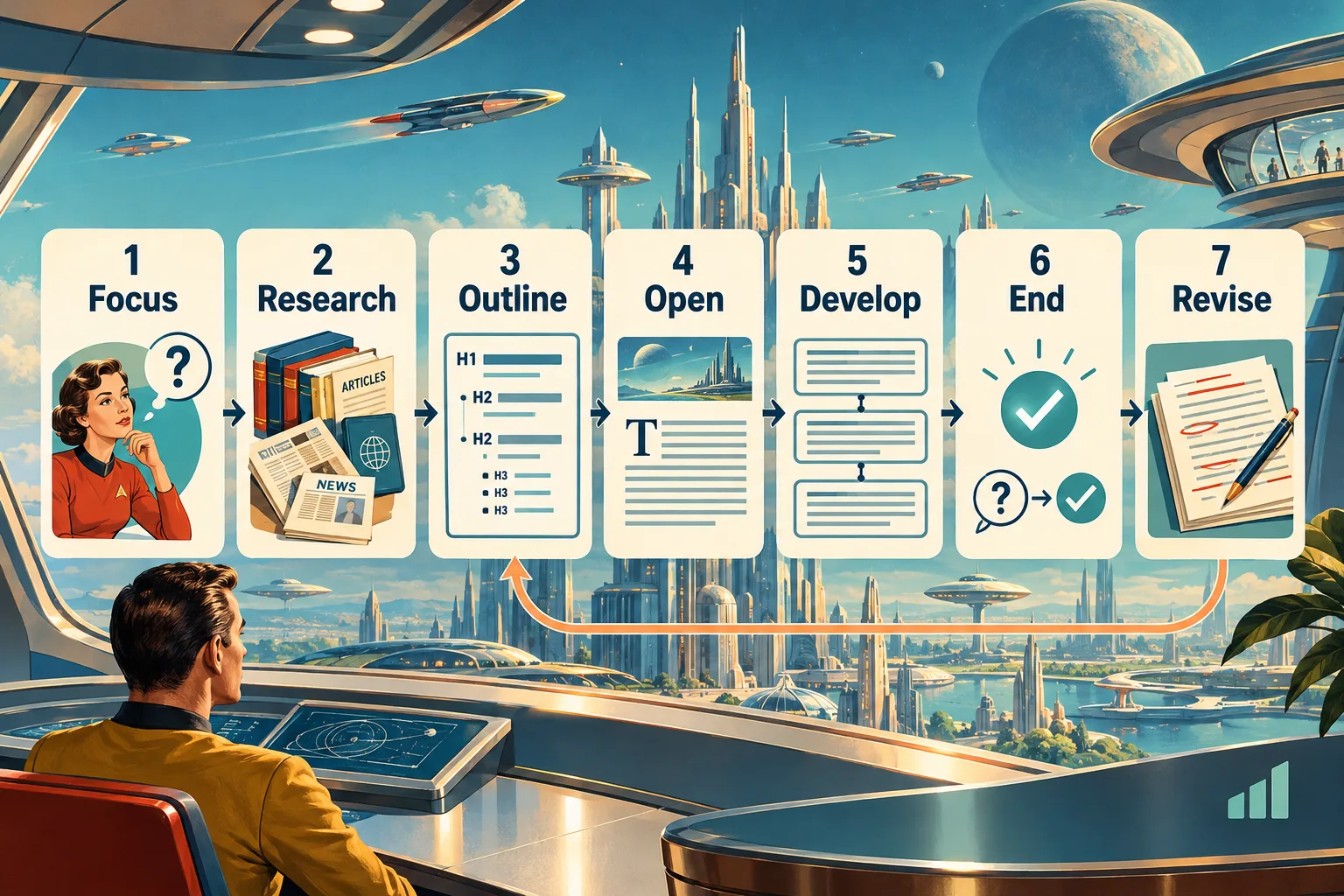
1. Narrow the topic to one reader and one question
Start by choosing whom you are helping and what they need from this particular piece. Cambridge International's article-writing guidance connects language and organisation to audience and purpose. Make those choices before trying to sound engaging.
Our broad topic is team communication. That could cover meetings, feedback, project updates or conflict. It is too wide for our exercise.
We narrow it like this:
- Reader: A marketing coordinator preparing their first weekly project update.
- Question: What should the update include so a manager knows where help is needed?
- Purpose: Help the coordinator write an update that distinguishes progress, blockers and requested decisions.
- Exclude: Choosing project-management software, running meetings and redesigning the team's reporting system.
Now write the assignment in one sentence: Help a marketing coordinator write a weekly project update that makes progress and needed decisions clear.
That sentence is the first finished output. Test yours by asking someone what the article will help them do. If their answer is broader than your intended task, narrow the question again. If the sentence joins two unrelated outcomes with “and,” you may have two articles rather than one.
2. Decide your central point and collect supporting material
A topic tells you the subject. A central point tells you what you will say about it.
For our example, the central point is: Organise a project update around what the reader needs to know or decide, rather than listing every activity. This is the editorial recommendation our sample will explain, not a claim that one format works for every organisation.
Next, identify what would let you write responsibly. For a real assignment, you might examine an approved reporting template, ask a project lead which information they require, and inspect an anonymised update with permission. If the organisation already mandates a format, explain how to use it rather than inventing a replacement.
Keep evidence attached to the statement it supports:
| Proposed statement | Material needed | Editorial decision |
|---|---|---|
| This team requires a Friday update | Confirmed reporting instructions | Include only if verified |
| A particular task is complete | Approved work or project record | Check what “complete” means |
| A reporting format saves time | Relevant measurements | Omit the claim without evidence |
For external information, read the original study, documentation or guidance where available. Check who produced it, when it applies and whether it supports your exact wording. A quotation should match the original; a paraphrase still needs attribution.
Our running example uses invented project details solely to demonstrate writing choices. It does not describe a customer or prove a productivity improvement.
You are ready to outline when you have a defensible point and enough material to explain it. If a crucial assertion remains unsupported, investigate it, qualify it or remove it before building the article around it.
3. Build an outline and a headline that promise the same answer
Arrange your supporting ideas in the order the reader needs them. Purdue OWL's outlining guide recommends grouping related ideas, establishing an order and labelling the resulting sections.
For our exercise, use the working headline “How to Write a Weekly Project Update.” It names the task without promising an entire communication strategy.
Under that headline, sketch the article's structure:
- Opening: Explain what a useful update should help its reader understand.
- Progress: Describe what changed since the previous update.
- Blockers: Explain what cannot move forward and why it matters.
- Decisions: State the response needed, its owner and any relevant deadline.
- Ending: Ask the writer to check whether the required action is visible.
Under each body heading, add one concrete detail you could use. For the blockers section, our fictional detail is an approval that must arrive before the launch date can be confirmed. That is more useful drafting material than a note saying “discuss challenges.”
The basic article format is a headline, an opening, a developed body and an ending. Those parts have different jobs; they do not need equal space or a prescribed number of paragraphs.
Read your headline and outline without the notes. Can you predict a complete answer? If two sections do the same job, combine them. If the reader would need a definition before following an instruction, move it earlier. The result should be a route through the answer, not an inventory of everything you researched.
4. Write an opening that gives the reader a reason to continue
For a practical article, try an opening that names the reader's difficulty and states the useful approach. You can draft the body first if the opening is blocking progress.
Here is a weak opening for our fictional assignment:
Communication is very important in every business. There are many different ways to communicate, and project updates are one of them.
It introduces the subject but does not move the reader towards the task. We would replace it with:
A weekly project update should help its reader see what changed, what is blocked and which decision comes next. Build it around those questions rather than a diary of everything you did.
The revised version states the point and prepares the reader for the body. It does not need an invented statistic or a dramatic story.
Underline the sentence that makes your article's promise. If you cannot find one, add it. If the opening promises an outcome the body cannot deliver, change the promise or the draft. For other approaches, our guide to beginning an article with a specific opening explores alternative first lines and transitions.
5. Develop paragraphs and connect their ideas
Now draft the body from your outline. Give each paragraph a clear job: explain a point, demonstrate it, examine an exception or move the reader to the next decision.
Purdue OWL's paragraph guidance emphasises a unified focus, coherent connections and adequate development. In practice, do not stop at an instruction such as “be specific.” Show the reader what specificity looks like.
Consider this weak passage:
Mention any blockers. Updates should be clear. The manager should know what is happening. It is also important to include next steps.
The sentences repeat broad advice without explaining what to write. Here is a developed version for our fictional project:
Name the blocker before predicting the launch date. If product approval is still pending and the launch depends on it, explain that dependency rather than calling the work “nearly finished.” The manager can then see why the date remains uncertain.
Next, turn that uncertainty into a specific request. Ask the product lead to confirm approval by the agreed deadline, and state what happens to the schedule if approval arrives later.
The first paragraph establishes a point, supplies a concrete situation and explains its significance. The second carries forward the uncertainty and shows the next action. The illustration below makes those sentence functions visible.
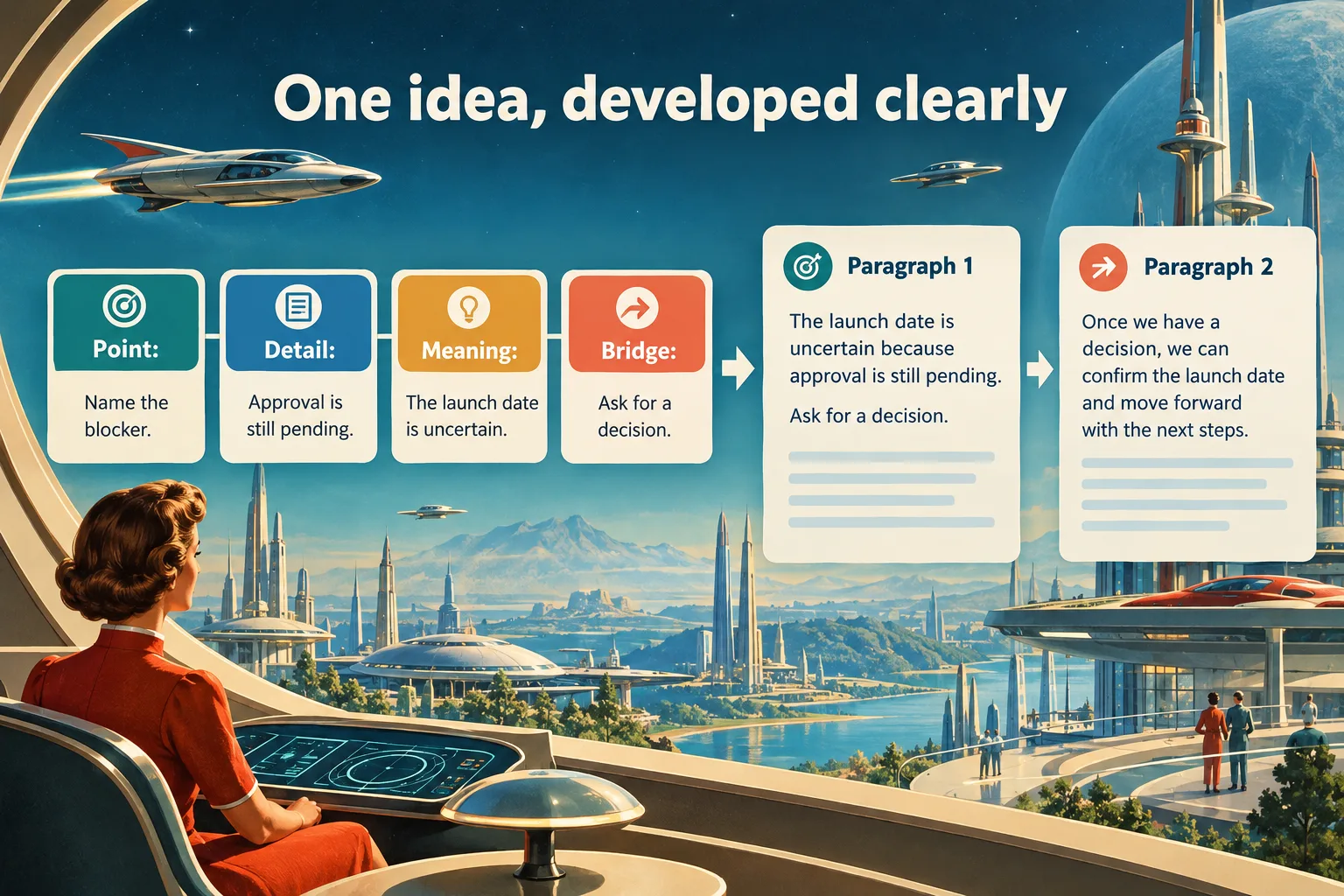
Use this as a diagnostic aid, not a compulsory four-sentence formula. A simple point may need little explanation; a difficult distinction may deserve several paragraphs. Start a new paragraph when the focus changes, and let the idea determine its length.
Make the connection real, not just verbal
Before adding “however,” “therefore” or “in addition,” decide the relationship between the ideas. Are you showing a consequence, an example, a contrast or the next step?
In our passage, “that uncertainty” refers to the unresolved launch date. The link works because the next paragraph answers the question the previous one raises. Adding “furthermore” would not repair an unrelated paragraph about choosing software.
Test the body by writing a short margin note beside each paragraph. If your note says “more about communication” twice, the paragraphs may need sharper roles. If you cannot explain why one follows another, reorder them or add the missing reasoning before polishing the transition.
6. Write an ending that completes the article's promise
Finish by resolving the original question and giving a proportionate next action. For our example, that action is to inspect an update and make its requested decision explicit. It is not to introduce a new system or repeat the entire article.
A possible ending is:
Before sending the update, highlight the sentence that asks for a response. If the reader must guess what you need, rewrite that sentence first.
If your conclusion suddenly needs a new explanation, move that explanation into the body. The ending should use what the article has already established.
The worked example, assembled
Here is our original miniature article. It is a fictional teaching sample, not an account of a real team's reporting policy. Its brevity suits the narrow exercise; a real publication may need more context or a different format.
How to Write a Weekly Project Update
A weekly project update should help its reader see what changed, what is blocked and which decision comes next. Build it around those questions rather than a diary of everything you did.
Start with the change. Describe the outcome since the previous update. “The campaign draft is ready for product review” tells the reader where the work stands. “Worked on the campaign” leaves the result unclear. Use the wording that matches the actual status, including any review still required.
Explain what cannot move forward. If the launch depends on approval that has not arrived, name that dependency. Do not describe the work as ready to launch while leaving the missing approval in a separate note. Explain what remains uncertain without inventing a new date.
Ask for the decision you need. State who should respond, what they need to decide and any agreed deadline. A request such as “Product lead: please confirm whether this draft is approved by Thursday at 3 pm” gives the reader an explicit action. Use only a deadline and owner that reflect the real project.
Before sending the update, highlight the sentence that asks for a response. If the reader must guess what you need, rewrite that sentence first.
Notice the boundaries: the headline promises one task, each section advances it, and the ending offers a check the reader can perform. The sample does not wander into software selection or claim that its format guarantees faster projects.
7. Revise the structure, check the facts and proofread
Revision asks whether the article works. Proofreading asks whether the remaining wording is correct. We recommend separating those jobs so you do not perfect a paragraph that needs to be removed.
Check the structure with a reverse outline
List the main idea of each paragraph in a separate document, in its existing order. The University of Wisconsin–Madison Writing Center's reverse-outline method uses this condensed view to inspect focus, sequence, repetition and missing development.
Our miniature article produces this outline: define the update's purpose, describe progress, explain a blocker, request a decision, and check the request. Every entry serves the headline.
If your outline reveals repeated points, combine or distinguish them. If a paragraph covers several unrelated jobs, split or narrow it. If a necessary explanation appears only at the end, move it before the reader needs it. A paragraph about reporting software would fail this exercise unless it directly helped the promised task.
Check what the article asks readers to believe
Purdue OWL's revision questions address the main point, audience, evidence, relevance, language and grammar. Apply that scrutiny to your actual draft:
- Compare figures, names, dates and quotations against the original material.
- Check that paraphrases preserve the source's meaning and limitations.
- Label hypothetical examples and obtain permission for real internal examples.
- Remove unresolved placeholders and unsupported promises.
- Ask a knowledgeable reviewer to check specialist statements when needed.
For our sample, an actual reporting policy might require a different owner or deadline. Change those details to match the evidence; do not treat the invented example as an instruction from the organisation.
Edit sentences, then read as a stranger
Replace vague references such as “this issue” when several issues could be meant. Prefer a named action over an abstract phrase: “ask the project lead to decide” is clearer than “decision-making should occur” when that is the correct owner.
Read aloud to catch awkward connections, then proofread agreement, tense, punctuation, spelling and formatting. Open your source links and check their destinations. Finally, ask someone unfamiliar with the draft to explain its point and follow one instruction. If they cannot, return to the missing explanation rather than merely shortening sentences.
Your finished result is a focused article whose opening, paragraphs and ending deliver the same promise, with important facts checked and no unresolved drafting notes.
Put the exercise to work
Choose one unfinished article and write a reverse outline before changing its wording. Find the first paragraph that does not advance the reader's question, then decide whether to develop, move or delete it. That gives your next revision a concrete starting point. ✍️
When your marketing team also needs to connect research, planning and editable drafts, explore GrowthScout's content workflow. We bring those stages together and offer review-first publishing; your editor should still check the article's evidence and final message.
Sources
- Cambridge International: Writing an Article
- Purdue OWL: Why and How to Create a Useful Outline
- Purdue OWL: On Paragraphs
- University of Wisconsin–Madison Writing Center: Creating a Reverse Outline
- Purdue OWL: Steps for Revising Your Paper
- GrowthScout: Content Planning, Drafting and Review
Recommended Reads
- How to Begin an Article: Write an Opening That Gets to the Point, for more focused work on introductions.
- 5 Blog Writing Examples: One Marketing Problem, Five Different Posts, to compare how different article formats develop an idea.
- How to Write an Article: A Review-Ready Workflow for Marketing Teams, when you need to organise review responsibilities and the publishing handoff.