
TL;DR
If you need to hire an SEO article writing service, compare the work behind the article, not just the price per post. Ladybird SEO offers a direct freelance relationship; Brafton offers a broader agency programme; Textbroker offers managed production through freelance writers. GrowthScout is a different option: software for teams willing to own editorial review while connecting research, planning, drafting and publishing. Ask every option for a sample brief, a defined review process and clarity about who measures results.
An article can look polished and still answer the wrong question, repeat unverified claims or have no useful place in your website. Buying writing therefore means buying a decision process: which topic deserves a page, what the reader needs, what the draft must prove and who owns the finished result.
This comparison is for UK marketing teams, agencies and businesses deciding whether to commission an SEO article writing service or run a more automated production workflow. We have included our own product as an explicitly labelled software alternative, not presented it as a staffed writing agency. None of these approaches guarantees search traffic or enquiries. Google's people-first content guidance emphasises original value, clear sourcing and content that helps the intended audience, rather than pages made primarily to attract search visits.
Table of contents
- How we selected and assessed these options
- 1. Ladybird SEO: direct access to a UK blog-writing specialist
- 2. Brafton: agency writing within a wider SEO programme
- 3. Textbroker: managed production for article batches
- 4. GrowthScout: software for teams that keep editorial ownership
- Questions to put in every writing brief and proposal
- Frequently asked questions
- Choose the delivery model before you choose the writer
- Sources
- Recommended Reads
How we selected and assessed these options
We chose four verifiable ways to get search-focused articles produced: a UK freelance specialist, a UK agency, a managed writing service and an in-house-led software workflow. We reviewed each provider's public service or product page on 12 October 2026. This is a comparison of documented offerings, not a hands-on quality test. Scope and prices can change; confirm a written proposal before committing.
We apply six questions to every option: research and intent (who decides what to write?), brief and expertise (how is business knowledge captured?), editorial assurance (who checks claims and AI use?), on-page delivery (who handles headings, metadata and internal links?), publishing and measurement (does the job end at a document?), and commercial fit (what is included in the quoted price?). A provider that does not publicly specify a step should be asked to demonstrate it; silence is not proof the step never happens.

| Option | Best fit | Production model | Published price approach |
|---|---|---|---|
| Ladybird SEO | A business wanting direct input from one UK specialist | Freelance, per blog | £300 per standard blog; fuller guides may cost more |
| Brafton | A team seeking writing within wider SEO strategy | Agency-led, scoped work | Tailored statement of work; typical SEO services spend stated as £2,000–£10,000 monthly |
| Textbroker | A team commissioning managed batches | Content manager plus freelance writers | Request a custom quote for managed service |
| GrowthScout | A team that can review drafts in-house | AI-assisted software, not a staffed writing service | Three-day trial with three AI article drafts; then £74/month per website for the Growth plan |
These are different scopes, so the amounts above are not a like-for-like price ranking. In particular, Brafton's figure covers its SEO services rather than a published per-article rate, and GrowthScout's fee pays for a platform, not a human writer. The providers' own Ladybird SEO service details, Brafton SEO writing page, Textbroker managed-service page and GrowthScout plan explain their stated models.
1. Ladybird SEO: direct access to a UK blog-writing specialist
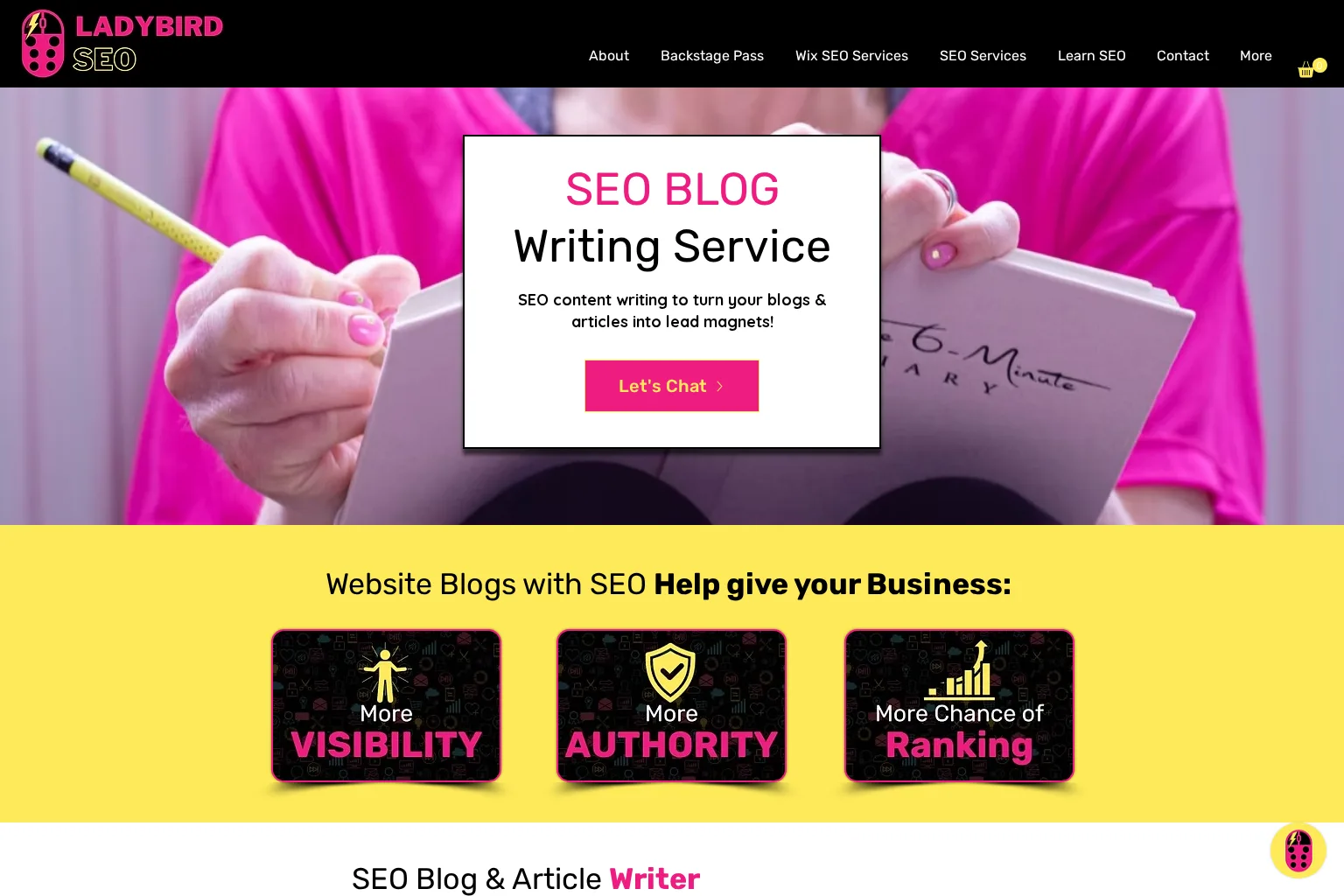
Best for: A smaller business that wants to work directly with a writer and contribute its own expertise to each article. Ladybird SEO describes an initial conversation about audience, goals and industry knowledge, followed by research and SEO blog writing. Its public price is £300 per blog, including the call, keyword research, strategy planning, initial draft, edits and final copy. More extensive guides can cost more, and it separately lists a £150 price to refresh an existing blog. Review Ladybird SEO's scope and prices.
That direct conversation is a meaningful advantage when a service business needs its terminology, objections and examples reflected in the writing. You can discuss what the article should help a prospective customer decide instead of sending a keyword list into a general production queue.
Check before buying: Ask for a sample outline and agree whether the £300 scope includes source citations, title and meta description suggestions, internal-link recommendations, imagery, upload and post-publication reporting. The service page talks about research, SEO and a final copy deliverable, but those individual handoffs are not all itemised as included in every blog. Confirm how many revision rounds and subject-matter interviews your particular article needs. If you want a monthly cluster of articles across several writers, ask how volume and continuity would be managed.
Choose this model when you value one accountable specialist and can supply access to the people who know your product. A good pilot would give the writer a real customer question plus one existing page to connect to, then assess whether the draft says something your competitors cannot.
2. Brafton: agency writing within a wider SEO programme
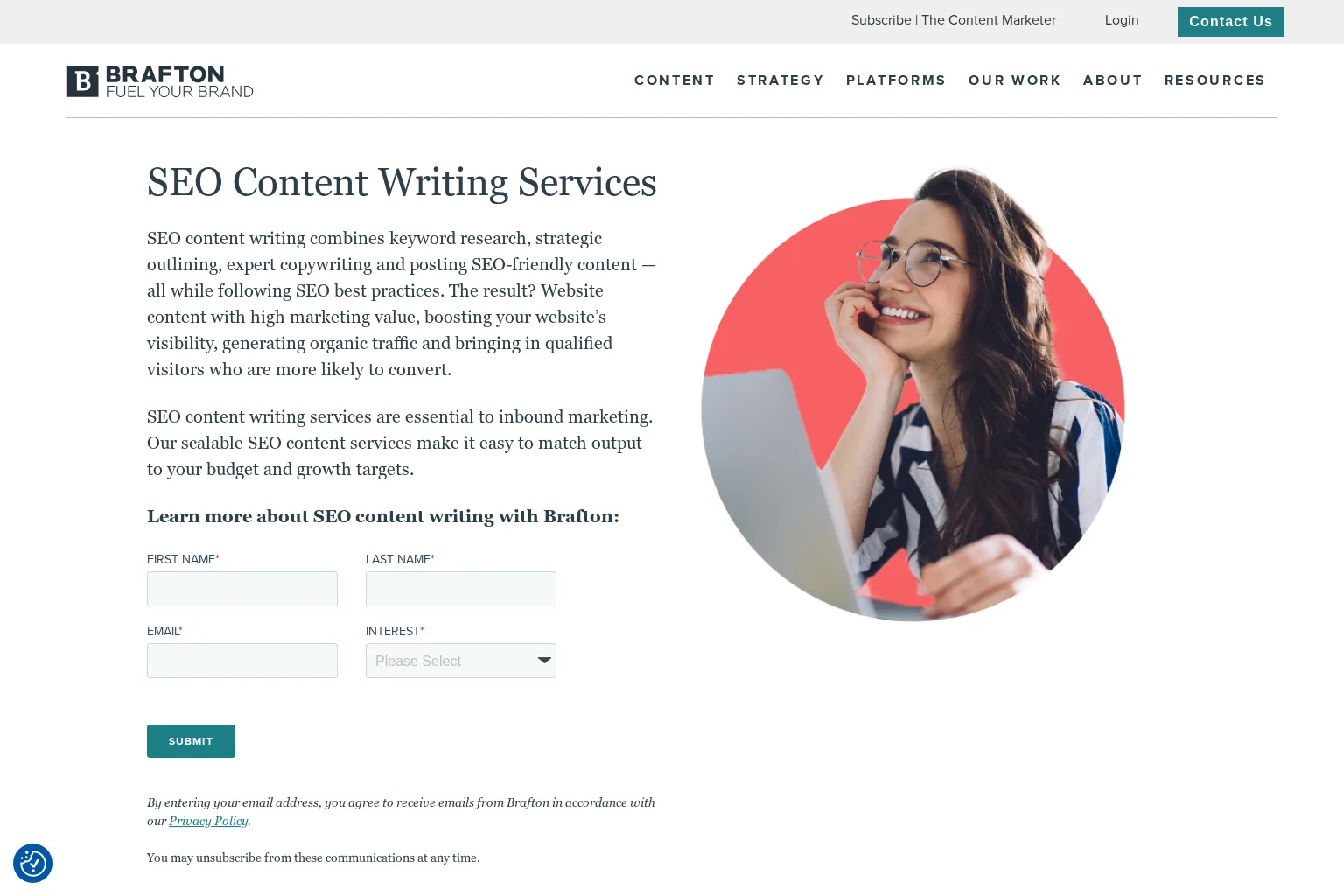
Best for: An organisation that needs content strategy, SEO expertise and production coordinated as an ongoing programme. Brafton's UK service page describes keyword research, content audits, competitor analysis, search performance briefs, writing, on-page recommendations and reporting against impressions, clicks and conversions. It also says project managers review outlines for brand alignment and topical coverage, and welcomes collaboration with in-house experts and revision rounds. See Brafton's SEO content writing offer.
This is a broader purchase than a freelancer's article. It may suit a team whose problem is not only writing capacity but also deciding which pages to prioritise and how to connect them with existing content. Brafton's stated typical client spend of £2,000–£10,000 per month is for SEO services, with each statement of work tailored; it is not a promised article-writing package or a per-blog price. Ask for the actual deliverables, approval stages and fees in your proposal.
Check before buying: Who prepares the brief, who writes, who fact-checks specialist claims and who has permission to publish? Confirm whether technical recommendations, internal links, CMS upload, performance reporting and content refreshes sit inside the same agreement or in separate workstreams. For regulated or highly technical topics, request the qualifications of the reviewer assigned to your account rather than assuming an agency-wide capability applies to every piece.
Choose Brafton when you want an external team to connect writing to strategy and measurement, and have a budget and internal stakeholder time for an agency relationship. If you already have an excellent strategy and only need a few finished articles, compare its proposed scope against a narrower commission before signing.
3. Textbroker: managed production for article batches

Best for: Teams needing a manager to coordinate multiple writing assignments. Textbroker says its managed SEO content service begins with onboarding and an approved author brief; a content manager can handle topic creation and keyword research if needed, select writers, process feedback and arrange delivery. The company describes editor review and a plagiarism check before handoff, and says direct publishing can be arranged. Its page invites buyers to request a custom quote, rather than publishing a fixed managed-service article price. Read Textbroker's process.
The distinction is coordination: you are not simply browsing individual freelancers, but using a managed process that can carry instructions across a batch. Textbroker also describes a pilot of two to five articles before a main campaign. That is a useful structure for testing whether its writer matching, briefs and revisions meet your standard before expanding volume.
Check before buying: Ask which services in the public description will actually appear in your quote. Is keyword research included or contingent on your existing plan? What original sources and expert input are expected? Who approves writer selection, checks factual accuracy and makes page-specific internal-link choices? Confirm the intended UK audience, spelling and examples for your brief; the page reviewed here is a US-domain service page, so do not assume regional editorial fit without testing it.
Choose Textbroker when production coordination and a repeatable queue matter more than a single named writer. Request a paid pilot with one straightforward topic and one specialised topic; compare not just speed but the amount of your own editing each draft requires.
4. GrowthScout: software for teams that keep editorial ownership
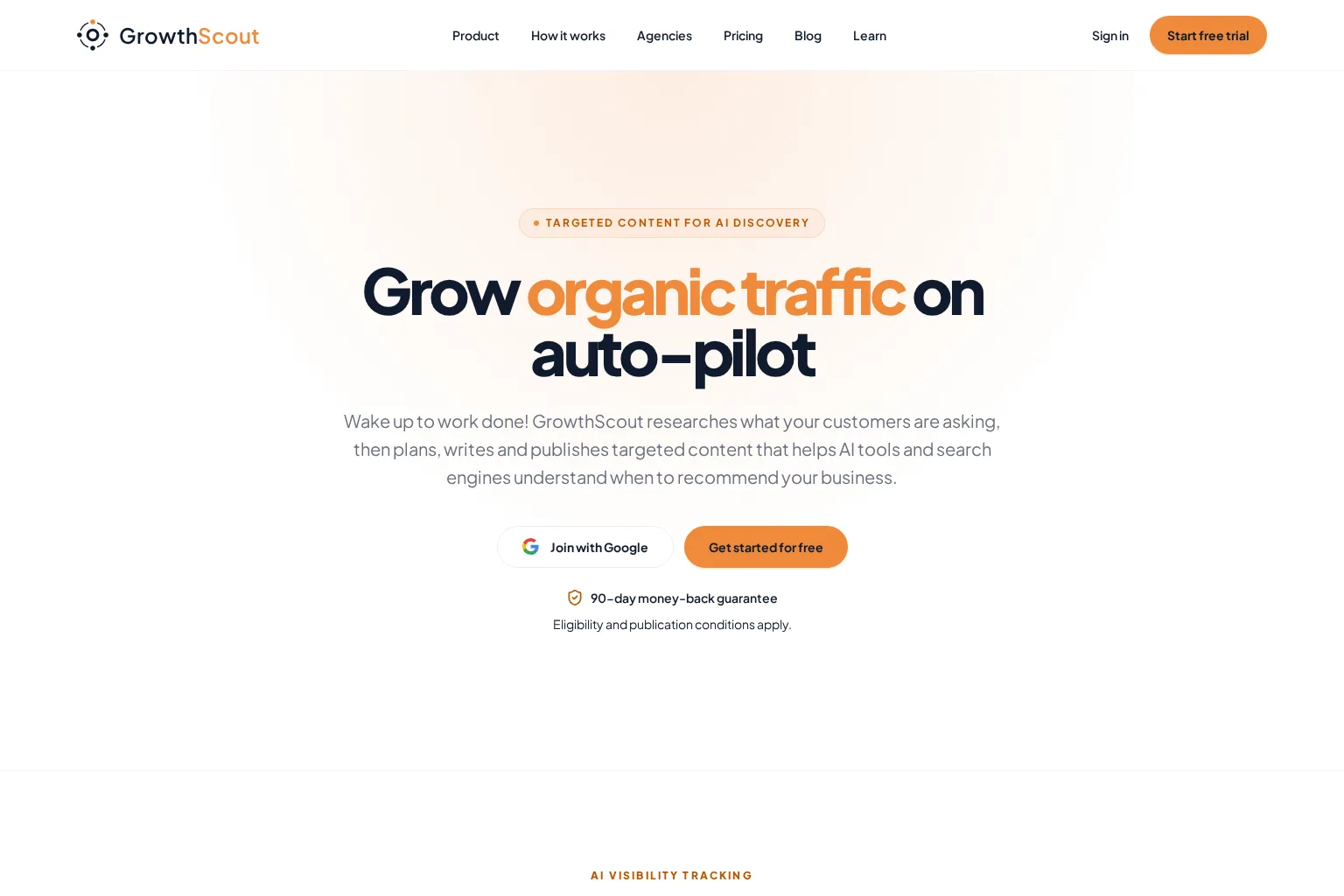
Best for: A marketing team or agency with a reviewer who wants to connect website context, opportunity selection, a 30-day plan, article drafts and publishing. We built GrowthScout's research-to-publication workflow to help teams avoid drafting isolated articles: the product describes website and competitor context, intent-led opportunity prioritisation, planned article research and an editable draft. Teams can review before publication or choose optional scheduled WordPress or webhook delivery; manual transfer remains possible.
Important distinction: GrowthScout is not a substitute for hiring a human specialist when you need interviews, original reporting, expert sign-off or somebody else to own accuracy. The website explicitly says you remain responsible for reviewing work and settings. Google's guidance on generative AI content likewise calls for manual fact-checking of AI-generated material, including metadata, before publication. A draft and a published, defensible article are different deliverables.
The public Growth plan lists a three-day trial with three AI article drafts, then £74 per month per website; the paid plan lists 31 AI article drafts per month and says you can cancel anytime. The fee covers a software workflow, not commissioned human-written articles. Check the checkout terms and whether its WordPress, webhook or manual delivery matches your CMS. See GrowthScout's current plan description.
Choose GrowthScout when your team already owns the editorial bar and needs a repeatable plan-to-draft system. If you cannot spare time for source checking or approvals, a staffed writer or agency may be the more honest choice. You can also combine the models: use a planning workflow to identify topics, then commission a specialist for pieces that require interviews or specialist judgment.
Questions to put in every writing brief and proposal
Do not let a proposal stop at “one SEO-optimised article.” We recommend asking for a sample brief that shows the proposed query, the reader's underlying decision, a short review of competing page types, the evidence needed and the article's relationship to an existing commercial page. That tests research quality before you pay for polished prose. Ask why the topic needs a new page instead of an update to one you already own.
Next, put the handoffs in writing:
- Evidence and originality: Which sources, first-hand examples or subject-matter interviews will support claims? Who checks quotations, data and statements about your business?
- AI and editorial review: If AI helps with research or drafting, what is checked by a person, and who has final approval? Google's AI guidance stresses accuracy and value, not a blanket ban on AI-assisted content. Read its publication guidance.
- On-page delivery: Will you receive a title suggestion, meta description, sensible headings, links to relevant pages and a readable CMS-ready draft? Google's link best practices favour descriptive anchor text that sets the right expectation for a reader.
- Publishing ownership: Who adds images and alt text, formats the page, checks links, schedules publication and corrects errors after it goes live?
- Reporting and rights: Who owns the finished text and source files? When will you review search visibility, relevant enquiries and what to improve? Define these terms in the contract rather than assuming a service page settles them.

A practical paid pilot gives every shortlisted provider the same audience, goal and customer question, while allowing them to propose the best angle. Compare the brief first, then the draft, then how much editorial work remains on your side. We use this five-point decision rule: Can we defend the claims? Does it say something specific to our business? Would the intended reader get an answer? Can we publish it without rebuilding it? Do we know what to measure afterward? A cheap draft that fails those checks may cost more staff time than it saves.
For measurement, distinguish a search signal from a business result. Google's Search Console Performance report lets you inspect queries, pages, clicks, impressions and click-through rate over time. Pair those with whatever on-site enquiry or conversion tracking your team actually uses. Agree on a review date and an owner for updates; do not demand a promised ranking from a writer who cannot control your entire site or the search results.
Frequently asked questions
Should I buy per article or on a monthly retainer?
Buy a tightly scoped pilot first if the relationship and editorial standard are unproven. A per-article commission makes the unit deliverable easier to inspect; a retainer can be useful when the provider also owns planning, coordinated production and regular improvement. Compare what is included, not simply the monthly total.
Is an AI writing platform the same as an SEO article writing service?
No. Software can research and prepare drafts, but you still need someone to supply business context, verify claims and approve publication. A staffed service may take on more of those steps if they are specified in its agreement. The right choice depends on which responsibility your team wants to keep.
How do I know whether an article is worth commissioning?
Ask whether it helps an identifiable reader make a decision your business can credibly support, whether an existing page already covers that need and what distinct evidence you can bring. If those answers are unclear, improve the content plan before buying another draft.
Choose the delivery model before you choose the writer
If your biggest gap is expertise, commission a specialist. If it is strategic capacity and ongoing coordination, ask an agency for a scoped programme. If it is managing a steady queue, pilot a managed service. If you already have reviewers and need a more connected production workflow, explore GrowthScout's website-aware planning and drafting before deciding how much work to keep in-house. Whichever route you choose, purchase a verifiable brief and a reviewable article, not a promise of rankings.
Sources
- Google Search Central: Creating helpful, reliable, people-first content
- Google Search Central: Guidance on generative AI content
- Google Search Central: Link best practices
- Google Search Console Help: Performance report
- Ladybird SEO: SEO blog writing service
- Brafton UK: SEO content writing services
- Textbroker: SEO content writing services
- GrowthScout: Product workflow and pricing
Recommended Reads
- SEO Article Writing: A Step-by-Step Process for Marketing Teams, for teams building their own review process.
- How to Build an SEO Content Strategy That Drives Sustainable Organic Growth, for deciding which articles belong in the plan.
- 4 SEO Publishing Automation Tools for Review-First Content Workflows, for comparing publishing handoffs after the writing decision.