
TL;DR
The right SEO article writing service depends on which work your team wants to hand off. Zenith Copy suits teams seeking a named specialist writer; Textbroker offers managed production across a freelance pool; Siege Media sells a wider content marketing programme; and GrowthScout is software for teams willing to retain editorial responsibility. Compare the full cost of research, expertise, revisions, publishing and internal review, not just the price of a draft.
Buying articles is easy to describe and surprisingly hard to scope. A draft may arrive ready for a CMS, or it may still need evidence checks, brand edits, internal links, imagery and a person to decide whether it should have been written at all. Those differences matter more as publishing volume grows.
This guide is for marketing teams and agencies comparing SEO article writing services against an in-house, software-assisted workflow. We include our own product and identify it as software, not a staffed writing service. Our assessment uses public provider information available on 13 October 2026, not hands-on tests or guarantees of results. Google's people-first content guidance asks whether content offers original value, clear sourcing and a satisfying answer for its intended audience. Those are useful standards to apply to any provider.
Table of contents
- How we selected and compared the options
- 1. Zenith Copy: specialist-led SEO writing for SaaS teams
- 2. Textbroker: managed freelance production for repeatable batches
- 3. Siege Media: an agency programme for strategy and production
- 4. GrowthScout: software when your team keeps the editorial job
- Compare the total cost of an approved article
- Frequently asked questions
- Choose the work you need to buy
- Sources
- Recommended Reads
How we selected and compared the options
We chose four documented approaches that solve different production problems: a specialist independent writer, a managed pool of freelance writers, a full-service content agency and a planning-to-publishing platform. We assessed each on the same six questions: who researches the topic, who supplies expertise, who checks the draft, what SEO handoffs are included, who publishes, and what the commercial commitment covers. If a detail is not specified on a public page, we flag it for the buyer to confirm instead of assuming it is included.
A self-service freelance marketplace is another route: you choose and contract with an individual writer, then generally have to establish the brief and quality process yourself. Textbroker's managed freelancer model below is not the same purchase as hiring directly from a marketplace. Decide whether you want to select and manage writers yourself or pay for coordination before comparing quotes.

| Option | Best fit | What you buy | Public pricing approach |
|---|---|---|---|
| Zenith Copy | Specialist input for a focused SaaS article or cluster | A writer-led brief and article | Blog content writing from $985, minimum 1,500 words |
| Textbroker | Coordinated batches with an external content manager | Managed freelancer production | Custom quote for the managed service |
| Siege Media | Broader strategy, design and content production | An ongoing agency programme | $8,000/month minimum; 12-month contract with a 30-day out clause |
| GrowthScout | A repeatable in-house-led content pipeline | Research, planning, drafting and publishing software | Three-day trial with three AI article drafts, then £74/month per website for Growth |
These prices are not directly comparable: they represent a starting article scope, a quote, an agency minimum and a software subscription in two currencies. Details below come from the providers' Zenith Copy service page, Textbroker service page, Siege Media service page and GrowthScout product page. Confirm the current quote and terms before committing.
1. Zenith Copy: specialist-led SEO writing for SaaS teams

Best use case: A marketing team that wants to work with a named SEO writer on a small number of substantial pieces and can contribute its product knowledge. Zenith Copy's blog writing service describes a discovery call, keyword research where needed, approval of detailed briefs, on-page optimisation, relevant links and WordPress upload. It lists one round of revisions per piece. This is an unusually explicit workflow for a buyer trying to distinguish a finished article from a document delivered by email.
The public blog-writing offer starts at $985 for a minimum 1,500-word piece and includes keyword research, a detailed brief, link recommendations, on-page optimisation and professional editing. Its separate topic-cluster package starts at $3,500 and covers at least ten briefs, not ten finished articles. Check which scope you actually need. A lower-volume team may value a direct writer relationship more than an elaborate production queue; a team with daily publishing targets should ask how capacity and deadlines would work in practice.
Where your team still participates: Provide access to product experts, examples that competitors cannot copy, and approval of the brief. Confirm whether source verification, image selection, metadata, WordPress permissions and any additional revision rounds are included in your proposal. The page describes a process, not an unconditional promise that every optional step is included in every engagement. If UK-specific examples or spelling matter, put them in the brief rather than assuming a writer will infer them.
2. Textbroker: managed freelance production for repeatable batches

Best use case: A team with a pipeline of articles that wants somebody outside the business to coordinate briefing, writer assignment and editorial handoffs. Textbroker's managed SEO writing page describes onboarding with a content manager, an author brief that the client approves, writer selection, feedback handling, editor review and a plagiarism check. Topic creation and keyword research are described as available if needed. Textbroker says it often runs a two-to-five-article pilot before a larger campaign and can arrange direct publishing if requested.
That pilot matters because coordination is the thing being purchased. Test whether the manager can preserve the same brand context across different writers and whether specialist topics receive appropriate expertise. A freelancer marketplace may provide more direct control over whom you hire; a managed service can take on more administration, but only the contracted scope tells you how much. For UK readers, ask to see an article written to UK conventions before scaling a US-domain service arrangement.
Pricing and limits: The page asks buyers to request a custom quote for the managed service, so there is no reliable public per-article figure to put against Zenith Copy's starting rate. Ask for the number and length of drafts, research responsibilities, revision rounds, any minimum batch, direct-publishing fees and who checks factual claims. Textbroker describes editorial and plagiarism checks, but neither replaces a knowledgeable reviewer who can verify your company's own assertions. Choose this model when the management of a repeatable queue is worth paying for.
3. Siege Media: an agency programme for strategy and production

Best use case: A team buying a content marketing programme, not simply a few blog posts. Siege Media's content marketing service describes content strategy, writing, design, subject-matter editorial review, distribution and SEO recommendations. Its FAQ says it uses AI for some supporting tasks, while human contributors do the creative work. That broader remit can be attractive when the bottleneck is deciding which assets to produce and how to differentiate them, rather than merely adding writing capacity.
Siege states a $8,000 per month content-marketing minimum, asks for a 12-month contract and says its contracts include a 30-day out clause. It prices programmes using monthly content units rather than a fixed blog-post price. Do not divide the minimum by an assumed article quota. Instead, request a sample monthly plan: how many assets, which formats, what design work, what editing and which distribution activities would your actual budget buy?
A wider programme also has more dependencies. Ask who obtains access to subject-matter experts, who approves research and designs, whether articles will be uploaded to your CMS, and how progress will be reported. A small team needing two carefully briefed articles may find an agency programme broader than necessary. A mature team that needs research, design and distribution as well as writing may find the extra scope worthwhile, subject to its proposal.
4. GrowthScout: software when your team keeps the editorial job
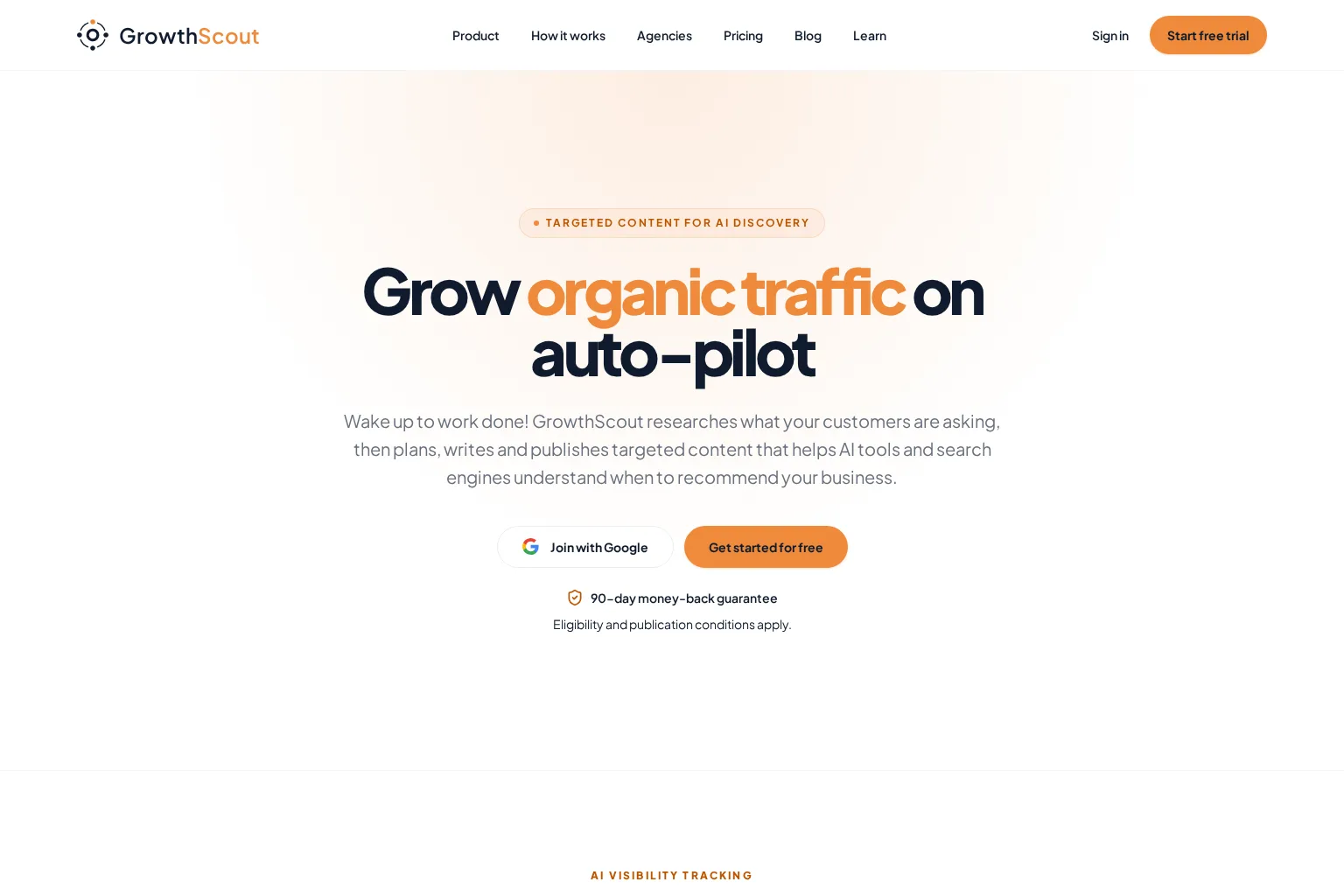
Best use case: A team with an editor or subject-matter reviewer that wants one workflow for finding opportunities, planning articles and moving approved content toward publication. We built GrowthScout around website context, a 30-day content plan, competitor research for planned articles, editable AI drafts and optional WordPress or webhook delivery. You can keep automatic publishing off and review articles first. Agencies can keep each added client's knowledge, goals and settings separate, while additional website capacity is purchased separately at a price shown in the in-app checkout.
The public Growth offer is a three-day trial with three AI article drafts, followed by £74 per month per website; the paid plan lists 31 AI article drafts per month. The subscription is for software and its workflow, not for human-written or fact-checked articles. A website may also need a separate staff budget for briefing, expert interviews, editing, image review and final sign-off. For an agency, do not assume that one website subscription covers every client.
Our limitation is straightforward: automation cannot interview your customers or take legal, technical or brand accountability for you. Google's guidance on generative AI content says AI-assisted content needs manual fact-checking and review, including metadata. Start with draft review, test that your CMS receives the fields you need, and turn on scheduled delivery only if your editorial process supports it. Choose software when your team has the expertise to own quality but needs a more dependable production system.
Compare the total cost of an approved article
A quoted writing fee is only one component. To compare providers fairly, write down the same scope for all four: target audience, article purpose, approximate complexity, interview or research needs, source standard, number of revision rounds, meta title and description, internal-link plan, images, CMS formatting and publication. Record whether each task is included, assigned to your team or separately charged.
Then calculate effective cost per approved, published article as provider fees plus internal hours and any other scoped costs, divided by articles that pass review and go live. This is a planning calculation, not an industry benchmark. A draft requiring six hours of rewriting is a different purchase from a ready-to-review article with a sound brief. At higher volumes, also account for capacity limits and the time a senior reviewer can realistically spend on each piece. Do not compare monthly retainers with per-article fees until you know what each retainer actually delivers.
💡 Run one controlled pilot: Give shortlisted providers the same customer question, audience, relevant product facts and existing website pages. Ask for the brief before the draft. Evaluate whether it identifies the reader's intent, inspects competing page formats without copying them, shows where original insight is needed and proposes a natural link to an existing page. If your team wants a more detailed brief-building method, see our SEO article writing process for marketing teams.
A simple scorecard is more useful than a vague impression of polish:
- Research: Does the proposed topic belong on a new article rather than an existing page update? Does the brief address the actual reader decision?
- Evidence: Can an editor verify factual claims and see what original expertise, examples or interviews will be added?
- Editorial fit: Does the draft match your brand voice and industry, and how much rewriting remains after the included revisions?
- Delivery: Are metadata, links, imagery, CMS formatting and publication assigned to named owners?
- Commercial fit: What is the minimum commitment, what is excluded, and how many articles can your team approve without creating a bottleneck?
Reject an apparently cheap offer if it leaves the most expensive decisions to a colleague who has no time to make them. Equally, do not buy an agency programme when a named specialist and a strong internal brief would solve your actual problem.
Frequently asked questions
Is an SEO article writing service the same as an AI content platform?
No. A staffed writing service can provide a writer, editor or content manager according to its agreed scope. A platform supplies software for research, drafting or publishing, while your team retains responsibility for expertise and sign-off. Some teams combine them: use a planning workflow to identify a topic, then commission a specialist for reporting or expert-led writing.
What should I ask about revisions and ownership?
Request the number of included revision rounds, what qualifies as a revision versus a new brief, who owns the finished copy and source materials, and whether the provider will correct factual errors after publication. Ask for these terms in the proposal, not just in a sales conversation.
Should we commission articles before we have a content plan?
Usually, decide the audience, the pages you already have and the commercial next step first. Otherwise, even a strong writer may produce an article with nowhere useful to lead. Our guide to an SEO content strategy explains how to connect content decisions to existing pages and business goals.
Choose the work you need to buy
If you need specialist judgment, speak to a named writer. If you need a coordinated queue, pilot a managed service. If you need strategy, design and distribution together, get a scoped agency proposal. If you already own editorial quality and need continuity from research through publishing, explore GrowthScout's planning and drafting workflow and keep review enabled until you trust your process. In every case, judge the resulting brief and published article, not a promise that a keyword will rank.
Sources
- Google Search Central: Creating helpful, reliable, people-first content
- Google Search Central: Guidance on using generative AI content
- Zenith Copy: SEO blog writing service and published prices
- Textbroker: Managed SEO content writing services
- Siege Media: Content marketing services and FAQ
- GrowthScout: Product workflow and Growth plan
- GrowthScout for agencies: Multi-website workflow and additional capacity
Recommended Reads
- SEO Article Writing: A Step-by-Step Process for Marketing Teams, for defining the writing and review workflow behind a pilot.
- How to Build an SEO Content Strategy That Drives Sustainable Organic Growth, for choosing which articles deserve a place in your plan.
- 4 SEO Publishing Automation Tools for Review-First Content Workflows, for comparing delivery and approval options after choosing a writing model.