
TL;DR
Comparing SEO Birmingham services? Start with the work you need, not ranking promises. Our non-ranked shortlist covers Chris Shaw for Shopify consultancy, Mega SEO for package-based work, MFF Marketing for technical SEO and content strategy, and Syama Digital for local-search work. These are documented service differences, not independently verified performance verdicts. Give finalists the same brief, compare responsibilities and commitments, and request relevant client evidence before signing.
A Birmingham retailer, a service-area trades business and a national ecommerce company need different proposals. A provider can sound convincing while quoting for work that does not address your problem. We compare four services below, then show how to assess their proposals without declaring a universal winner.
Table of contents
- How we selected and compared these services
- Define your Birmingham SEO brief first
- 1. Chris Shaw: Shopify consultancy with remote delivery
- 2. Mega SEO: published packages with commitment details to check
- 3. MFF Marketing: technical SEO and content strategy
- 4. Syama Digital: an outlined local-search scope
- Compare proposals by work, evidence and ownership
- Compare commitments, not just monthly prices
- Require reporting that leads to decisions
- FAQ
- Choose the right responsibility to outsource
- Sources
- Recommended Reads
How we selected and compared these services
This guide is for Birmingham businesses and UK marketing teams buying external SEO support. We selected providers with accessible official pages explicitly marketing SEO to Birmingham, covering local-search, technical, package-based and Shopify-focused work. Entries are alphabetical, not ranked. Inclusion does not establish a Birmingham office or verified client results.
We reviewed the service pages on 7 November 2026. We have not commissioned campaigns, tested service quality or independently audited case studies. Screenshots illustrate advertised offers, not outcomes.
Our shared criteria are business fit, technical and content scope, local or off-site work, evidence and reporting, pricing approach, and responsibilities to confirm. A missing detail on a reviewed page is a question for the provider, not proof that it cannot deliver that service.
Define your Birmingham SEO brief first
Write one primary goal: qualified enquiries for a service, better visibility around a branch, or sales from an ecommerce category. Specify the locations you serve and the pages that matter commercially.
For local businesses, distinguish Google Maps visibility from website search performance. Google explains that local results depend mainly on relevance, distance and prominence. One citywide ranking screenshot should not represent your entire service area. Read Google's local-ranking guidance.
Prepare a page inventory, current measurement access, known website problems and available approval time. Our website content analysis guide explains how to turn existing pages into improvement decisions.

📌 Illustrative brief: A Harborne electrician wants more commercial inspection enquiries. Ask finalists which existing page needs attention, how they would assess nearby visibility, what they would change first and who would implement it. Do not start by ordering blog posts.
1. Chris Shaw: Shopify consultancy with remote delivery
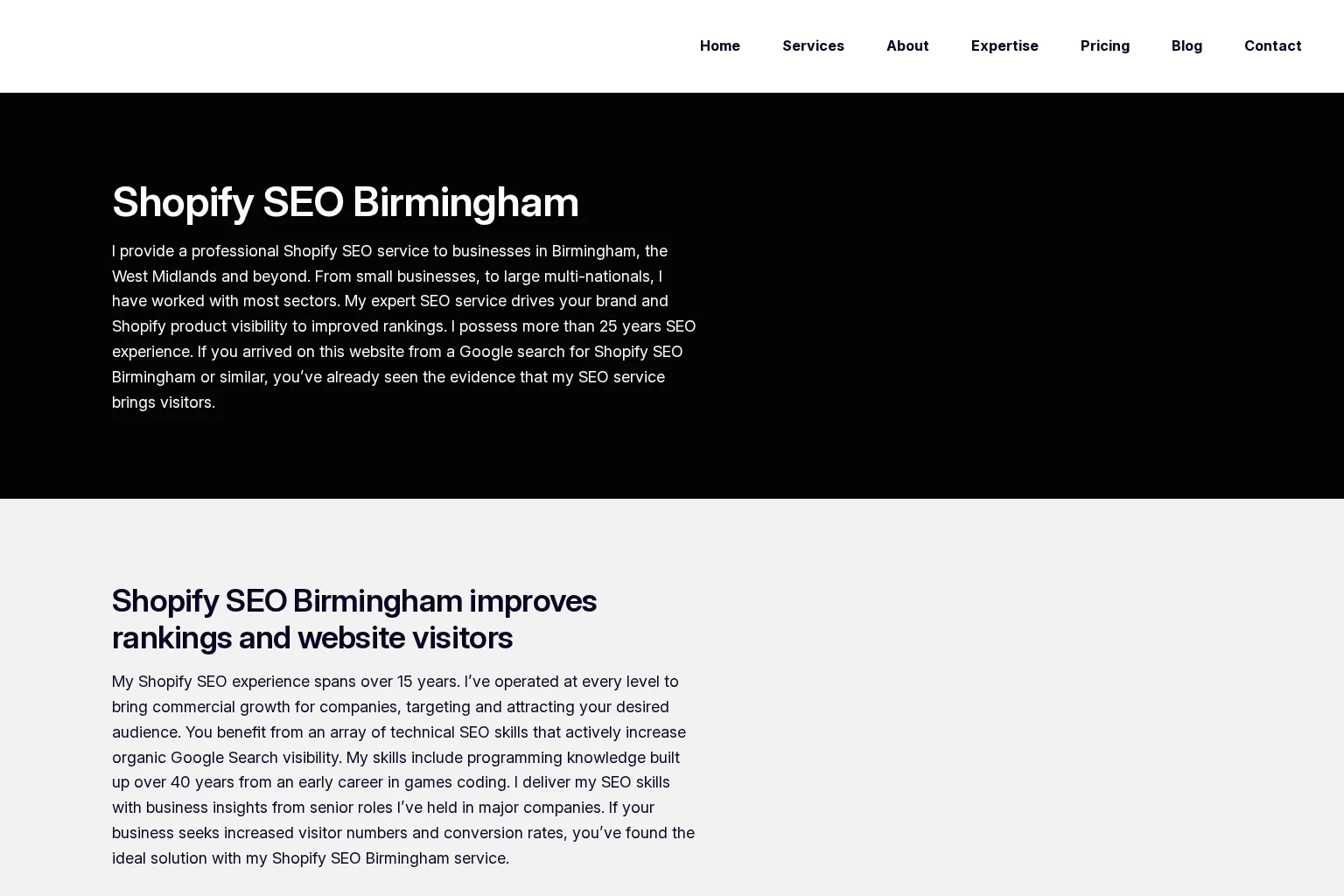
Potential fit: A Birmingham Shopify business wanting direct access to a specialist consultant rather than a general local-marketing package.
Chris Shaw's Shopify SEO Birmingham service describes remote delivery to Birmingham and the West Midlands. It covers technical expertise, product visibility, competitor investigation and optional conversion rate optimisation. The page also describes direct communication, regular video meetings and reports covering recommendations, scheduled tasks and completed work.
Pricing approach: A written quotation and fixed monthly fee, payable 30 days in advance for the relevant month. The page does not publish one universal monthly amount for this service.
Request a representative category or product-page assessment and a report connecting recommendations to completed changes. Agree whether theme development, product copy, Merchant Center work and conversion optimisation are included or separately commissioned. Optional CRO should not silently become part of the assumed SEO scope.
Limit to resolve: This is platform-focused, remotely delivered support. For a Business Profile programme or non-Shopify migration, request a specific scope. Confirm availability, notice terms and responsibilities when work requires your developer. Consider this option when Shopify expertise and direct consultant access are central requirements.
2. Mega SEO: published packages with commitment details to check
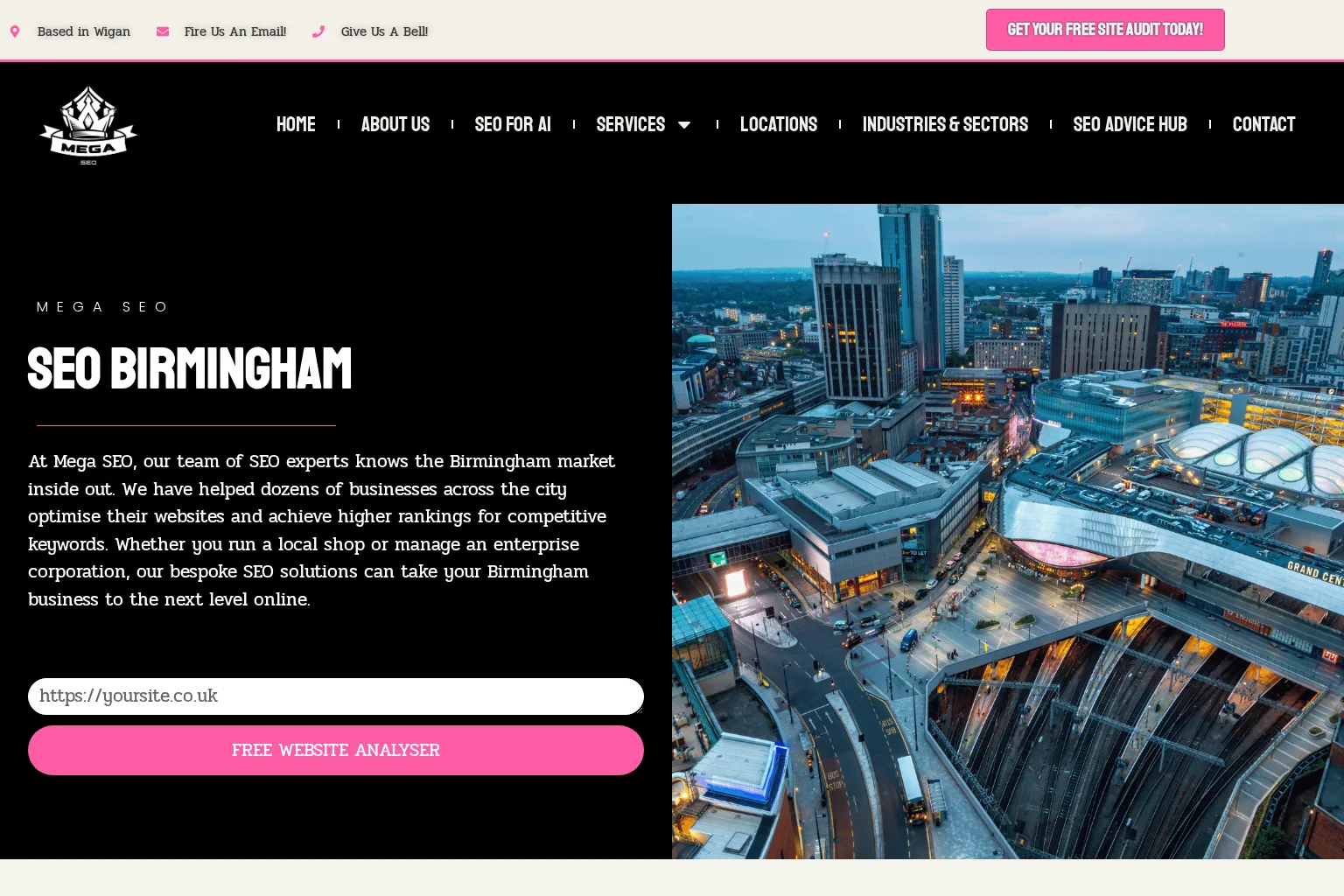
Potential fit: A business wanting visible package starting points and willing to inspect what each buys.
Mega SEO's Birmingham service page describes one-off audits, monthly packages and projects. Stated coverage includes technical, on-page, local and off-page SEO, with reporting on rankings, traffic, leads and sales.
Pricing approach: The reviewed page lists a £150 monthly package containing one human-written blog, a site health check, plugin updates and URL indexing. A £750 monthly package lists five human-written pages, keyword tracking and analytics, on-page and off-page SEO, and regular technical audits. These are different scopes, not two prices for identical work.
The page promotes no-contract, month-to-month arrangements but also displays a separate six-monthly offer. Ask which commitment applies to your quote and obtain cancellation, pause and refund terms in writing. Confirm VAT treatment rather than assuming displayed figures include it.
Request a change log and sample report identifying the pages worked on. Ask how links are acquired and whether technical findings are fixed within the fee.
Limit to resolve: A maintenance-and-blog package is not an extensive technical campaign. We have not independently verified the page's performance claims. Choose against your brief, not a projected return.
3. MFF Marketing: technical SEO and content strategy
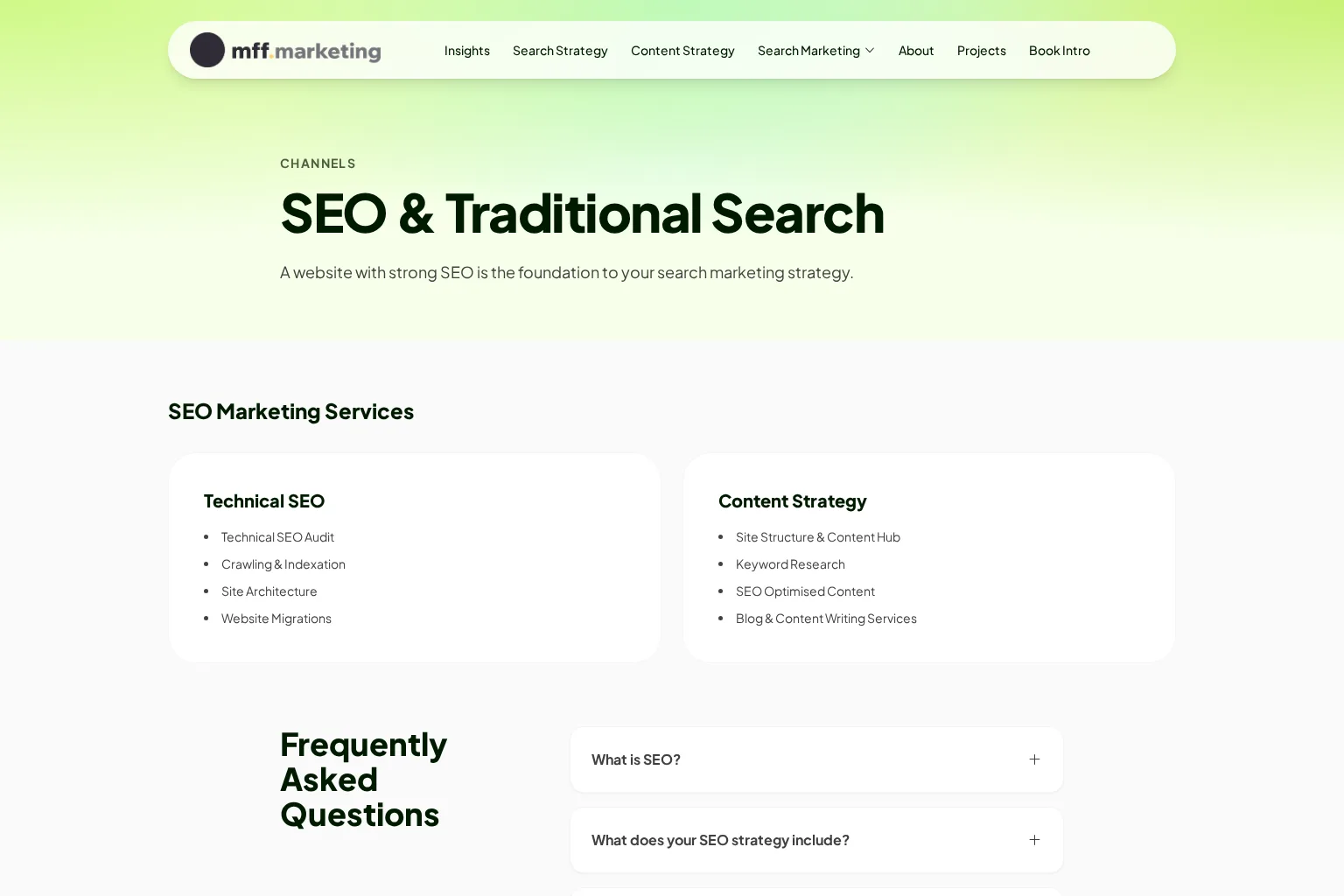
Potential fit: A business needing website structure, technical problems and content priorities assessed together.
MFF Marketing's SEO service page lists technical audits, crawling and indexation, site architecture and migrations. Its content scope includes content hubs, keyword research, optimised content and blog writing. The FAQ describes on-page optimisation, internal linking and performance monitoring.
Ask for an example prioritisation document: which problem gets fixed first, why, by whom and with what dependency? That is more useful than an unprioritised audit export when your marketing team and developer share delivery.
Pricing approach: The reviewed SEO page does not state a fixed fee. Request a proposal separating investigation, implementation, ongoing content and reporting. Do not assume an audit includes every development task needed to act on it.
For evidence, request a relevant client example and a report distinguishing completed work from recommendations awaiting approval. Migration buyers should establish who owns the launch checklist, redirects and post-launch investigation.
Limit to resolve: The public overview does not itemise a local listings programme, reporting frequency or contract duration. Confirm these if important. Consider MFF when technical and content work need coordinating, while making local deliverables explicit.
4. Syama Digital: an outlined local-search scope
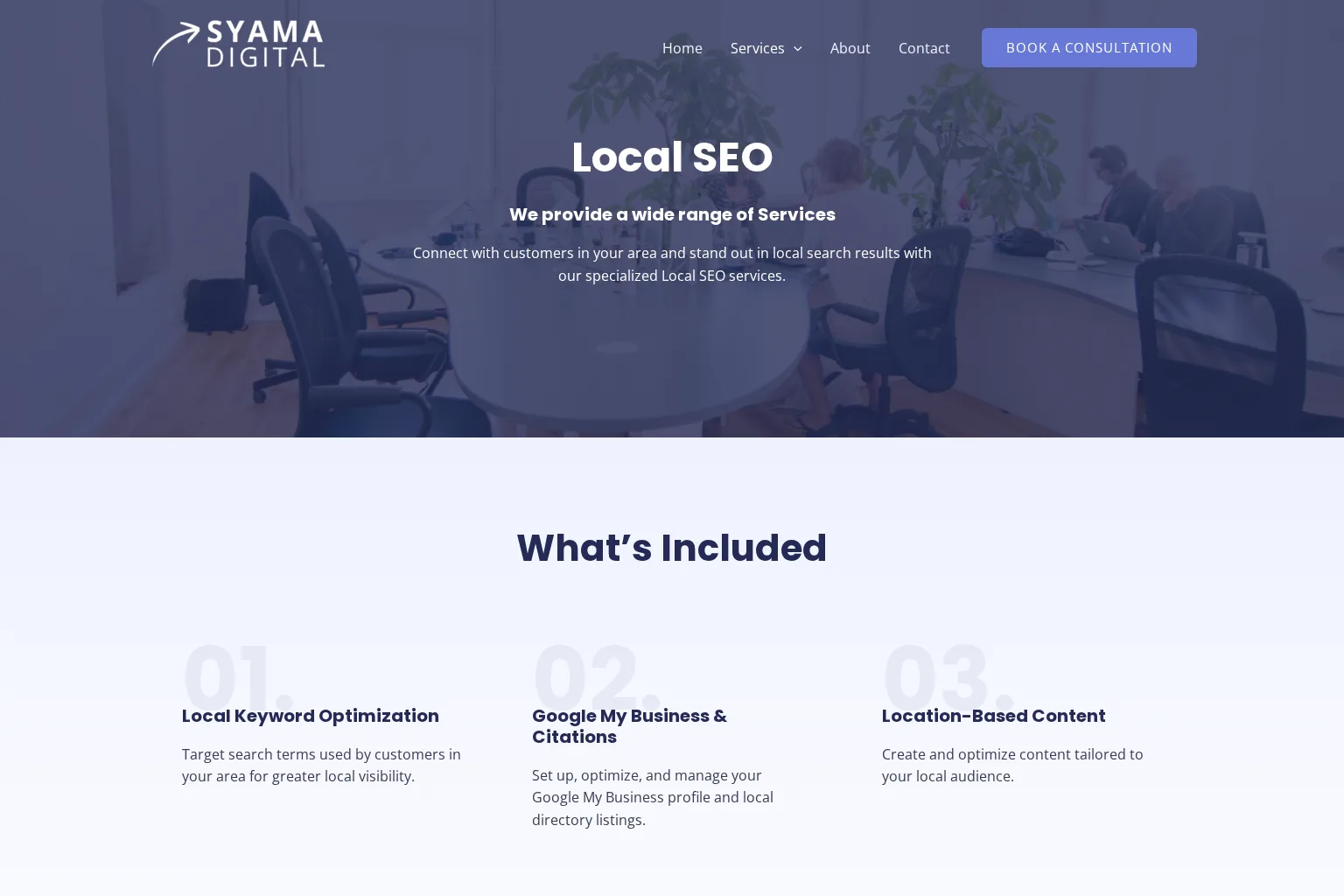
Potential fit: A customer-facing or service-area business wanting its proposal to address local discovery directly.
Syama Digital's local SEO service page lists local keywords, Business Profile management and citations, location-based content, reputation management, local link building, and analytics and reporting. It uses the older Google My Business wording for its profile service.
Use that activity list as the start of a brief. Ask how the team would assess your service area, choose existing pages to improve and keep business details consistent across relevant listings. Request a local report rather than only a broad traffic chart.
Pricing approach: The reviewed page does not publish a fixed fee. Ask about locations covered, setup work, recurring activities, reporting frequency and separate directory or content charges.
An advertised activity list is not evidence of results. Request an attributable client example and, where possible, a reference who can discuss delivery. Ask how local links are earned and placements reviewed.
Limit to resolve: Do not assume this scope includes extensive technical remediation, ecommerce optimisation or a large content programme. Consider Syama when local visibility is central, then require deliverables and ownership for each workstream.
Compare proposals by work, evidence and ownership
Give suitable finalists the same inputs. We recommend a prioritised first-stage plan rather than presentations built around different definitions of SEO.
| Workstream | What the proposal should specify |
|---|---|
| Technical | Affected URLs, investigation method, implementation owner and acceptance checks |
| Local | Locations, profile work, listing accuracy and geographic measurement |
| Content | Existing pages to improve, justified new pages, expert input and approval |
| Links | Acquisition method, example placements, relevance and rejection rights |
| Delivery | Named contact, dependencies, deadlines and completed-change records |
Several services can belong in a strategy without starting simultaneously. If priority pages cannot be indexed, ask why publishing should come first. If technical foundations are sound but service pages are unconvincing, request narrower content-and-conversion work.
Check experience against your sector and actual market. Google recommends asking about industry and city experience, previous work, communication and measurement, and checking references. Read Google's advice on choosing an SEO.
For case studies, request the baseline, dates, work performed and outcome definition. Separate branded from non-branded searches where relevant. Ask whether paid campaigns, a redesign or other changes overlapped the period. A percentage increase without its starting point is weak buying evidence.
Also ask who will actually work on your account. A convincing sales conversation does not establish the experience of the assigned team. Clarify the contact for strategic decisions and the route for urgent website problems.
Compare commitments, not just monthly prices
Request a breakdown covering setup, recurring fees, content, development, software, third-party charges and tax treatment. Compare the minimum commitment and exit process: a monthly invoice does not automatically mean monthly cancellation rights.
Ask who owns website accounts, content, analytics access and working documents, and how unfinished work is handed back. These are buying questions, not a substitute for reviewing the agreement.
One proposal might cost less but leave implementation with your developer; another might include it. Compare the cost of completing the same priority work, including approval time. If the affordable option leaves the central problem untouched, reduce the scope deliberately rather than pretending you bought a complete programme.
Require reporting that leads to decisions
Agree the baseline and cadence before work starts. We recommend a monthly operational review covering completed changes, search performance, relevant enquiries or sales, blocked tasks and next actions.
Search Console reports clicks, impressions, click-through rate and average position, with dimensions including queries, pages, countries and devices. These are search measures, not qualified-customer counts. Google documents the Performance report. Keep local visibility checks separately labelled and connect outcomes through the measurement your team actually has.
Ask what changes if progress disappoints. A useful review ends with a decision: continue, investigate, revise priorities or stop an unproductive activity. Record who owns that next step and when it will be reviewed.
Warning signs worth challenging
- Guaranteed first place: Google warns that nobody can guarantee a number-one ranking. See its hiring guidance.
- Unexplained links: Purchased ranking links, excessive exchanges and automated link creation appear in Google's link-spam policy. Ask about methods, not just volume.
- Vague reports: Ask for URLs, changes, owners and the next check.
- No business context: Challenge a proposal that never establishes your customers or implementation capacity.
FAQ
Does my provider need a Birmingham office?
We would prioritise relevant experience, communication and accountability over a postcode. Chris Shaw explicitly describes remote delivery. If in-person workshops matter, confirm the office and meeting arrangements before signing.
How much should I budget for Birmingham SEO?
There is no single comparable price across these scopes. Mega SEO publishes different packages; Chris Shaw describes a tailored quotation; the reviewed MFF and Syama pages do not state fixed fees. Request prices for matching deliverables and commitments.
Should I address a narrower problem first?
Start narrower when you can isolate the need, such as a migration review, profile work or service-page improvements. Ongoing support makes more sense when strategy, implementation and measurement need coordinated ownership. Ask finalists to justify their first priority.
Choose the right responsibility to outsource
Send a shared brief to two finalists. Request a reference, sample report and written first-stage scope. Choose work that addresses your problem with responsibilities you can hold accountable.
If your bottleneck is website-informed planning and article production, explore our GrowthScout workflow. Our Growth plan connects site context, research, a 30-day plan and drafts, with optional publishing and human review. It is software, not a Birmingham SEO agency. The trial includes three days and three AI article drafts, then £74 per month per website, with cancellation available anytime. Keep specialist agency work where needed.
Sources
- Chris Shaw: Shopify SEO Birmingham
- Mega SEO: Birmingham packages
- MFF Marketing: SEO services
- Syama Digital: Local SEO
- Google: Local ranking
- Google: Do you need an SEO?
- Google: Search Console Performance report
- Google: Spam policies
- GrowthScout: Workflow and Growth plan
Recommended Reads
- Website Content Analysis: How to Find SEO Gaps and Improve Existing Pages, for preparing your inventory.
- SEO Content Planning: An 8-Step Process for a Focused Publishing Roadmap, for assessing content priorities.
- 5 UK SEO Software Options Compared for Local Growth and Content Execution, for deciding what to keep in-house.