
TL;DR
The right UK SEO software depends on the job you need done. Start with Google Search Console for your own Google Search performance; consider GrowthScout for site-informed content planning and production, Semrush for broader research and rank monitoring, Screaming Frog SEO Spider for detailed crawls, and BrightLocal for location-level visibility. None is a substitute for checking UK market settings, your actual workflow and the cost of the plan you would use.
A national retailer, a Manchester accountant and a three-location dental practice should not buy from the same feature checklist. They need different geographic evidence, different pages to improve and different ways to judge progress. This guide compares five distinct types of software, rather than declaring that one dashboard does every part of SEO equally well.
We include our own product, GrowthScout, and assess it by the same criteria as the other options. The assessment is based on public product information, not a claim that we tested paid accounts or independently measured vendor performance.
Table of contents
- What makes an SEO tool suitable for a UK business?
- How we selected and compared the five options
- 1. Google Search Console: best starting point for your own search data
- 2. GrowthScout: best for turning site knowledge into a content plan
- 3. Semrush: best for broader UK keyword and competitor research
- 4. Screaming Frog SEO Spider: best for a detailed website crawl
- 5. BrightLocal: best for businesses where the local map matters
- A UK buyer scorecard you can actually use
- Common buying mistakes
- FAQ
- Choose your next test
- Sources
- Recommended Reads
What makes an SEO tool suitable for a UK business?
UK-ready does not simply mean a price in pounds. Look for a United Kingdom search market where keyword estimates are relevant, the ability to check the towns or regions you serve, and reports that separate local outcomes from national ones. A London service firm may care about neighbourhood-level competitors; an ecommerce business may care more about national category pages and technical coverage. Test spelling and phrasing that customers actually use, such as “solicitor” versus an imported US term, rather than assuming an English-language setting solves market fit.
A useful buying process also separates first-party performance, third-party market estimates and execution. Search Console reports what happened to your property in Google Search and lets you break down results by page, query and country. A research platform can suggest opportunities you do not yet rank for. An audit can expose a crawl or indexing problem. A content system can help you turn an approved opportunity into a published page. Those outputs answer different questions and should not be presented as one interchangeable score. Google documents the Performance report's dimensions and metrics.
How we selected and compared the five options
This shortlist is for UK business owners and in-house marketing teams assessing a repeatable SEO workflow, especially those with existing pages to evaluate before creating more content. We chose identifiable, publicly documented products representing first-party reporting, content execution, broad SEO research, technical crawling and local-search operations. Screaming Frog's software is included, not its agency service; BrightLocal's platform is included, not its managed SEO service.
For each option, we ask the same questions: Who is it best for? What UK-specific evidence can it show? What does it do for site analysis, content or execution? What work remains manual? How is access priced or limited? Some answers are narrower than others because the products serve different jobs. Treat an unverified integration or plan feature as something to demonstrate, not an implied capability.

1. Google Search Console: best starting point for your own search data
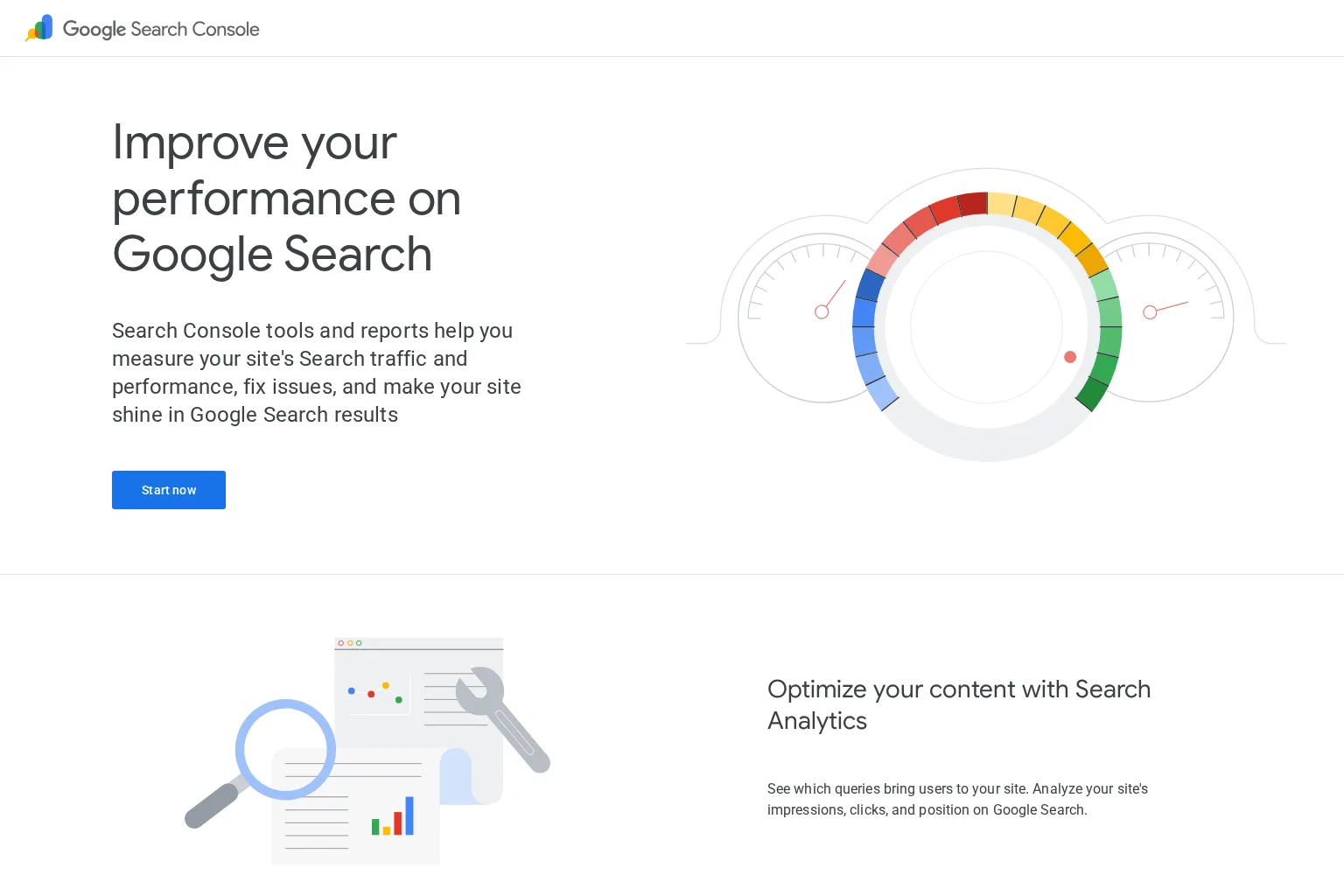
Best for: Any team that wants to understand how its verified website appears in Google Search before paying for another dashboard.
Search Console shows queries, pages, clicks, impressions, click-through rate and average position. Filter the Performance report by country when the question is UK demand for your site, and compare pages with the same date range and search type. Google also offers URL Inspection and indexing information that can help you investigate a specific page. Google's Search Console overview and Performance report guidance explain what those reports contain.
For a practical first pass, find an important UK-facing service page, check its queries and clicks, then inspect whether it is indexed. A page with impressions but few clicks might need a closer look at search intent and its search appearance; that observation alone does not prove a title change will fix it. Limit: Search Console does not provide a full competitor keyword database, a local map-grid view or a content-production queue. Country-filtered performance is also not the same as checking rankings in a particular postcode.
Pricing approach: Google offers Search Console without a software subscription charge; verify property ownership to access your data. Choose it as your measurement baseline, then buy specialist research or execution software only for a gap you can identify. Google explains the setup and ownership step.
2. GrowthScout: best for turning site knowledge into a content plan
Best for: A UK team whose biggest bottleneck is moving from website and competitor findings to prioritised, reviewed articles.
This is our product. GrowthScout crawls a selected website, combines its pages with the goals, audiences and competitors you provide, and prepares a site audit and 30-day content plan. Its article preparation shows a topic's intended audience, research and existing-page fit, so the editor can challenge a proposed new page when updating an existing URL would be more useful. It can draft articles, leave automatic publishing off for review, or send approved work through supported WordPress or webhook routes. These are the workflows described in our GrowthScout product overview.
For a UK pilot, enter the actual audience and service area, inspect the saved market on a candidate keyword and compare one proposed article against an existing page. Ask an editor to correct a claim and inspect the final destination before enabling scheduled publishing. The useful test is whether the rationale survives the journey, not how quickly a draft appears. Limits: Our public page does not establish a postcode-level rank tracker, local listings management or a replacement for a specialist full-site crawler; keep those tools if your work needs them. Its documented audit highlights the homepage and other important pages, so do not assume every URL has received a deep technical crawl.
Pricing approach: The published offer is a 3-day trial with 3 AI article drafts, followed by £74 per month per website for Growth if you do not cancel during the trial; the paid plan lists 31 AI article drafts per month and says you can cancel anytime. Check the checkout for the terms of additional websites and your intended publishing route. See the GrowthScout plan and trial. Choose this option when content planning and execution, rather than local map reporting or exhaustive technical diagnosis, need to stay connected.
3. Semrush: best for broader UK keyword and competitor research
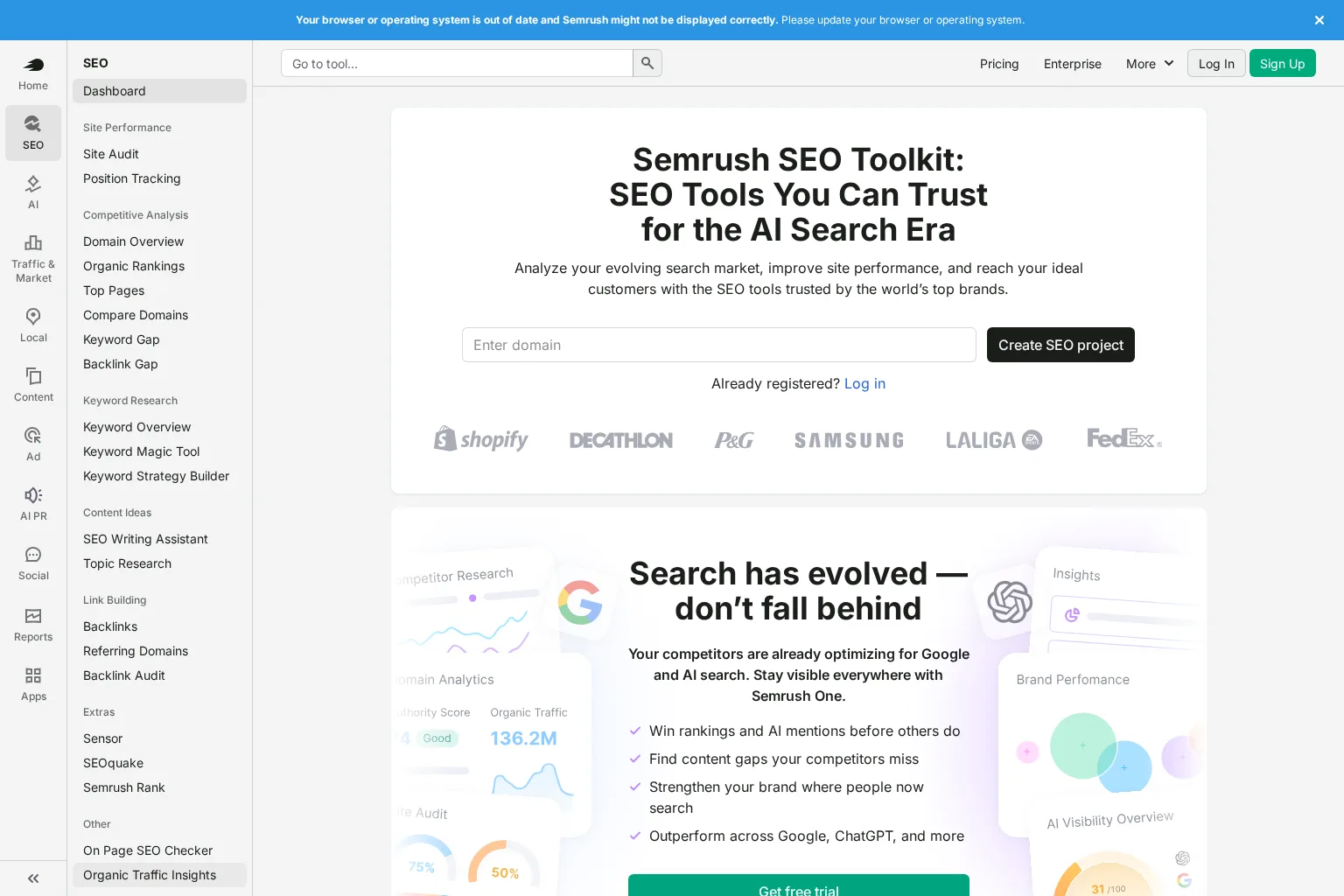
Best for: A team with someone able to turn research, tracking and audits into specific page-level decisions.
Semrush's SEO Toolkit includes keyword research, competitor comparisons, backlink tools, Position Tracking and Site Audit. Its Position Tracking documentation describes setting location, device and language for a campaign, including precise geographic targets. That is useful when the same service has different competitors in Birmingham and Bristol, but tracking a chosen set of terms is not the same thing as recording every query that sends traffic to your site. Use your Search Console property alongside it. Semrush SEO Toolkit documentation and Position Tracking documentation describe these capabilities.
An effective demonstration would compare UK keyword variants, inspect a genuine local competitor, run an audit and follow one finding into a named content or technical task. If backlinks matter, have the researcher explain what link evidence would change the decision, rather than treating a larger backlink report as a link-building strategy. Limit: Breadth increases the need for an owner: confirm which tier includes the content, AI visibility, reporting and additional-user capabilities you intend to use, and how an approved draft reaches your CMS.
Pricing approach: Semrush publishes different SEO and SEO-plus-AI packages, allowances and billing displays in pounds. Its monthly and annually billed monthly equivalents are different commitments; compare a quote using the same term, user count and monitoring needs for every finalist. Check Semrush's current plan comparison. Choose Semrush when research depth and ongoing tracking are worth the additional operating discipline.
4. Screaming Frog SEO Spider: best for a detailed website crawl
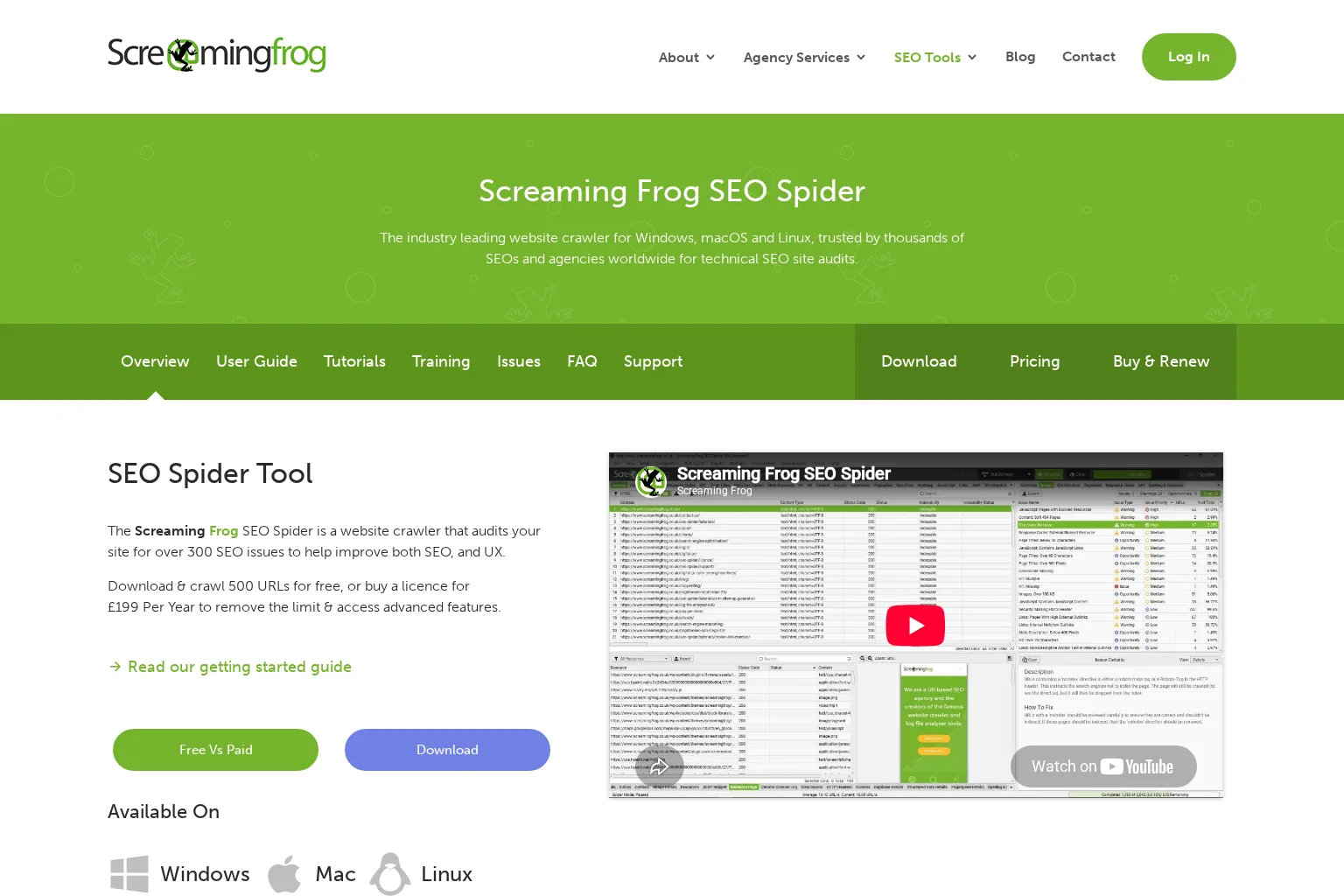
Best for: An SEO practitioner or developer who needs to inspect many URLs and diagnose technical and on-page problems.
The downloadable Screaming Frog SEO Spider crawls a website to report broken links, redirects, titles, headings, directives, canonicals, duplicate elements and site structure. Its documentation also lists advanced capabilities such as JavaScript rendering, scheduled crawls and integrations with Google data sources on the paid version. That makes it particularly useful when a UK business has several service-location sections, a large product catalogue or a migration to check. The official SEO Spider feature and licence page distinguishes the free and paid versions.
Start with an important section, review the URLs it reaches, and map issues to responsible people. A duplicate title report does not tell you which local service page deserves a new content angle; the crawl reveals evidence for editorial and technical judgement. Limit: The Spider is not a UK keyword-demand service, a local map tracker or a managed writing and publishing system. It also discovers URLs through a crawl rather than proving it saw every page in every state of a site.
Pricing approach: The published free version crawls up to 500 URLs; the paid licence is listed at £199 per year, with renewal required after one year. Its effective crawl size also depends on available memory and storage. Check the current free-versus-paid table before planning a large audit. Choose it when technical coverage and control outweigh a simple browser-based workflow.
5. BrightLocal: best for businesses where the local map matters
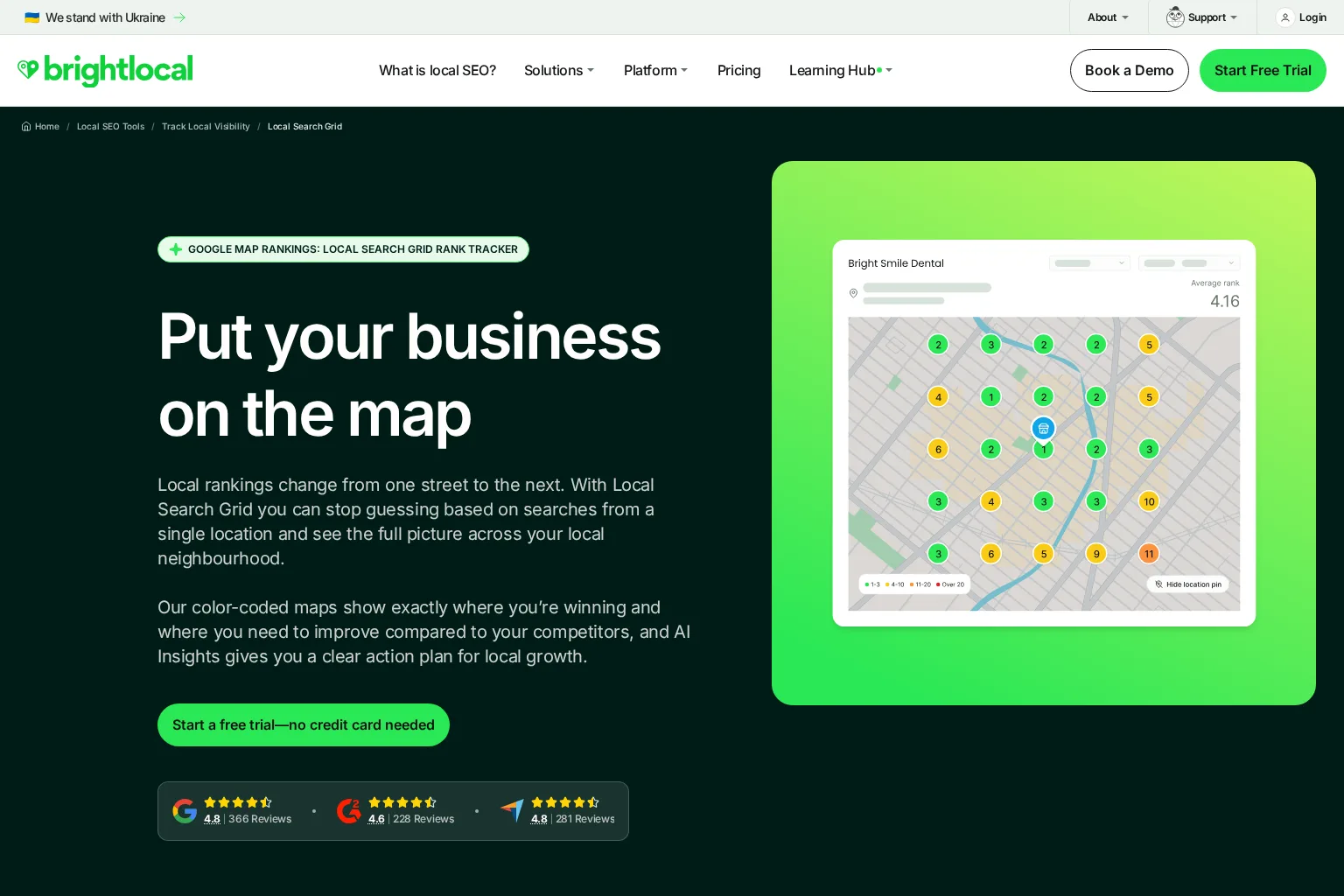
Best for: A UK business with physical locations or a service area that needs local rankings, listings and reviews in the buying decision.
BrightLocal's platform brings together local visibility tracking, listings and reputation tools. Its Local Search Grid compares ranking positions at multiple points around an area, which makes a different question visible from a national keyword chart: where nearby are we losing visibility to another business? Its platform page also describes a citation tracker and Google Business Profile auditing. BrightLocal's platform overview and Local Search Grid page show the relevant features.
For a useful UK trial, choose one branch and a realistic service radius. Compare grid results for a few commercially relevant searches, then inspect whether the affected location has inconsistent listings or incomplete profile information. Do not assume a map ranking change identifies its cause or guarantees more enquiries. Limit: A local platform does not replace a deep crawl of a large site or the editorial work of briefing, checking and publishing a national content programme. Confirm which on-site audit features and automation are in your actual plan.
Pricing approach: BrightLocal lists separate Track, Manage and Grow plans in US dollars, with the Track plan advertised from $31 per month. Confirm your quotation's currency, location allowances, billing term and any separate citation-building charges rather than converting that advertised starting figure into a fixed UK bill. Check BrightLocal's platform plans. Choose it when geographic variation in local search and listings work materially affect your business.
A UK buyer scorecard you can actually use
Do not award the most points to the vendor with the most boxes on a feature page. Score each shortlisted product or combination against the same assignment: one current page to assess, one new opportunity to decide on, and one target location to measure. Use 0 = not demonstrated, 1 = partial or manual, 2 = demonstrated with your data. Treat an untested feature as unverified, not as a success or a failure.
| Question to test | What a convincing demonstration looks like |
|---|---|
| UK market fit | Show the market selected for keyword data and the location or postcode behind a rank check; test UK phrasing. |
| Existing-site coverage | Identify an actual URL to improve, its content or technical issue, and whether the audit covered the section in question. |
| Opportunity choice | Show why a proposed topic fits your customers and is not already answered by an existing page. |
| Execution and approval | Carry the evidence into a brief, let an editor reject or correct a draft, and identify the publishing destination. |
| Measurement | Show the relevant Search Console page, country and time range; keep map ranks and AI mentions in separately labelled views. |
| Total cost and ownership | Quote your websites, locations, seats, add-ons, limits and billing term; name who will implement each recommendation. |
Weight the rows before the demo. A single-location business might give local evidence and listings more weight; a content-led SaaS team might put more weight on research-to-publishing handoffs; a large ecommerce site could prioritise crawl coverage. The point is not to manufacture a universal winner. It is to make each purchase answer an observable need.
📌 Pilot example: Suppose a Bristol-based accountancy firm already has an underperforming VAT service page and wants to reach nearby businesses. Check its UK-filtered Search Console queries, audit the existing page and its links, compare local search visibility, then decide whether that URL needs improving or a genuinely different question needs a new article. Require an editor's approval before publication and record a later page-level measurement date. This is an illustrative workflow, not a claimed customer outcome.
Common buying mistakes
Buying an agency instead of software. A provider can sell a platform and a managed service under the same brand. Request the licence and implementation responsibilities separately. If you need an agency to act on every finding, a self-serve dashboard alone will not provide that service.
Mistaking automated writing for automated improvement. A draft still needs an accurate business claim, a reason to exist, a reviewer and a working destination. Google advises manually checking AI-generated material for accuracy and value, particularly when automatically producing pages. Read Google's generative AI content guidance. Set a review gate before you consider scheduled publishing.
Treating AI mentions as Google traffic. An AI response sample or tracked prompt can tell you whether a brand appears in a particular answer; Search Console reports your own Google Search clicks and impressions. Those are separate observations, neither of which is a conversion measure. Our guide to keywords and AI prompts explains why related keyword estimates should not be added together or presented as a count of AI conversations.
FAQ
Do I need one UK SEO platform or several specialist tools?
You can start with Search Console and add the specialist that removes your clearest bottleneck. A content-planning system can work alongside a crawler or local rank tracker. Define how evidence travels between them and who owns the next action; avoid paying twice for reports nobody uses.
Can software guarantee local rankings or enquiries?
No. Software can document visibility, identify possible issues and help you execute a plan, but it cannot promise where an individual customer will see your site or whether they will enquire. Compare real decisions made during a pilot, not a predicted ranking or traffic uplift.
How should I compare AI-search tracking with ordinary SEO reports?
Ask which prompts, platforms, dates and sources an AI tool observes. Compare those observations with Search Console's page and query reports, but keep the measures separate. A brand mention is not the same event as a Google click, and neither alone establishes business impact. Google's Performance report defines the search measures.
Choose your next test
Pick two finalists for the job you most need done and give them the same UK location, existing page and candidate topic. Keep a short record of the evidence, the manual work and the quote for your real number of sites. If your bottleneck is turning site analysis into an editable plan and approved articles, explore GrowthScout's website-to-content workflow and test it against the same scorecard. We would rather you find a missing feature in a pilot than assume a marketing description covers your exact workflow.
Sources
- Google Search Console overview
- Google Search Console setup guide
- Google Search Console Performance report
- GrowthScout product, workflow and plan information
- Semrush SEO Toolkit documentation
- Semrush Position Tracking documentation
- Semrush plans and pricing
- Screaming Frog SEO Spider features and licence
- BrightLocal platform plans and features
- BrightLocal Local Search Grid
- Google's guidance on generative AI content
- GrowthScout guide to keywords and prompts
Recommended Reads
- 4 SEO Productivity Software Options Compared by Workflow, Not Feature Count for a closer look at research-to-refresh handoffs.
- SEO Workflow Automation: Compare 4 Platforms by Their Handoffs, Not Just AI Writing if approval and publishing are your deciding criteria.