
TL;DR
An auto SEO tool might generate content, deploy on-page fixes or connect an entire research-to-publication workflow. Those are different purchases. For agencies, GrowthScout is a fit for website-specific content planning; AirOps for configurable content and AI-discovery operations; Search Atlas OTTO SEO for broad execution including on-page changes; Alli AI for deploying on-page recommendations; and SEO.AI for agent-led content publishing. We recommend testing the work each platform actually completes for one client before expanding it across accounts.
An agency can produce more articles, collect more alerts and still leave its most expensive handoff untouched. The strategist has to work out which opportunity fits the client; the editor needs the right facts; someone must approve a change to the correct site; and the account lead needs evidence about what happened afterward. Automation is valuable when it makes those transitions more dependable, not simply faster.
This comparison is for SEO agencies evaluating software across multiple client websites. We include GrowthScout, our own product, alongside four alternatives. We assessed public product documentation and pricing pages, not live customer accounts or independently measured rankings. Published capabilities and terms can vary by plan and should be demonstrated with your own site and permissions before purchase.
Table of contents
- What qualifies as an auto SEO tool?
- How we selected and compared the five tools
- 1. GrowthScout: best for website-specific content planning and production
- 2. AirOps: best for configurable content and AI-discovery operations
- 3. Search Atlas OTTO SEO: best for broad SEO changes with deployment controls
- 4. Alli AI: best for approved on-page changes across CMSs
- 5. SEO.AI: best for an agent-led content publishing route
- Compare the tools by the bottleneck you need to remove
- Run a one-client pilot before buying for the portfolio
- Frequently asked questions
- Sources
- Recommended Reads
What qualifies as an auto SEO tool?
The label covers at least three different jobs. A monitoring tool gathers signals and tells your team what to inspect. A production tool turns research into briefs, articles or other assets. An execution tool can publish content or deploy changes to live pages. Some platforms combine these jobs; none removes the need to decide whether the proposed work serves the client's audience.
We would map an agency's desired loop as site and competitor review → opportunity and intent check → priority and plan → draft or proposed fix → human approval → delivery → measurement. Off-site link work and AI-search visibility can feed that loop, but they need their own evidence and controls. A measured AI mention, for instance, is not automatically a recommendation or a lead. Our guide to how keywords and AI prompts work together explains why a search-demand estimate cannot be treated as the audience for an AI question.
Google says generative AI can assist research and structure, but producing many pages without adding user value may violate its scaled-content policy. It also advises manual fact-checking before publication, including metadata and image alt text. That makes review controls a substantive buying criterion, not a decorative checkbox. Read Google's guidance on generative AI content.
How we selected and compared the five tools
We selected identifiable products with official public pages describing an automation path beyond an isolated keyword lookup. The list deliberately spans content planning, configurable AI operations, broad SEO deployment and focused on-page execution. We evaluated each against the same questions: What evidence informs its priorities? What does it create or change? Can an agency review or stop that work? How does it reach a live website? What can be measured afterward? What is the purchasing unit and what work remains manual?
The categories matter more than a single winner. A tool that excels at deploying title changes is not necessarily the best place to plan a client's article calendar. Nor should a content agent get credit for technical fixes it has not demonstrated. We have not assigned vendor performance scores from marketing claims.

Use this loop as a demonstration script: follow the proposed work through a human decision and back to evidence, regardless of whether the work is a new article or an on-page fix.
1. GrowthScout: best for website-specific content planning and production
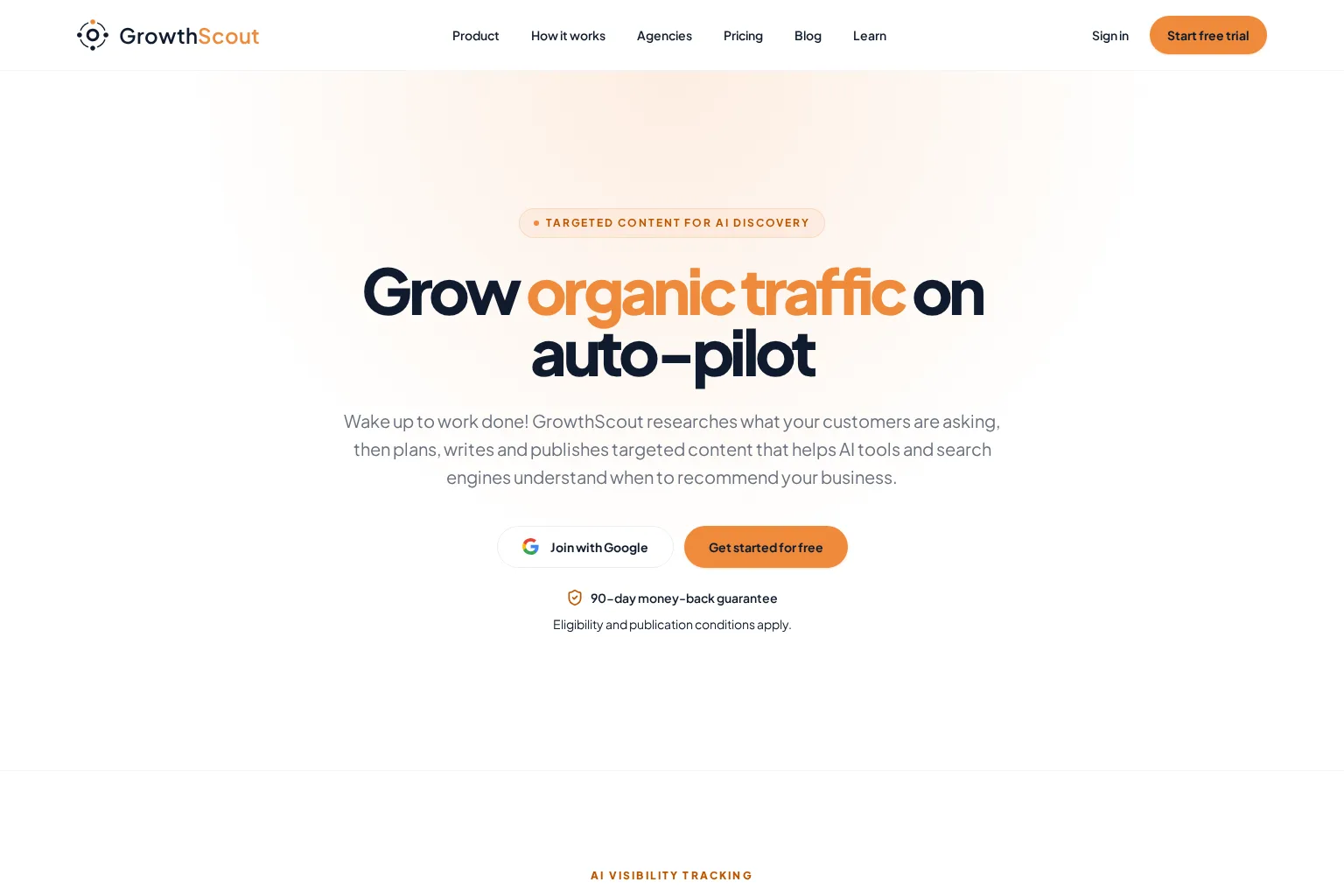
Best fit: Agencies that need a connected path from a client's website context and keyword opportunities to a visible content plan, editable article and optional publication.
GrowthScout is our product. It crawls the selected website, uses its content and supplied business goals to prioritise opportunities, and prepares a 30-day calendar. An article plan retains its target audience, intended search intent, research and relationship to existing pages before a draft is generated. That is useful when an agency's research otherwise gets detached from the brief that reaches its writer. Each added website has separate knowledge, goals, content plans and article settings, as described on our agency product page.
Review and delivery: Editors can inspect and edit articles with automatic publishing off. Supported delivery routes are WordPress, a custom webhook or manual transfer; scheduled publication is optional. The paid website plan includes weekly tracking of 10 AI prompts, and an eligible connected Google Search Console property supplies organic performance measures. Prompt observations can help suggest a content question, but they should not be presented to clients as proven AI-sourced revenue.
Limits and commercial model: This is not a claim that GrowthScout automatically repairs every technical issue or supplies a dedicated outreach team. Our agency page identifies a dedicated client approval portal, specific editorial and client roles, white labelling and shareable client reporting as ideas, not available features. Keep client sign-off in your existing process if you need it. The published offer is a 3-day trial with 3 AI article drafts, followed by £74 per month per website for the initial Growth plan, which includes 31 AI article drafts per paid month; the site says you can cancel anytime. Additional website capacity is purchased separately at the price shown in its in-app checkout. Check the amount for your intended client count before estimating agency costs. See the plan and agency terms.
Choose it if your recurring problem is carrying website-specific opportunity evidence into a reviewable publishing queue. Pair it with specialist technical or client-reporting software where those are central to the engagement.
2. AirOps: best for configurable content and AI-discovery operations
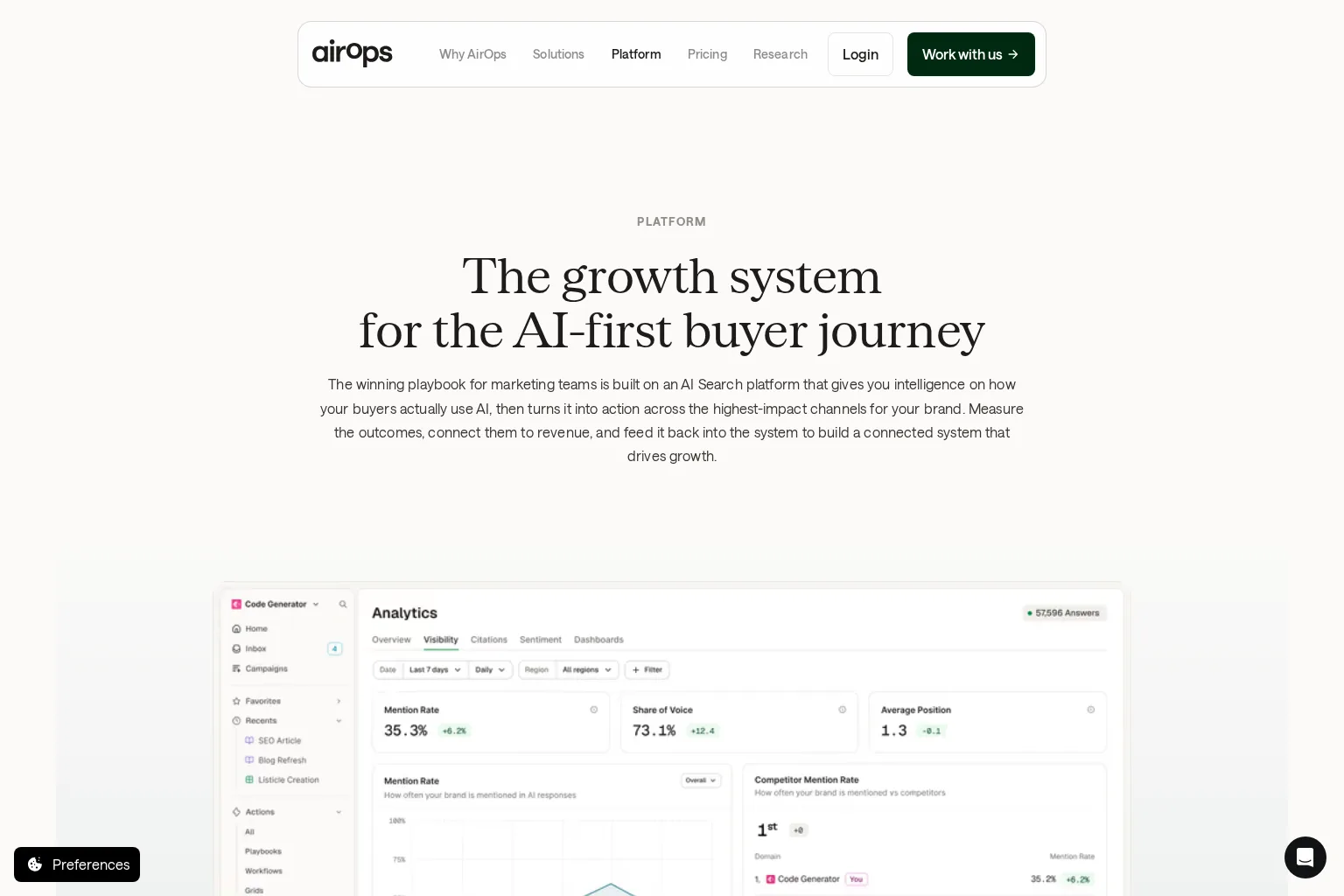
Best fit: Teams ready to configure how market and content signals become reviewed work, particularly when AI discovery, refreshes and cross-channel coordination matter alongside conventional SEO.
AirOps describes an intelligence, action and measurement loop: identify opportunities, use agents and workflows to research and create assets, then track what shipped and how results change. Its platform page documents human review that pauses a run, routes an artifact to an inbox and resumes after edits or approval. It also describes CMS integrations, page-update histories and measures such as citations and page performance. Those are useful distinctions for an agency whose product expert must check a claim before a workflow can continue.
Review and delivery: Ask AirOps to show the actual reviewer assignment, version history, CMS field mapping and failure handling for a client's content. The public platform description covers off-site opportunities too, but says the team reviews the rationale and coordinates placements through its own contacts and relationships. Do not score that as a guaranteed automated backlink service. Likewise, verify that the AI buyer segments and prompts used for reporting match the client's market instead of treating a broad mention rate as proof of success.
Limits and commercial model: Configuration and governance take an owner. The AirOps pricing page describes Solo and Pro for one brand or project, with task allowances, plus a tailored Enterprise offering. It says pricing depends on task volume and requirements, rather than providing a universal fee suitable for this agency comparison. Request a quote covering the number of client brands, reviewers, integrations, task usage and support you actually need. Choose it if your agency is prepared to maintain a more configurable operating system, not if the goal is the smallest possible setup for a single blog.
3. Search Atlas OTTO SEO: best for broad SEO changes with deployment controls
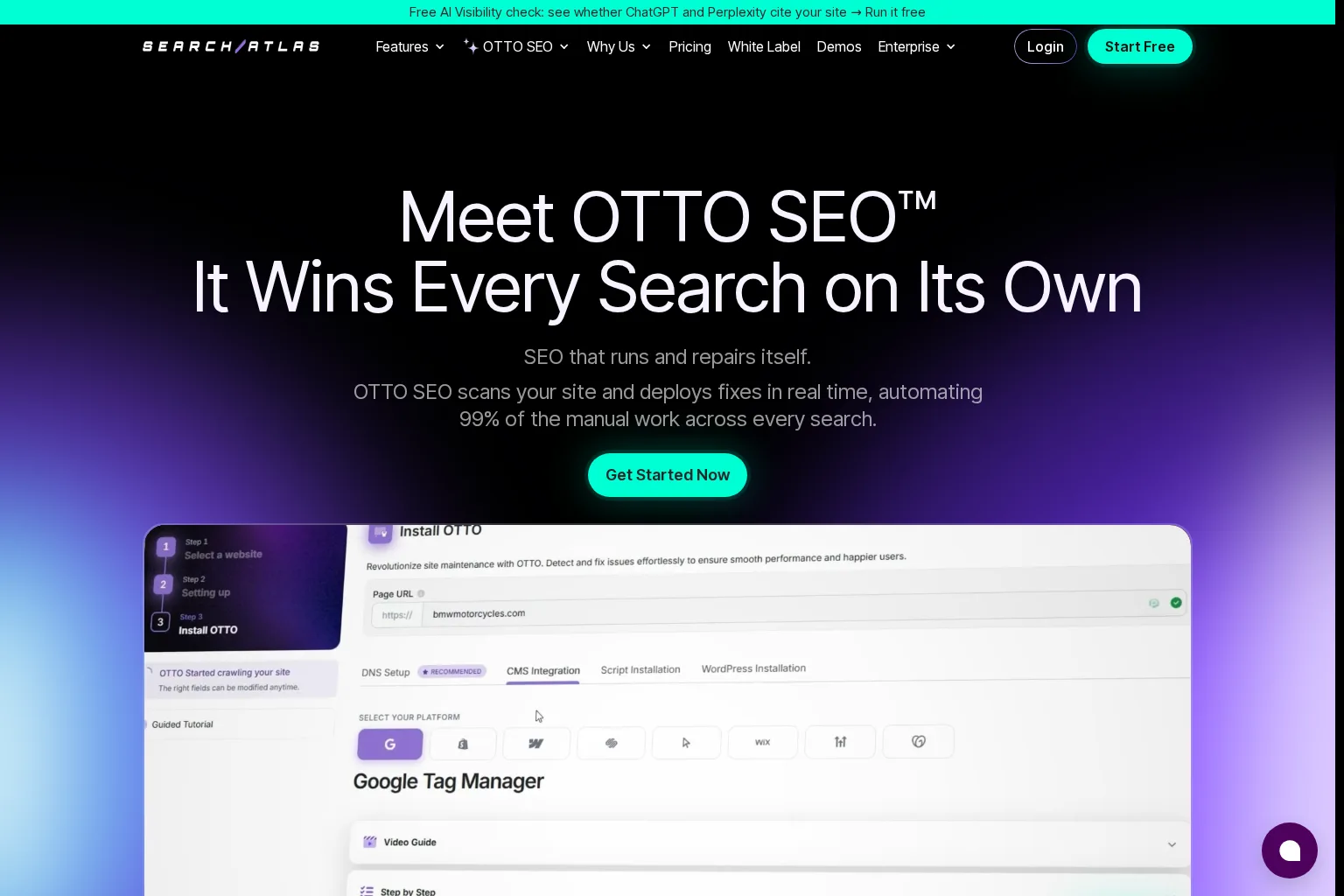
Best fit: Agencies looking to put audit findings and on-page changes into execution rather than forwarding every recommendation to a developer.
Search Atlas describes OTTO SEO as an agent for technical and on-page recommendations, topical maps, content production, local search activity and off-site work. Its product page says teams can run optimisations automatically or use an approval mode, edit individual suggestions and roll back changes. It describes deployment through a site connection and integrations. That creates a very different buying proposition from a draft-only writer: an agency can ask to see a proposed title or schema change, approve it, inspect the live page and reverse it if necessary.
Review and delivery: Test the connection on a low-risk client page before enabling broad deployment. Confirm what the site owner sees, who can approve a bulk change, how the change is served and whether it persists after disconnecting the service. Although Search Atlas advertises indexing features, submission or a deployment claim is not proof that Google has indexed a page. For its advertised off-site automation, request sample destinations and editorial criteria before letting it operate for a client. Google's spam policies list automated link creation and excessive exchanges among examples of link spam; this is a reason to examine the method, not a finding that a specific OTTO placement violates policy.
Limits and commercial model: The published Search Atlas pricing page lists Starter at $99 per month billed monthly with one project, one seat and one OTTO-powered site; its higher plans expand projects, seats, AI visibility and shared usage credits. Agency pricing is listed as from $999 per month billed monthly. Confirm which actions consume credits and the package needed for your actual client portfolio. Choose it if controlled deployment of a wide range of optimisations is worth the extra implementation and change-management responsibility.
4. Alli AI: best for approved on-page changes across CMSs
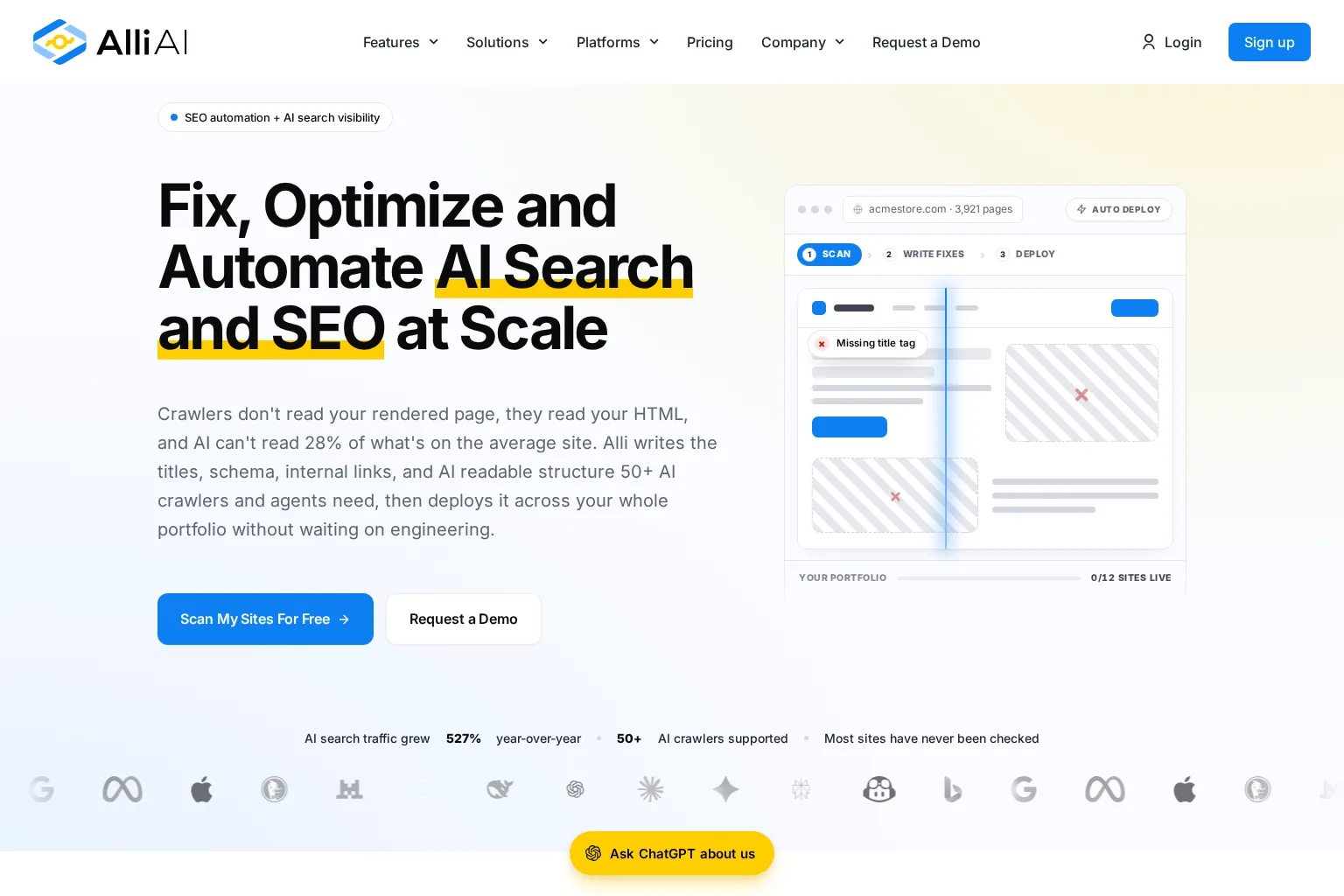
Best fit: An agency with a backlog of on-page recommendations and limited developer capacity to implement them across client platforms.
Alli AI's on-page automation page describes rule-based optimisations, a visual editor, audits and bulk actions. Its setup instructions say you install a site code snippet, review recommendations, adjust titles or descriptions and click Approve to push changes live. The page also explains ways to check a live change, including the page view in its dashboard and Google Search Console URL Inspection. That is a concrete task to test in a pilot: choose one approved change, compare the rendered page with the intended result and record who authorised it.
Review and delivery: Do not confuse fast on-page implementation with an evidenced client content strategy. Ask to see where keyword intent, existing-page overlap and editorial rationale enter the process if your agency also needs an article plan. Check site access and the exact rendered output before approving a bulk rule. A script-based change also merits a conversation with the client's technical owner about performance, ownership and rollback.
Limits and commercial model: The Alli AI pricing page advertises a 10-day trial and says you can cancel anytime, but the readable public page we checked did not establish a reliable plan amount or included website/page limits. Request the applicable quote, caps and overage terms; do not assume trial access means an ongoing free plan. Choose it if shipping reviewed on-page recommendations is the constraint. Keep a separate research and editorial system if the pilot does not show the upstream planning your accounts require.
5. SEO.AI: best for an agent-led content publishing route
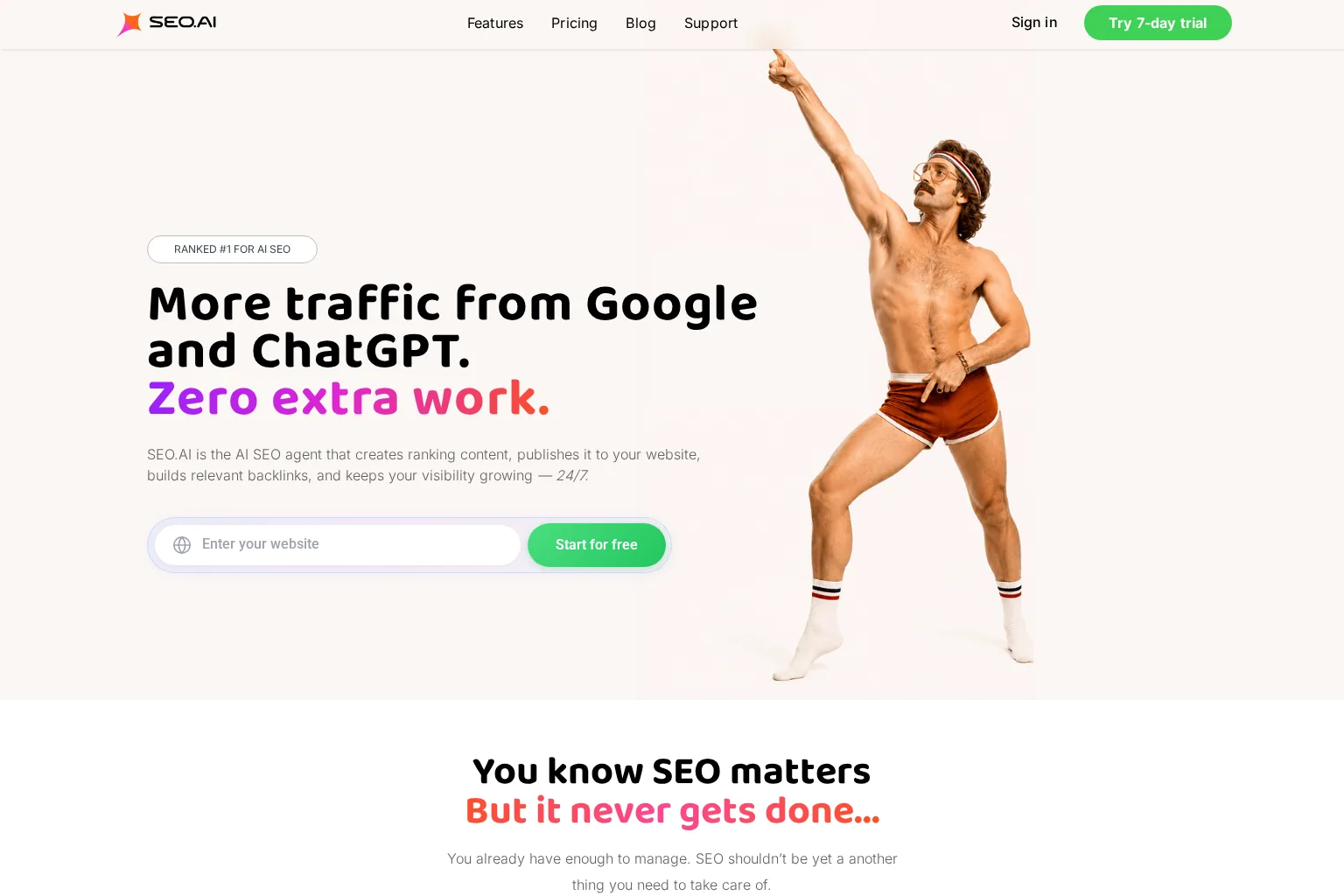
Best fit: Agencies assessing an automated path from keyword discovery and content recommendations to drafted or live pages, with review choices and a defined number of websites.
SEO.AI describes identifying search terms, planning, writing and publishing content to a connected CMS. Its FAQ says a team may use automatic publication, save drafts or review inside the platform. Those are distinct operating modes: ask which one a given client account uses and whether a scheduled article can bypass the approval process your contract requires. Its public material also promotes a link-exchange network. Assess proposed placements separately from content output, including relevance, outgoing-link obligations and whether participation is optional. Google's link-spam policy names excessive exchanges among potential violations, without determining whether any particular placement breaches the policy.
Review and delivery: Request a complete example for one existing client site: proposed keyword and why it matters, comparison with current pages, editable draft, CMS destination, live URL and subsequent performance evidence. Confirm which product claims are reviewed by a person; the vendor's description of specialist spot checks is not a promise that your client's individual draft will receive comprehensive expert sign-off.
Limits and commercial model: The SEO.AI pricing page lists $149 per month for one website in one language and $299 per month for up to three websites or languages on the displayed Multi Site option. Prices exclude VAT. It describes monthly plans as having no binding period and annual payments as binding for the paid period; check the checkout for the precise configuration. Choose it if agent-led publishing is the bottleneck and your client agrees with the review and off-site-work policies. It is not a substitute for your agency's responsibility to validate facts and outcomes.
Compare the tools by the bottleneck you need to remove
These are documented emphases, not hands-on scores. Use the matrix to decide what each vendor must demonstrate before you grant it access to a client site.
| Tool | First workflow to test | Approval or control to demonstrate | Budget unit to check |
|---|---|---|---|
| GrowthScout | Site context → opportunity → calendar → editable article | Keep scheduled publishing off until the draft is approved | Paid website and additional website checkout |
| AirOps | Buyer signal → configured workflow → reviewed content → measured change | Assigned reviewer pauses and resumes a run | Brands or projects, tasks and tailored package |
| Search Atlas OTTO SEO | Audit suggestion → approved change → live page | Category or individual approval and rollback | Projects, OTTO-powered sites, seats and credits |
| Alli AI | On-page recommendation → approved rule → rendered result | Explicit approval and site-level access | Quoted plan and page or site limits |
| SEO.AI | Keyword suggestion → reviewed draft → CMS publication | Draft mode versus automatic publishing | Websites or languages, VAT and billing term |
📌 Our rule: A vendor gets credit for a handoff only when your team can trace it with the right website, reviewer and destination. A dashboard screenshot is evidence of an interface, not proof that a particular plan supports your client's process.
Price the whole assignment, not the headline subscription
Build a quote for three representative clients, even if you pilot only one. Ask each vendor for included websites or projects, seats, article or action allowances, credits or task overages, CMS integration, AI visibility tracking, reporting access, off-site work and support. Then add the agency hours needed for setup, research interpretation, factual review, publishing checks and client reporting. Keep currencies and billing commitments separate; a monthly plan and an annual prepayment are not equivalent simply because both display a monthly figure.
If a vendor claims to build links, ask where they come from, who chooses the destination and whether the agency can decline a placement. If it claims AI-search visibility, ask whether it helps discover buyer-relevant prompts and plan a response, or only counts brand mentions in a fixed sample. Record the prompt, model, location and check date before drawing conclusions from a change. Our agency workflow page explains how we separate each website's context, but it also makes clear which client-facing features are not yet available.
Run a one-client pilot before buying for the portfolio
Pick a client who has both an existing relevant page and permission to test one new article or low-risk on-page change. Agree on the audience, market, intended business action and named reviewer. Keep automatic publication and bulk site changes off while you establish the baseline. Then give each shortlisted tool the same brief and ask it to complete the task for which you would buy it.
- Check the input. Can the operator see the source page, target query or prompt, competitor context and reason this work should take priority? Does the tool suggest improving an existing page when that is the better answer?
- Check the decision. Show a proposed brief, draft or on-page fix. Ask the reviewer to reject one claim or change. Verify that rejection stops the relevant deployment rather than merely adding a comment.
- Check the output. With the client's consent, deliver one approved item. Inspect the actual URL, title, visible content, links and rendered technical change. Log failures and how you would reverse them.
- Check the return loop. Identify who reads subsequent page- and query-level evidence and who decides whether to keep, improve or stop the work. Google Search Console's Performance report provides clicks, impressions, CTR and average position, with page, query, country and date dimensions. Those search measures do not, by themselves, establish a qualified lead.
For each stage, mark demonstrated, documented but untested or not established. Track review minutes and rework alongside software spend. An option that makes drafting instant but doubles the time spent correcting unsupported claims has not solved the agency's bottleneck. If the tool passes on one client, test a second with a different CMS or approval policy before standardising the process.
Frequently asked questions
Can an auto SEO tool do all of an agency's SEO work?
A platform can automate substantial research, production or deployment, but those scopes differ. Your team remains accountable for the client's priorities, accurate claims, relevant links and permission to publish. Google asks publishers to check the trustworthiness of AI-generated content before it goes live. See its guidance.
Is a free trial enough to assess multi-client fit?
Usually not on its own. A trial can demonstrate one site's workflow, but you also need to validate a second client's data separation, approval path and capacity, plus any charges for extra websites, users or actions. Ask for a written proposal using your actual account count before expanding.
Should we choose the tool that publishes the most articles?
No. Compare whether it selects relevant work, respects existing pages, adds original client knowledge, supports rejection and measures the right outcome. Article quantity is an output, not evidence of helpfulness. Google's scaled-content guidance focuses on value for users and warns against mass-producing unoriginal pages primarily to manipulate rankings.
Our recommendation is review first, automate deliberately. Let software handle repeatable collection, coordination and preparation; keep a named person responsible for strategy, factual claims, brand fit and the final decision to publish. If your agency's biggest gap is getting from client-specific research to a reviewed content calendar, explore GrowthScout for agencies and put our own workflow through the same pilot as every alternative.
Sources
- GrowthScout: product overview and published website plan
- GrowthScout for agencies: current features and additional website capacity
- GrowthScout: how keywords and prompts work together
- AirOps: platform, review and measurement capabilities
- AirOps: plan allowances and task-based pricing
- Search Atlas: OTTO SEO product and controls
- Search Atlas: plans, site allowances and execution credits
- Alli AI: on-page automation and approval process
- Alli AI: trial and pricing page
- SEO.AI: agent and publishing options
- SEO.AI: plan and billing details
- Google Search Central: guidance on generative AI content
- Google Search Central: spam policies
- Google Search Console: Performance report
Recommended Reads
- SEO Workflow Automation: Compare 4 Platforms by Their Handoffs, Not Just AI Writing, for a closer look at approval and publishing transitions.
- Multi-Client SEO: An Operating System for Managing Multiple Websites, for the client separation and governance process.
- 4 Auto SEO Services Compared: Coverage, Review Controls and Costs, if you are comparing ongoing services rather than tool capabilities.