
TL;DR
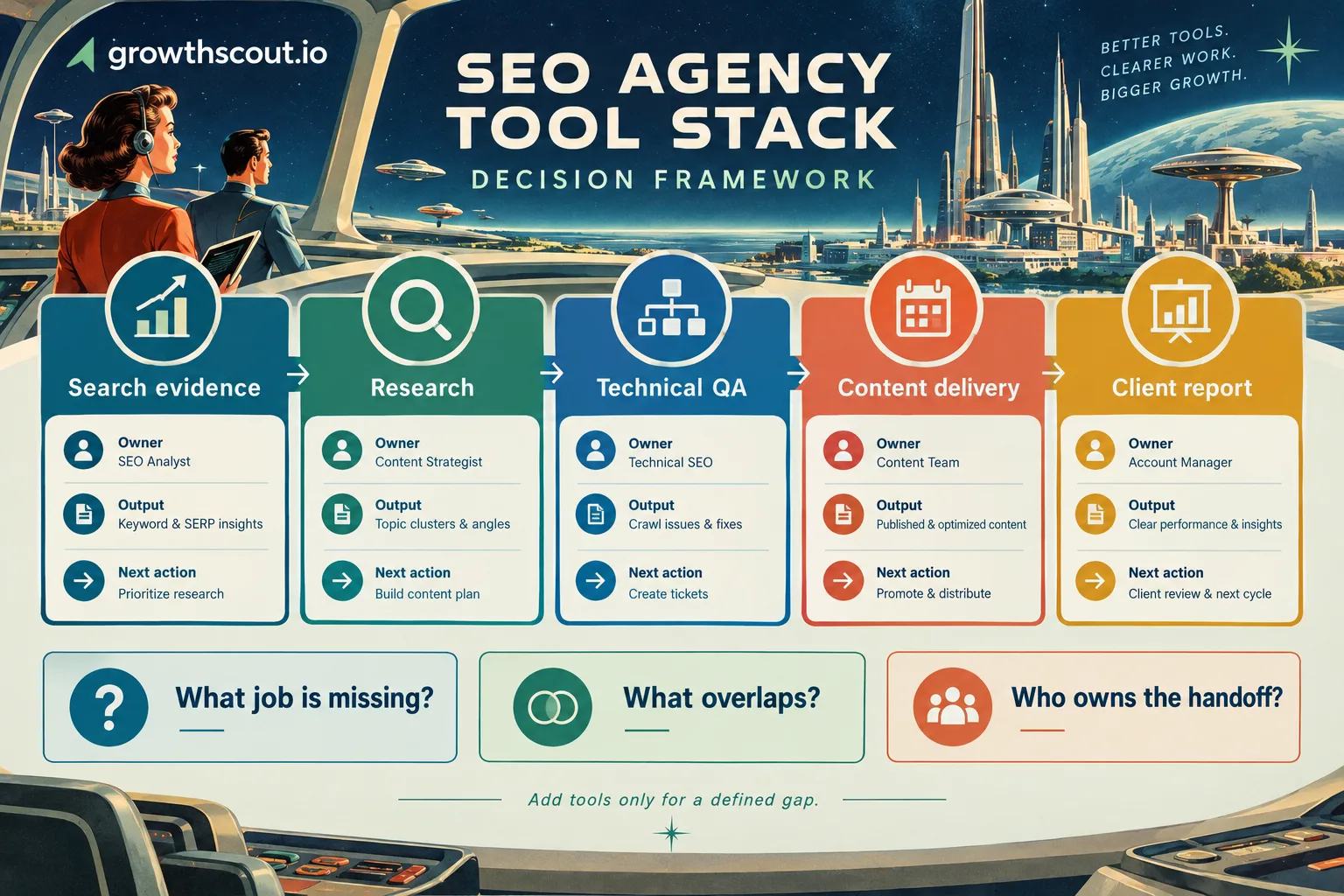
Build your SEO tool stack around five jobs: search measurement, market research, technical quality assurance, content delivery and client reporting. Google Search Console, Ahrefs, Screaming Frog SEO Spider, GrowthScout and Google Data Studio offer different ways to cover those jobs. They are not five compulsory subscriptions. We recommend assigning one source of truth to each task, keeping tools you already use effectively, and testing the missing capability before expanding the stack.
An agency does not need every useful SEO tool. It needs evidence to choose the right work, a dependable way to deliver it and a clear account of what happened afterwards.
This comparison is for agencies managing organic growth and content across multiple client websites. Rather than rank products as interchangeable alternatives, we compare their roles in a working stack: what each should own, what it should hand off and what justifies its cost.
For a central-suite buying decision, use our comparison of SEO platforms for agencies. Here, the question is narrower: which capability is missing from your delivery process?
Table of contents
- How we selected these SEO tools
- 1. Google Search Console: establish the search baseline
- 2. Ahrefs: buy research depth where it changes decisions
- 3. Screaming Frog SEO Spider: make technical findings actionable
- 4. GrowthScout: connect client context to content delivery
- 5. Google Data Studio: present evidence without duplicating it
- Assign one source of truth to each task
- Buy the smallest stack your service needs
- Compare total cost, not entry prices
- Pilot the stack before migrating clients
- FAQ
- Choose the missing capability, then prove the handoff
- Sources
- Recommended Reads
How we selected these SEO tools
We selected five products with official information supporting distinct workflow roles. This assessment uses published documentation, not a hands-on performance benchmark. GrowthScout is our product, and we include its limitations alongside its capabilities.
We applied the same criteria throughout:
- Job and output: What decision or deliverable should the tool support?
- Client separation: Where do website data, access and context stay distinct?
- Handoff: What does the next person receive?
- Overlap and limits: Which existing capability makes another purchase unnecessary?
- Cost: Which billing units, commitments and allowances affect the bill?
Product information and GBP prices were checked on 9 November 2026. Confirm your configuration, taxes and checkout terms before buying.
| Tool | Recommended responsibility | Useful output |
|---|---|---|
| Google Search Console | Search measurement | Page and query evidence |
| Ahrefs | Competitive research | Evidence-backed opportunities |
| Screaming Frog SEO Spider | Technical diagnosis | URL-level findings |
| GrowthScout | Content delivery | A plan and reviewed articles |
| Google Data Studio | Client reporting | A sourced dashboard |
These are recommended responsibilities, not claims that each product has only one capability. The sections below provide the supporting official references.
1. Google Search Console: establish the search baseline
Best fit: Client engagements requiring evidence about a website's performance in Google Search.
Google describes Search Console as a free service for monitoring and troubleshooting search presence. Its Performance report includes clicks, impressions, CTR and average position, with dimensions such as pages, queries, countries and devices.
We would use it to ask: Which service page attracts relevant searches? Did an updated article gain clicks in the client's target country? Record the property, period and filters with each finding before attaching it to a proposed action. Otherwise, a useful observation becomes a screenshot nobody can reproduce.
Client separation and handoff: Keep a property-to-client register and request appropriate access. Google's permissions documentation distinguishes owners, full users and restricted users. A shared agency login should not replace an access record.
Limits and cost: There is no subscription charge, but Search Console is not a competitor-research or editorial-production system. Its evidence also answers a different question from on-site behaviour. Google's Search Console and Analytics guide explains why clicks and sessions need not match.
Choose it as a measurement foundation. Before purchasing another dashboard, establish a review that ends with a decision about a particular page. More presentation software cannot decide which observation deserves action. Keep the original evidence accessible when a report prompts further questions.
2. Ahrefs: buy research depth where it changes decisions
Best fit: Agencies investigating competitors, keywords and backlink opportunities beyond their clients' own search data.
Ahrefs provides competitive-intelligence and content-research tools including Site Explorer and Keywords Explorer. Its plan comparison also lists Site Audit, Rank Tracker and reporting capabilities. We would assign it the research role rather than automatically activate every overlapping function.
A useful handoff is a short opportunity record: client domain, market, candidate topic, competitor pages, supporting evidence and recommended action. Include the reasoning for updating an existing page instead of creating another. An export without that decision moves prioritisation to someone else.
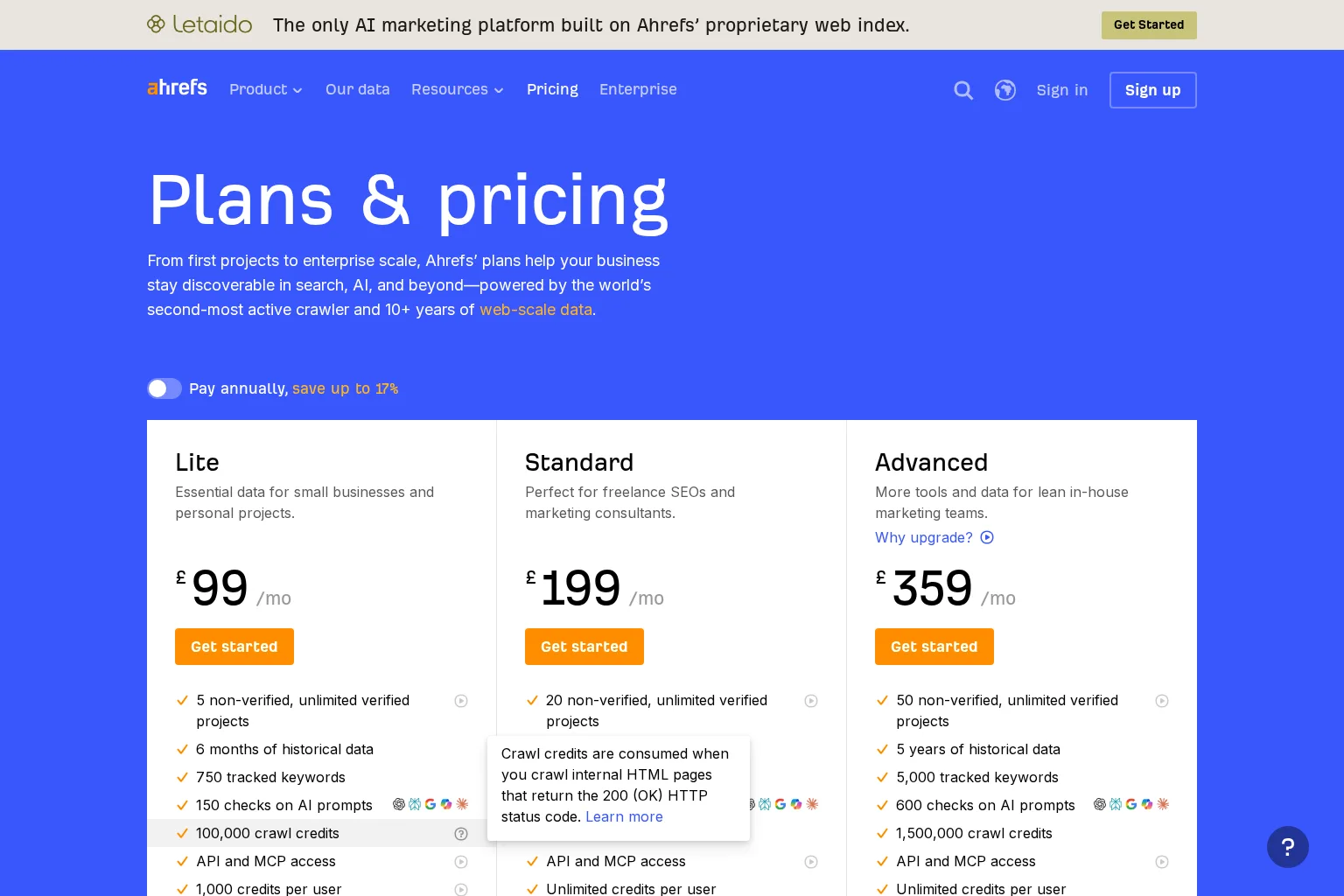
Client separation and cost: GBP monthly prices are £99 for Lite, £199 for Standard and £359 for Advanced. Standard includes one user, with additional users listed at £48 per month each. Project allowances distinguish verified and non-verified sites. Model your actual client access rather than treating every project as equivalent. See the official allowances and pricing.
Overlap to challenge: If another suite already supplies useful research, compare the same assignment before buying both. Does the second tool change the opportunity selected, or merely produce a different score? Ask the strategist to explain the difference in the resulting brief.
Choose Ahrefs when additional research improves prioritisation. Keep approved briefs and editorial sign-off in their designated workflow; access to research is not itself an approval process.
3. Screaming Frog SEO Spider: make technical findings actionable
Best fit: Agencies delivering technical audits, migrations or URL-level quality assurance requiring specialist analysis.
Screaming Frog SEO Spider investigates broken links, redirects, metadata, canonicals, directives and site architecture. Paid capabilities include JavaScript rendering, crawl comparison, scheduling and integrations with Google Analytics, Search Console and PageSpeed Insights.
We would keep crawl evidence here, but transfer approved remediation work into the technical backlog. Each ticket needs affected URLs, the observed problem, proposed fix, owner and verification method. Preserve enough context to distinguish a real change from a different crawl configuration.
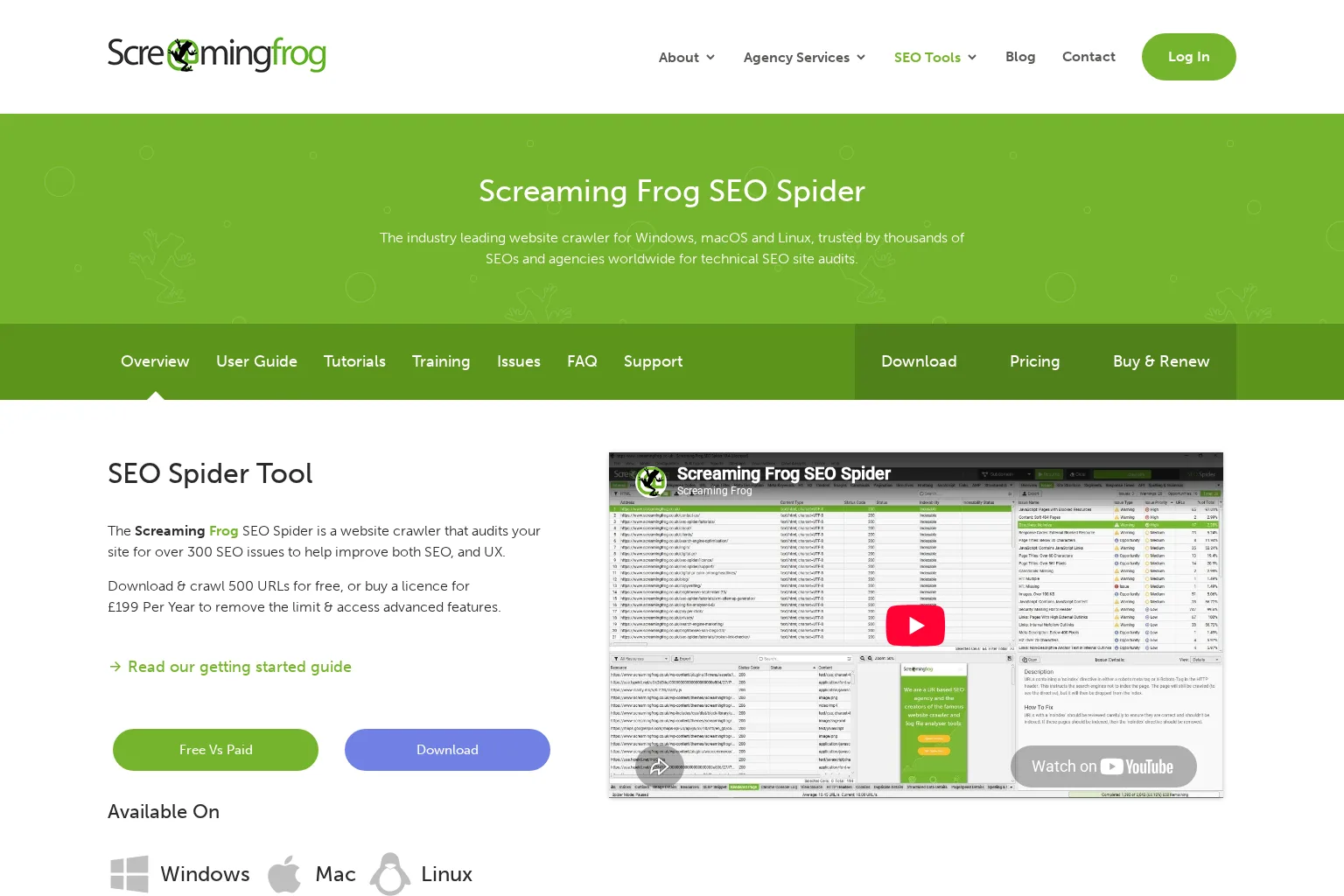
Limits: The free edition is restricted to 500 URLs per crawl and restricts advanced features. Removing the paid URL limit does not remove infrastructure constraints: the vendor says maximum crawl size depends on allocated memory and storage. Those qualifications appear on the product page.
Pricing: For purchases of one to four licences, the licence page lists £199 per licence per year. Licences are per user, so two analysts need two licences. This is an annual purchase, not a cancel-anytime monthly subscription.
Choose it when technical depth is part of the service delivered. If an existing audit supports routine checks, reserve specialist crawling for assignments where deeper investigation earns its place. A second health score matters less than a finding someone can fix and verify. Agree who will interpret the output before expanding access.
4. GrowthScout: connect client context to content delivery
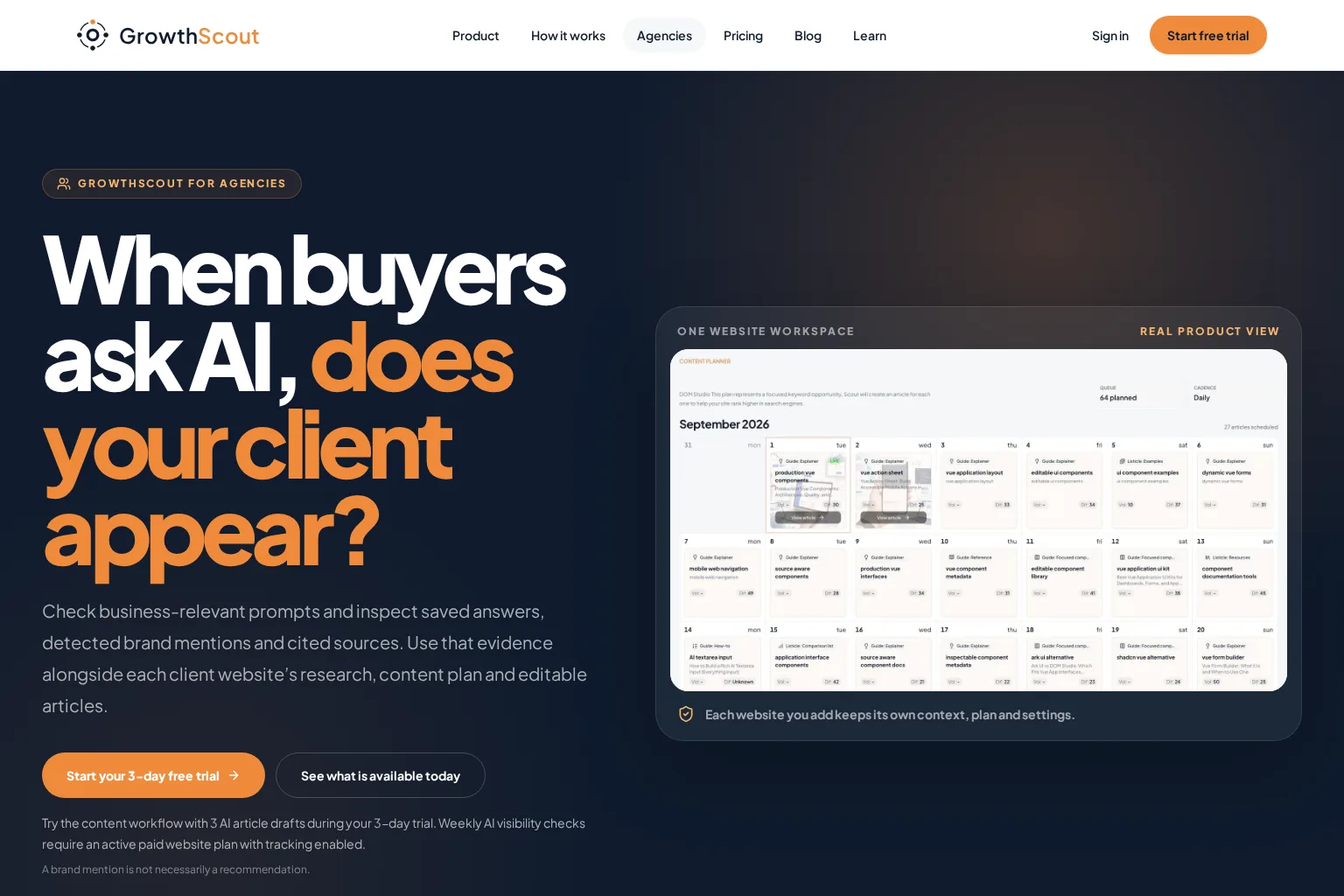
Best fit: Agencies whose bottleneck is turning website-specific opportunities into a visible plan and reviewed articles.
Our GrowthScout agency workflow keeps each added website's knowledge, goals, audiences, competitors, plan and settings separate. It connects website context with opportunity research, planning, article production and editorial review. Delivery can be manual or use supported WordPress and webhook publishing.
We would use it as the content work record, carrying an article's rationale into production rather than asking the writer to reconstruct it. External research should become evidence for a client-specific decision, not an instruction to publish every keyword in an export.
Important boundary: Dedicated client approval access, a cross-client delivery dashboard, agency-wide defaults, expanded editorial roles and shareable client reporting are ideas, not current capabilities. Our agency page distinguishes ideas from available features. Keep formal client sign-off in your existing process and automatic publishing off where approval is required.
Pricing: The initial website plan is £74 per month after a three-day trial containing three AI article drafts. Additional website capacity uses a separate in-app checkout showing the recurring price before confirmation. Applicable VAT and the total appear at checkout. The initial payment does not cover an unlimited roster.
Choose GrowthScout when connected planning and production solve a real handoff problem. Retain specialist research, technical analysis and reporting tools where they provide necessary depth. A clearer content workflow need not replace every agency function.
5. Google Data Studio: present evidence without duplicating it
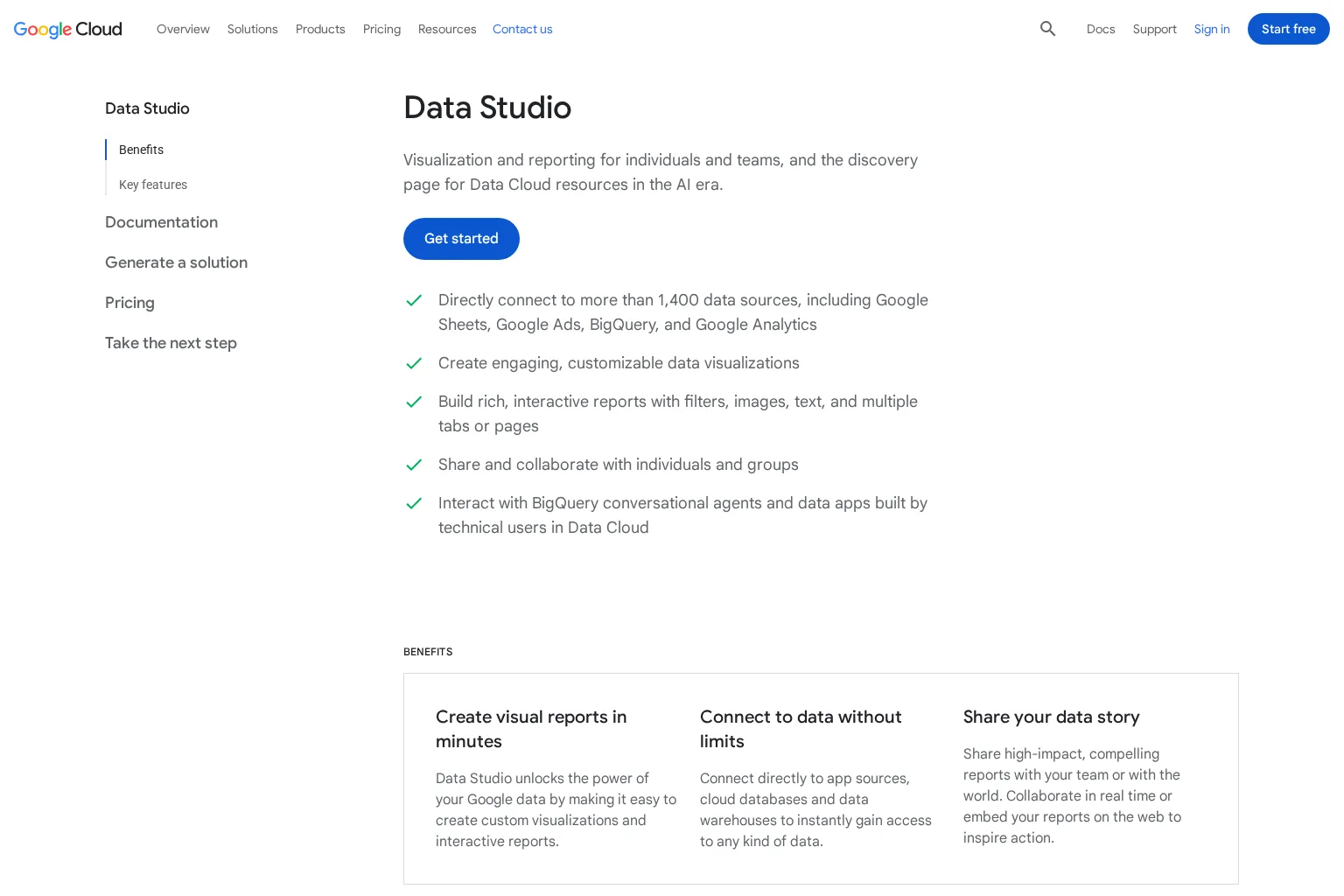
Best fit: Agencies wanting configurable reporting with someone responsible for maintaining dashboards, connections and access.
Google's Data Studio documentation describes a no-cost reporting tool with configurable charts, filters, sharing and connections including Search Console, Google Analytics and Google Sheets. It confirms that Looker Studio returned to the name Data Studio in April 2026. Older guides and connectors may use the former name.
We would assign it presentation responsibility. Underlying tools retain their evidence; the dashboard explains the period, completed work, observed change and next decision. Do not let a copied chart become a second, undocumented definition of a client's KPI.
Client separation: Report sharing and data credentials are not interchangeable. Google documents that Owner's Credentials can let viewers see data through the credential owner's authorisation, while Viewer's Credentials rely on each viewer's access. Test the recipient experience before sharing templates.
Cost and limits: The standard product is no-cost, with a paid Pro option. Budget separately for required paid connectors, source services, setup and maintenance. Flexible reporting still needs an accountable owner.
Choose Data Studio when custom presentation is useful and maintainable. If your SEO suite already produces adequate reports, another reporting canvas may be unnecessary. Test the explanation the client receives, not just the chart's appearance. A report should make the next conversation easier without creating another source of conflicting numbers.
Assign one source of truth to each task
Consolidation should produce fewer conflicting records, not simply fewer browser tabs. Use this responsibility map before switching tools:
| Record | Recommended home | Handoff requirement |
|---|---|---|
| Search performance | Search Console | Property, period, filters and observation |
| Market research | Selected research tool | Evidence, market and rationale |
| Technical evidence | Crawl archive | URLs, configuration and verification method |
| Approved fixes | Existing task system | Owner, acceptance criteria and status |
| Content work | Selected content workflow | Brief, reviewer and publication decision |
| Client report | Reporting system | Named sources, interpretation and next action |
These are recommendations, not verified native integrations between every listed product. Count manual transfers. Check connector eligibility, data scope and failure behaviour before relying on automation.
📌 Overlap is acceptable when it has a purpose. A suite audit might monitor routine issues while a specialist crawl investigates difficult cases. Competing priority lists with no agreed owner are a different matter.
Imagine a strategist discovers a competitor topic in Ahrefs. The content owner checks existing coverage and records an update-versus-create decision. An analyst opens a ticket for any blocking technical issue. The report later explains what shipped and what relevant data shows. No stage needs to duplicate the preceding system.
Keep the client identifier attached to each transfer. A useful integration moves evidence into the next decision; indiscriminate syncing can create more records to maintain.
Buy the smallest stack your service needs
Not every retainer needs all five tools. Start with the contracted work:
- Content delivery: Keep search measurement and a dependable production workflow. Add paid research when it improves decisions, not because every account must have identical subscriptions.
- Technical engagements: Prioritise crawl evidence and a remediation backlog. Article-production software may add little to a migration assignment.
- Reporting-heavy accounts: Keep sources trustworthy and reporting repeatable. Another research suite will not automatically solve a presentation problem.
Local listings, large-scale log analysis, dedicated outreach and defined AI-search monitoring need their own assessment. Add specialist tools when a deliverable or demonstrated evidence gap justifies the extra cost and handoff.
Ask what would stop working if a subscription disappeared. If the answer is vague, investigate adoption before renewal. Distinguish software that is occasionally interesting from software necessary to deliver the service. A rarely used tool can still earn its place, but the reason should be explicit.
Compare total cost, not entry prices
Consider an illustrative pilot with one initial GrowthScout website plan, one Ahrefs Standard user and one Screaming Frog licence, alongside no-cost Search Console and standard Data Studio.
Using the official prices linked above, paid subscriptions would be £273 per month plus £199 per year. Maintaining the monthly subscriptions for 12 months and buying one annual crawler licence totals £3,475, before applicable taxes, extra capacity, connectors, setup and staff time. This assumes neither an annual discount nor a deduction for the short trial.
This is not an agency-wide quote or the cheapest possible stack. Additional GrowthScout websites need separate checkout quotes; extra research and crawler users change the total. Keep annual licence commitments distinct from monthly subscriptions when forecasting cash flow.
Compare three budget lines:
- Software: Subscriptions, websites, users, usage allowances and add-ons.
- Operation: Training, onboarding, connectors, maintenance and information transfers.
- Exit: Exports, ownership transfers and rebuilding important workflows.
A higher subscription can be worthwhile if it removes recurring work. Measure that work rather than assuming automation saved it. Request a configuration matching your real roster, not one based on a demonstration website.
When reviewing an annual contract, also identify what happens if a client leaves mid-term. The price per active client can change without any increase in the vendor's headline rate. Keep capacity forecasts separate from signed client commitments.
Pilot the stack before migrating clients
Choose two unlike websites, such as a service business and a larger content or ecommerce site. Test only authorised work. A two-week pilot can reveal operational friction; it is not a credible deadline for proving organic growth.
Capture the current process. Time a research decision, technical handoff, content review and reporting update. Record repeated copying, missing access and questions requiring someone to reconstruct context.
Move one assignment per site through the proposed stack. Give each a domain, evidence link, owner and acceptance criteria. Can the next colleague continue without asking the strategist to explain everything? Keep publication manual until review and destination checks are dependable.
Test awkward cases:
- A contractor needs access only to the intended client's work.
- A reviewer rejects a queued draft.
- A report connection becomes unavailable.
- A departing client needs its records exported.
- A planned article should become an existing-page update.
Record what works natively, requires another system or remains unverified. Compare time, rework and configured costs with the baseline. Retain a tool only if it improves a defined job without weakening required controls.
Set decision rules before the trial ends. Require transferred assignments to retain their website, owner, evidence and next action. A convincing demonstration should not outweigh a pilot in which the team repeatedly loses those details. Ask the people doing delivery to identify the remaining friction, not merely whether they like the interface.
FAQ
Should an agency buy Ahrefs and another SEO suite?
Only when the additional evidence or capability changes decisions enough to justify the cost. Run the same assignment through both. If the second subscription largely duplicates research already used effectively, retain one primary environment.
Can free SEO tools support client work?
Yes. Search Console and standard Data Studio offer useful no-cost capabilities. They do not eliminate interpretation, setup, communication or delivery work. Assess the whole service rather than equating a zero subscription price with a zero-cost workflow.
Do these tools connect automatically?
Do not assume so. This comparison assigns responsibilities, not a preconfigured integration between every product. Confirm connections, plan requirements, exports and manual handoffs for your setup before committing.
Choose the missing capability, then prove the handoff
We would start with the earliest broken delivery step, not the longest feature list. Give each tool a responsibility, keep one approved work record and make the next handoff visible.
If client-specific planning and production are the gap, explore GrowthScout for agencies. Assess the current website-level workflow against a real assignment while retaining approval and reporting controls where they still work.
Sources
- Search Console overview, Performance report and permissions
- Google: Search Console and Analytics together
- Ahrefs capabilities and pricing
- Screaming Frog capabilities and licences
- GrowthScout agency workflow and pricing
- Data Studio overview and data credentials